

Unto the end. A psalm for David. (Psalm 10:1 DR)
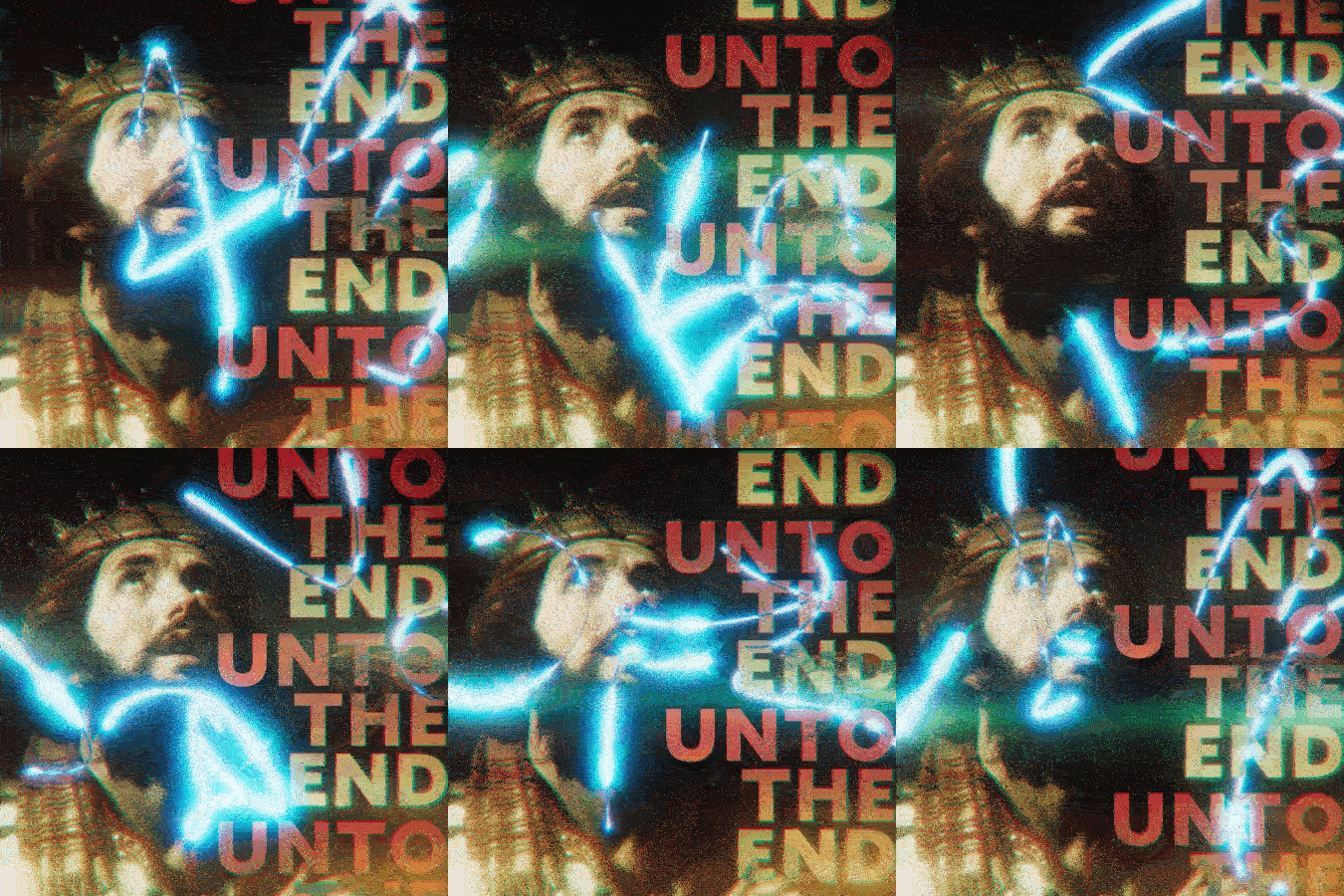
In the Preface to his Explanation of the Psalms, Cassiodorus expounds at some length on the nature of the titles/headings/superscriptions of the Psalms, stating that the Psalms are solely the work of King David, even though other authors seem to be noted in some of these headings, going on to adduce some proofs by which this might be substantiated. In Cassiodorus’ day the custom was to announce the Psalm being read as “A Psalm of David” prior to reading it, such as happens before the other readings of the Epistle and Gospel:
Moreover the Catholic Church under the inspiration of the Holy Spirit maintains a general and undeviating custom that when any Psalm prefaced by another name is to be sung, the reader must not presume to announce it as other than a psalm of David. If the psalms were the work of Idithun, or the sons of Core, or of Asaph, or of Moses, their names would be specifically proclaimed, as happens with the Gospels, which are cited under the names of Mark, Luke, Matthew or John. (Cassiodorus, Explanation of the Psalms, Preface, Chapter 2, Ancient Christian Writers.)
The importance of David as the unifying source of the Psalms ultimately has a theological dimension and undergirding, as our Lord speaks of the Psalms as of David—such as quoting from Psalm 2 or 109—in reference to Himself as the prophesied Son of David. This identification of Christ with David is of immense importance, for it forms the early Church’s interpretative key to the Psalms, in that David stands in typologically for Christ and thus by extension for His mystical Body the holy Catholic Church. Cassiodorus (following St. Augustine) sees especial importance in the oft-employed superscription unto the end, which forms an interpretive matrix for understanding the Psalms in light of Christ. After noting that end has the common meaning of that which is consumed, he goes on to describe its use in the Psalms in terms of perfection:
The second sense of end is that perfect and abiding end which we now seek, and which begins to extend and prolong itself when our dedicated minds attain it. So the end and fullness of the law is our Lord Christ. As St. Paul says: For the end of the law is Christ, unto justice for everyone that believeth. When we have obtained this End, we shall seek nothing further; we shall be content in this End of blessedness, and enjoy the fullest sweetness… So whenever you you find this phrase, Unto the end, in psalm-headings, concentrate your mind keenly on the Lord Saviour, who is the End without end, and the full perfection of all blessings. (Cassiodorus, Explanation of the Psalms, Preface, Chapter 3, Ancient Christian Writers.)
He goes on to list six different types of headings that—if interpreted literally—would be irrelevant to the content of the Psalm, but when interpreted figuratively act as a means to plumb the prophetic and mystical depths of the Psalms. He categorizes them into six groupings that require such a consideration:
historical situations
locations
dates
Hebrew names
comparison of attitudes
comparison of situations
Ultimately these headings exist, he argues, not to obscure the meaning but to unfold it. It is their seeming irrelevance to the content of the Psalm which provokes a figurative reading, given the confidence that they are indeed part of the Psalms and thus also inspired:
Careful analysis shows that these things are mentioned there to demonstrate some similar but hidden meaning. These expressions hang in front of the Psalms like consecrated curtains. By directing your mind’s eye through their thin texture, you can easily gaze into their hidden depths. Who would regard all these explanations and these differing expressions as superfluous? It is wicked to believe that the divine Scriptures contain any idle matter; as we read in Scripture: Amen, amen I say to you, one jot or tittle shall not pass of the law till all be fulfilled. (Cassiodorus, Explanation of the Psalms, Preface, Chapter 10, Ancient Christian Writers.)
And since Christ is the end of the Law as St. Paul writes, for the law which He fulfills to contain anything superfluous would entail that He is perfecting that which is not speaking of Him. That is, if the Psalm headings do not have some connection to this end in Christ, then the entirety of the law which Christ comes to fulfill would not be fulfilled, since there would be elements contained in the Law which were never meant to be fulfilled, if they were indeed superfluous.
This is why Cassiodorus (and Church Fathers such as St. Augustine) insisted on both a unified author of the Psalms in David and the integration of the headings of the Psalms into the meaning of the Psalms. In fact, as Cassiodorus eloquently noted, they act as consecrated curtains which obscure the meaning at first glance to unbelievers and heretics, but when understood for what they are can be peered through and become the lens through which the meaning of the Psalms is unlocked. Thus the various categories Cassiodorus mentions are not simply tacked on to the headings of the Psalms but in some manner illumine the contents of the Psalm.
The Psalms—as being ultimately about this end in Christ—thus must be understood primarily in terms of speaking of the person of Christ in some manner or another. Cassiodorus lists three ways in which the Psalms can be understood in relation to the person of Christ:
In respect to His Incarnation: (such as in Psalm 2; Psalm 20)
In respect to His eternal divinity: (such as Psalm 2; Psalm 109)
In respect to His Church and her members (such as Psalm 21; Psalm 68)
This third one is especially important in terms of verses which speak of the wickedness or sins of the Psalmist:
O God, Thou knowest my foolishness, and my offenses are not hidden from Thee. We must interpret this statement as referring to individual believers. (Cassiodorus, Explanation of the Psalms, Preface, Chapter 13, Ancient Christian Writers.)
It is the union of Christ with the Church as Head to Body that enables this interpretive framework to avoid being ad hoc or arbitrary, and St. Augustine quite often adduces the example of our Lord speaking to St. Paul before his conversion on the road to Damascus, wherein he says: Saul, Saul, why persecutest thou Me, which is in reference to Saul persecuting the Church. Yet our Lord ascribes Saul’s persecution to Himself, saying Me rather than My Body, thus demonstrating this inextricable connection between Christ and His Body, in which what is spoken of in the Psalms can freely be spoken of at one time of Christ in respect to His divinity and at others in respect to the members of His Body.
This forms part of the consecrated curtains which require that one read the Psalms with the mind of the Church, with the end which is Christ firmly in mind so that the spiritual realities of the Psalms can be understood.
As Psalm 10 opens, Cassiodorus applies the methodological and interpretive principles he has adduced to the superscription, which forms the key to unlocking this particular Psalm:
Though the expression, Unto the end, often appears in these headings and invariably concentrates our minds on the Lord Christ, it is undoubtedly set there to denote different marvels. At one time it points to the glorious Passion, at another to the triumphant Resurrection at which all nations wonder. But here it denotes the holy faith through which most faithful Christians experience mortal combat with heretics. So it continually reaches to Christ but is found joined to Him in different senses. (Cassiodorus, Explanation of the Psalms, Psalm 10.1, Ancient Christian Writers.)
The rest of the Psalm will therefore unfold this understanding as applying to the Body of Christ in the Church Militant as joined to Him yet still ever reaching for Him through its pilgrimage in this vale of tears.
I found this great image of King David playing a harp and singing and wanted to use it as a base for this animation.
I started by typing out the text and then precomping it, adjusting the padding of the area in the precomp so I could later on repeat it in the main comp. Back in the main comp I used Motion Tile on the precomp and then animated the Origin Point so that the text would have a looping scroll. Next I applied a Gradient Ramp to the precomp as an effect before the Motion Tile so that the gradient would scroll with the text.
I then added in some glowing orbs and used a script called Trails which creates trailing animations based on the position, speed, etc., of the layer to which it is attached. On the orbs themselves I simply applied a seamless looping wiggle expression and set the Amount pretty high so they would swirl around and automatically create the trails. Some call it lazy, I call it, well, lazy, yes, but also efficient.
I finally added in some color correction and camera shake to conclude.
Enjoy.
Unto the end. A psalm for David.
(Psalm 10:1 DR)
View a higher quality version of this gif here:


