

Psalm 11:1
the end of the week
Unto the end; for the octave, a psalm for David. (Psalm 11:1 DR)
The Psalmist will often inscribe his Psalms as “unto the end,” which can seem obscure, but which church fathers such as St. Augustine understood as a reference to Christ, for in him the consummation of God’s will for humanity, He in whom all things hold together and unto whom are all things:
“Christ is the end of the law for righteousness to every one that believes.” [Romans 10:4] For this end signifies perfection, not consumption. (St. Augustine, Expositions on the Psalms, 4, 1.)
The octave, however, is more specific, often taken as a reference to the final judgment. St. Augustine notes that some have interpreted it this way so as to accommodate a particular eschatology:
Now it has seemed to some to intimate the day of judgment, that is, the time of the coming of our Lord, when He will come to judge the quick and dead. Which coming, it is believed, is to be, after reckoning the years from Adam, seven thousand years: so as that seven thousand years should pass as seven days, and afterwards that time arrive as it were the eighth day. (St. Augustine, Expositions on the Psalms, 6, 1.)
He finds this a fanciful interpretation that flies in the face of other scriptural passages, but offers an alternative reading that still retains the them of judgment:
The day of judgment may indeed, even without any rash computation of years, be understood by the eighth, for that immediately after the end of this world, life eternal being attained, the souls of the righteous will not then be subject unto times: and, since all times have their revolution in a repetition of those seven days, that perhaps is called the eighth day, which will not have this variety. (St. Augustine, Expositions on the Psalms, 6, 2.)
He then proceeds to mystically treat of the “seven” days as relating to man, four being assigned to his body (owing the the four elements) and three to his spiritual nature (in loving God with heart, soul and mind). The consummation of these seven characteristics is thus found in the day of judgment, the “octave,” as it were, of the use that was made of them in the “week” of our lives:
Those numbers then of the body which have relation to the old man and the Old Testament, being past and gone, the numbers too of the soul, which have relation to the new man and the New Testament, being past and gone, a septenary so to say being passed; because everything is done in time, four having been distributed to the body, three to the mind; the eighth will come, the day of judgment: which assigning to deserts their due, will transfer at once the saint, not to temporal works, but to eternal life; but will condemn the ungodly to eternal punishment. (ibid.)
To modern ears this may seem an equally fanciful reading of this “octave,” yet there is a certain consonance with the biblical narrative. God gave his people the Sabbath on which to rest, the cycle of seven days of the week forming a sort of microcosm of man’s relation and service to God. The Sabbath was, however, a foreshadowing of of the consummation of this “week,” for Christ’s resurrection occurs on a Sunday, forming the “octave” as it were of this mystical week. St. Paul in the Epistle to the Hebrews relates how there remains a Sabbath rest for those who turn towards God and do not harden their hearts. This day of rest is meant mystically, referring to “today”—that is, this life, when we have the opportunity to repent:
Again he limiteth a certain day, saying in David, Today, after so long a time, as it is above said: To day if you shall hear his voice, harden not your hearts. (Hebrews 4:7 DR)
This Sabbath rest is culminated and consummated in the Resurrection, for after “today” comes the judgment, at which every man’s works will be judged. Being mindful of this end and the future consummation of all things, we should take account of the state of the “week” of our lives, both body and soul, so that we can enter into union with the one who is the end of all things:
Behold, I come quickly; and my reward is with me, to render to every man according to his works. I am Alpha and Omega, the first and the last, the beginning and the end. Blessed are they that wash their robes in the blood of the Lamb: that they may have a right to the tree of life, and may enter in by the gates into the city. (Apocalypse 22:12-14 DR)
This was a rather straightforward animation in that I wanted to focus on Christ as the “end” spoken of in this verse.
I found this nice stained glass window of Christ as Alpha and Omega. I ended up having to touch it up quote a bit, making use of Photoshop’s Generative Fill tool. It often makes short work of these types of things, but struggled with this image for some reason, so I basically had to hold its hand and trick it into giving me the results I wanted.
In After Effects I added some glows and light streaks and some particles for a fairly simple animation, but it turned out nicely and how I was envisioning it.
Enjoy.
Unto the end; for the octave, a psalm for David.
(Psalm 11:1 DR)
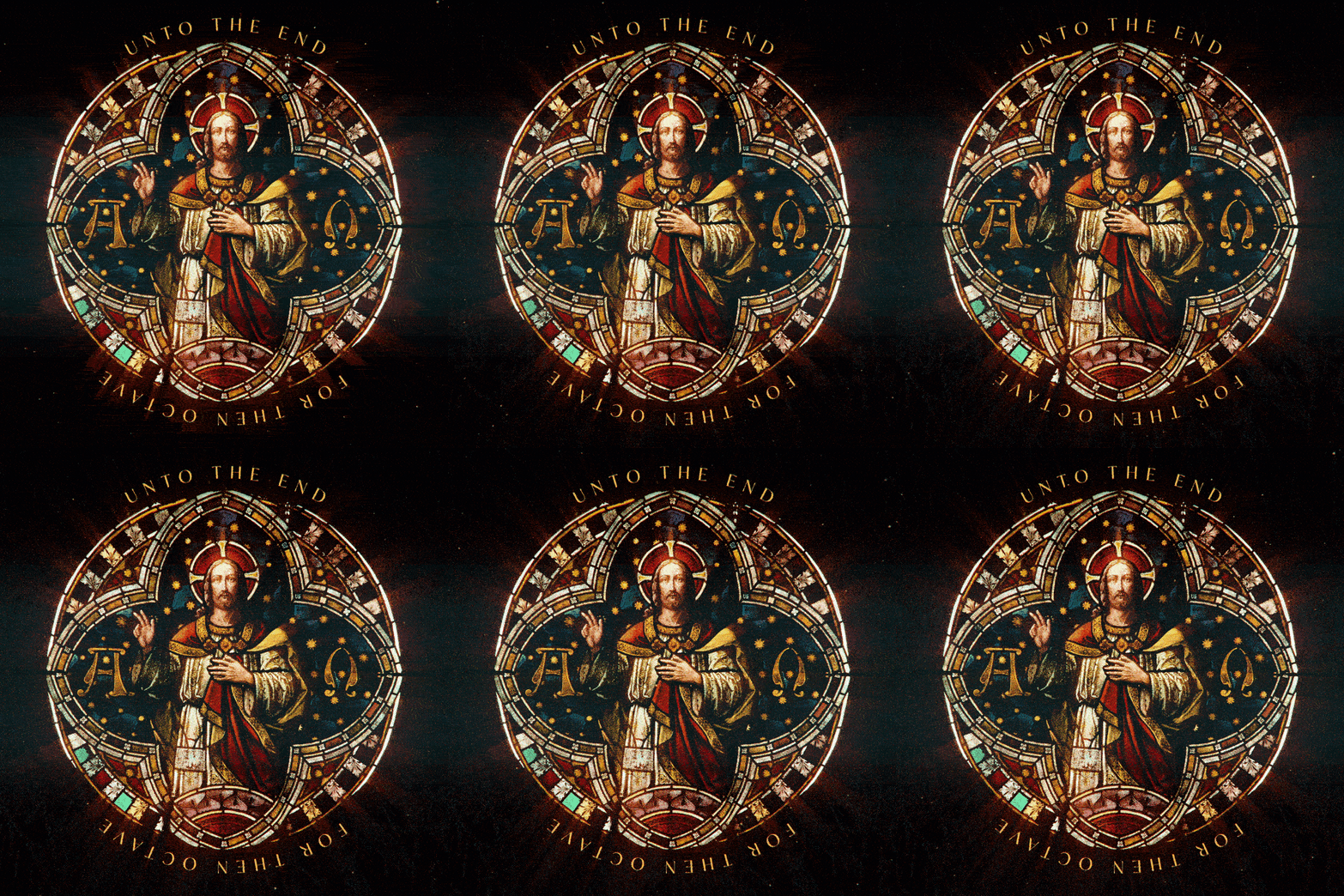
View a higher quality version of this gif here: