

Psalm 11:5
finding ways to say shut your piehole
Who have said: We will magnify our tongue; our lips are our own; who is Lord over us? (Psalm 11:5 DR)
As we witness Western civilization increase the velocity of the circling of the toilet drain into which all empires and societies that reject God eventually plummet, it can be wondered if the impending collapse and doom is the judgment to come, or rather if the rapidity of our descent is itself the judgment. St. Paul potentially sheds some light on this:
For the wrath of God is revealed from heaven against all ungodliness and injustice of those men that detain the truth of God in injustice… Wherefore God gave them up to the desires of their heart, unto uncleanness, to dishonour their own bodies among themselves. Who changed the truth of God into a lie; and worshipped and served the creature rather than the Creator, who is blessed for ever. Amen. (Romans 1:18, 24-25 DR)
The fascinating aspect of St. Paul’s words here is that the wrath of God is here described not primarily in terms of some “external” act of God like fire from heaven or disasters or other such things, although His wrath can certainly take those forms. Rather, St. Paul here frames it primarily in terms of God allowing the wicked to have what they want.
H.L. Mencken is purported to have said “Democracy is the theory that the common people know what they want, and deserve to get it good and hard.” In other words, in our limited vision and fallen nature we tend to revert to our basest desires, especially when given the opportunity to have them rubber-stamped by the surrounding society. This gets compounded when applied on a macro scale, when the basest desires of a society are given free reign and even promoted.
Political theories aside, human nature will tend towards the lowest common denominator. Whether through evil desires or good old fashioned sloth, we take the road of least resistance which generally runs straight through our lowest appetites. When we as individuals personally and then collectively as a society not only do not strive for virtue but elevate vice, God in effect “lets go of the rope” and effectively lets us have what we desire.
This giving over of individuals and a society to their craven desires thus is itself a means of judgment, as sin brings about its consequences and thus its own punishment. The removal of God’s restraining hand leads to not only a cessation in the promotion of virtue, but its inversion in promoting vice, which causes deterioration to accelerate. The Latin motto is Motus in fine velócior—motion accelerates near the end. Collapse is generally slow and plodding, and then all of a sudden, in terms of history.
The Psalmist looks at the enemies who surround him and rebukes them for their prideful speech, for they speak and act as if God does not exist or as if they are accountable to no one. They are not ashamed of their sins nor have any natural desire to conceal them. On the contrary— they now openly boast of them with their lips and actions. Shameful things are no longer done in the dark but out in the full light of day without shame.
In terms of societies not under judgment, there will always be sin and vice. But in societies that even nominally desire virtue these are either actively discouraged in terms of law or at least only tolerated by means of shunting those vices to certain areas so as to try and contain them. Probably every society has had its equivalent of red light districts, for it is impossible for any human society to completely eradicate such things without committing even greater evils in enforcement. Similarly there are no lack of hypocrites in any society, but “hypocrisy is the compliment vice pays to virtue;” that is, there still remains the desire to at least appear virtuous.
In societies under judgment there is an inversion where the things that weren’t mentioned in polite company or shunted off to the edges of town or the seedier areas are now openly spoken of and even celebrated. The “tongues” of those who openly advocate such things become “magnified,” now more so than ever before. We see in our our societies this inversion writ large for some of the most reprehensible things which are celebrated for weeks on end or lauded openly on the largest venues or platforms.
One can easily see the acceleration that occurs in that things which were only a few years ago at least only marginally accepted or even spoken of are now force-fed in all media. This rapid shift of the Overton window is dizzying and leaves voices which stand against it not only drowned out but condemned using the standard playbook of rhetorical cudgels.
The Psalmist—in the voice of his enemies—asks “who is Lord over us?” The implied answer, of course, is no one, and we see in St. Paul that in this situation in some sense they are correct, for God has removed His restraining hand and given them over to their passions and desires. When a society rejects God, it doesn’t get to exist in some sort of neutral state. It may coast for some time on the fumes of its previous prosperity or blessings, but nature abhors a vacuum, and human nature will seek some god to worship, even if it has to settle for itself and its basest desires. This race towards the bottom is the inevitable result that accelerates towards the end.
When God lets go of the rope, things go fast.
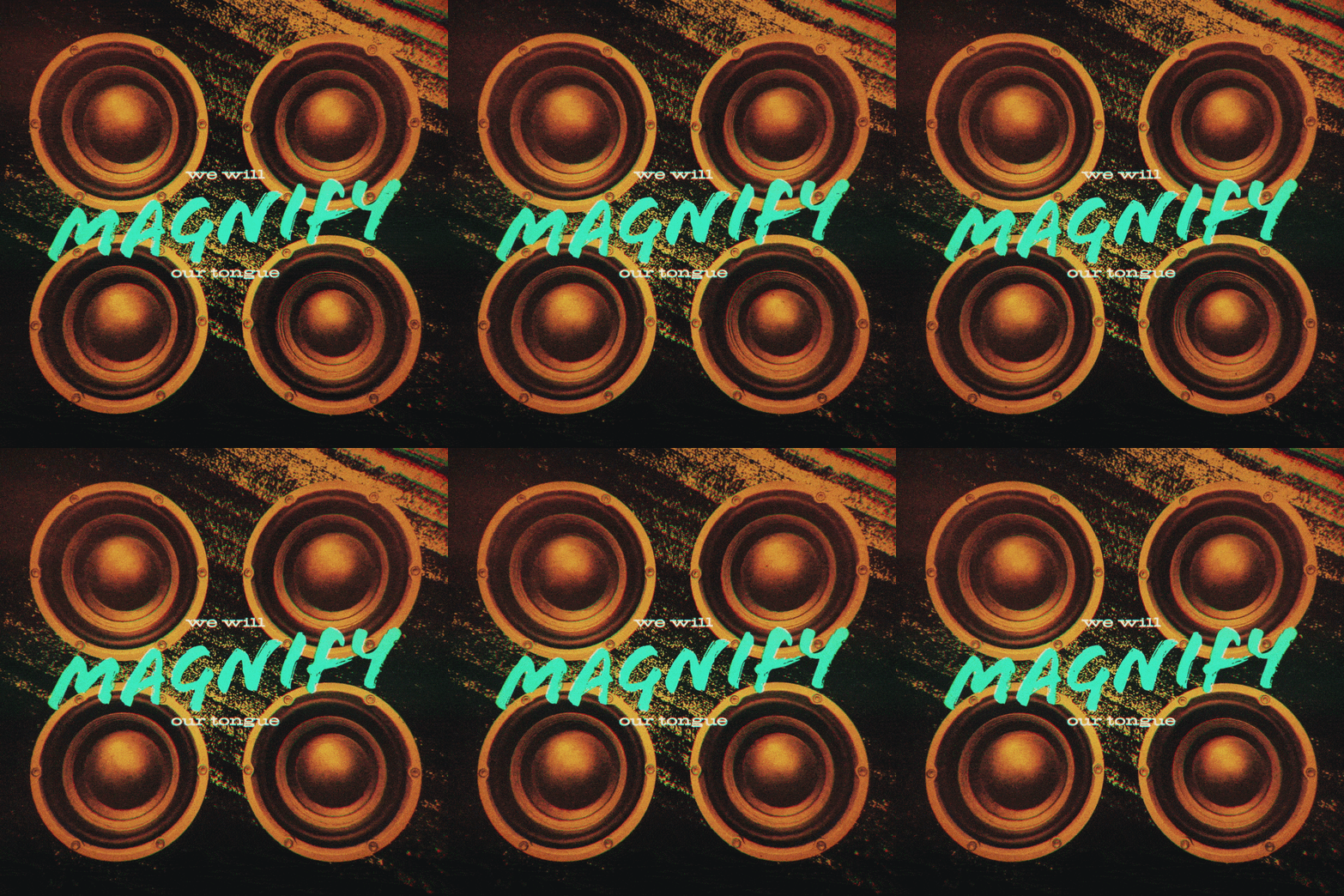
For this animation I was considering the notion of “magnifying” the tongue. I was reticent to search for “tongue” on stock image sites for fear of what I might inadvertently find, and so I began to think of the means rather than the cause. For some reason a speaker came to mind, which was much easier to find something that would work.
I cut out this speaker in Photoshop and separated the various layers of the inner speaker so that I could animate them separately. In After Effects I precomped all the layers and set up the scale animation for each layer to give it a bit of a bounce like the speaker was pumping out some strong bass or something like that. Once that was satisfactory I looped the scale using loopOut() and then used the script Lazy to offset the layers for some visual interest. I then duplicated the speaker precomp and positioned them in a square grid and offset those.
I am now wondering if I should have kept them synchronous, but I think perhaps the chaotic nature of it is more indicative of the verse.
Enjoy.
Who have said: We will magnify our tongue; our lips are our own; who is Lord over us?
(Psalm 11:5 DR)
View a higher quality version of this gif here: