

Psalm 121:3
looking for a city
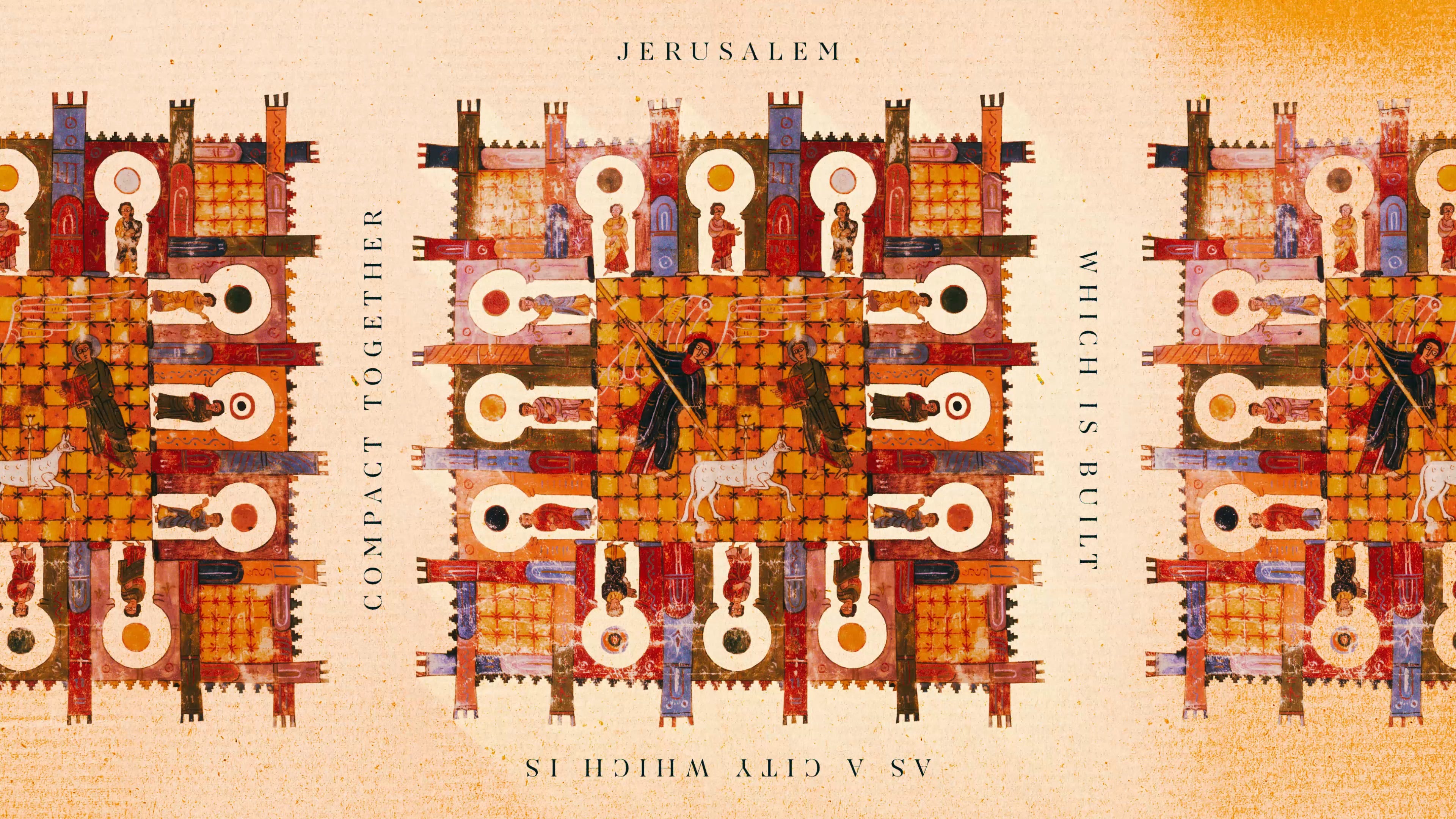
Jerusalem, which is built as a city, which is compact together. (Psalm 121:3 DR)
Keeping it Together
Our bodies are designed in such a manner that they tend to jealously guard their unity. When we consume something, the food or drink is broken down so as to be assimilated into the body, and that which cannot be is rejected and removed as waste. The immune system works to retain this homogenous state as well, ruthlessly attacking foreign matter that is not like unto itself. A great challenge to be overcome in terms of any sort of grafting or tissue transplantation is to keep the body from rejecting it before it can be incorporated. The immune system will naturally do its job and must be artificially suppressed.
This will happen on the macro level with organs and on the cellular level as well. In my own life as an adult I received a stem-cell transplant from my identical twin, which is the best case-scenario since theoretically we are genetically identical. Notwithstanding this, there are still differences on the level of proteins and other such factors which the body still recognizes as foreign and will reject, known in that field as graft-vs-host disease. In my own case it was relatively mild, but I still had to be on massive doses of steroids to avoid the worst of it and to ensure the transplant would eventually take. It could be that even years later there are still internal battles in trying to unify the divergent genetics, even if the differences seem slight.
Diversity is our strength, said no immune system ever.
Fleeing the Wilderness
Having come into the holy city, the courts of Jerusalem, the Psalmist now describes this city as one which is built as a city, which is compact together. In the modern world which is marked by sprawling cities, we sometimes have this romanticized notion of rural life, which finds its epitome in the exaltation of the notion of wilderness as some sort of pristine state of nature or of man’s relation to nature. We have this sense of the untouched wilderness as somehow more in keeping with man’s natural relation to the earth, and can see the civitas or city as an unnatural state. This disjunction is perhaps sometimes seen in how we take vacations to the wilderness, such as the mountains, and in that experience perhaps sense some connection with nature or a simpler and more pure form of existence.
And it is not to say that there is no truth to this, but in reality the modern experience of wilderness is probably better termed the touristification of the wilderness. After all, except for very limited situations, most of our experience of the wilderness is one in which there is relatively no danger and in which the conveniences of the city are relatively close at hand. In my own life my wife and I used to go to a cabin in the middle of a forest in Colorado, and to be fair, it was always a great experience to be away from the city and to have a relatively simpler life for a week or so. But in equal fairness, the cabin had electricity, a refrigerator, air conditioning and wifi. It was in the wilderness but it was not truly a part of the wilderness, and a town was only a fifteen minute drive away, and a city only thirty minutes or so. Our experience of the wilderness was not from within but from without, from the outside looking in but never having to be fully in.
In the ancient world there was not the same sort of romanticized notion of the wilderness that exists in the modern world, for the wilderness was largely a place of desolation and death. To be sent into the wilderness by oneself was practically a death sentence, either from the wild animals and lack of food or from brigands or other dangers. The nomadic peoples were not isolated individuals or small families but large clans who could survive only because of numbers. They didn’t have a city per se, but their community became as a civitas.
The city was what—to some extent—set apart man as man, as a civilized being. The city was in contrast to the wilderness, for it had walls and food and protection and community. Like all modern cities the ancient ones had their problems and squalor, but they were nevertheless a macrocosm of man himself, a diversity of the parts of the body united into one purpose, the city likewise a diversity of men united in one civitas and as one people.
Unity in Unity
Thus, when the Psalmist praises Jerusalem as being built as a city, he praises it as a unity of construction and purpose, whose reason for being is for the sake of its people within. Cities in the ancient world would often be what we might call city-states, in that the one city would often be the city of an entire people, and thus would refer not just to the geographical location or the extent of its boundaries but to the nation within it, a people with common blood and heritage:
He added the phrase “as a city” so that he might demonstrate the likeness of a city within it; for while every city is named for its citizens, that city is more truly called a city which is shown to contain citizens who are of one mind. (Cassiodorus, Explanation of the Psalms, 121, 3)
This likeness of mind and common heritage and lot is used by the Psalmist to prophetically look forward to the heavenly Jerusalem, of which the citizens within are not merely inhabitants, but the very edifice itself:
Lest you should perceive only the earthly Jerusalem he had previously mentioned, he signifies that heavenly city by distinguishing it with a marvelous subtlety. For he says first: “Jerusalem which is built as a city.” It is clearly being built, for it is daily constructed until the consummation of the world with living stones through a spiritual operation—namely, by the confessors, martyrs, and those who are devoted to the Lord with a sincere mind. (Cassiodorus, Explanation of the Psalms, 121, 3)
This heavenly Jerusalem thus differs from earthly cities in that the primary mark of her citizens is not commonality of blood or of tongue but rather of mind and will. The martyrs and confessors and virgins and others who make up this holy city have their minds devoted not to their own designs but rather to that of the Lord. In earthly cities concord is always at best theoretical, as the machinations of man in his own mind is often at cross-purposes with his fellow man and citizens. Civil war within the civitas is a tragic yet frequent occurrence in the city of man and always will be until the consummation of all things, for of himself man cannot exist in perfect unity with his fellow man, for the objects of man’s desire—which are of earthly provenance—cannot hold them forever in common. It is only a common cause and telos outside of themselves and higher than this world which can bind man in unity together, and that is only found when man becomes part of a heavenly city, the body of Christ. What the Psalmist perceives of the earthly Jerusalem he thus sees as perfected in the heavenly Jerusalem:
We must understand that this city which is now in progress contains undifferentiated and mixed peoples, whereas the city which is to come receives only those who are undoubtedly perfect. The former is shaken by contradictions, while the latter is carried along in perpetual security; the one is full of penitents, the other knows nothing of tears; one believes in hope, while the other sees God face to face. Consequently, although there are two cities, it is believed there shall be one future people of the faithful. (Cassiodorus, Explanation of the Psalms, 121, 3)
The Self-Same
The final clause of this passage contains a somewhat obscure phrase: which is compact together. In the Vulgate this is rendered as cujus participatio ejus in id ipsum, participatio translating μετοχή from the Septuagint. μετοχή means to have something in common, to have a share or a participation in something. It is not used elsewhere in the Septuagint and is only used once in the New Testament by St. Paul in 2 Corinthians 6:14:
Bear not the yoke with unbelievers. For what participation (μετοχή, participatio) hath justice with injustice? Or what fellowship hath light with darkness?
The Douay-Rheims translates this idiomatically, using compact almost as both an adjective and as a noun. That is, the city is compact in the sense of it being densely or closely built together, but it is also compact in the sense of compact being an agreement of life and will amongst its inhabitants. They thus have a compact or a participation in the city by having the same mindset and the same will for its good.
The word together is a bit more idiomatic, for the original can be somewhat obscure. The Vulgate has in id ipsum, which would literally mean something like in the self-same, the entire passage literally being: Jerusalem, which is built as a city, of which the participation of it is in the self-same.
Many early Fathers and other Christian writers saw this as an evident prophetic text of our Lord Jesus Christ, that the participation of this city is in Him, for what could be naturally called the self-same save for Him who is always the same?
What then is, the same, save that which is? What is that which is? That which is everlasting. For what is always different at different times, is not, because it abideth not: not altogether is not, but is not in the highest sense. And what is, that which is, save He Who when He sent Moses, said unto him, I AM THAT I AM? (St. Augustine, Expositions on the Psalms, 121, 5)
Unchangeable in the Changeable
There is then a fascinating theological implication, for in the Incarnation the One Who is always the Self-same and does not change took upon His unchanging Self our changeable nature, that He might bring those who are always changing into His eternal and unchangeable kingdom. Even more incredible, He does this by uniting those Whom He will redeem to His very Body, making them into His mystical body the Holy Catholic Church, building them as living stones into the heavenly Jerusalem which is compact together:
Remember what He, Whom thou canst not comprehend, became for thee. Remember the flesh of Christ, towards which thou wast raised when sick, and when left half dead from the wounds of robbers, that thou mightest be brought to the Inn (Luke 10:30, 34), and there mightest be cured. Let us therefore run unto the Lord’s house, and reach the city where our feet may stand; the city that is building as a city: whose partaking is in The Same. For what oughtest thou to hold? That which Christ became for thee, for He is Christ; and Christ Himself is rightly understood in the words, I AM THAT I AM, as He is in the form of God, where He hath not thought it robbery to be equal with God (Phil. 2:6), there He is THE SAME. But that thou mayest be a partaker in THE SAME, He first partook of thy nature; and the Word became flesh, that the flesh might partake of the Word. (St. Augustine, Expositions on the Psalms, 121, 5)
To be built into this city is to have compact with Christ, to have a participation in His mystical Body, to partake of His divine nature which is always the Self-same. This participation is most clearly evidenced in this life in the partaking of the Holy Eucharist, by which we partake of His Body and Blood, Soul and Divinity. In the normal food that we eat we assimilate it to become like ourselves, which are always changing. But in the Blessed Sacrament we are made into the likeness of Him Who is the Self-same, strengthened by His grace and built more and more into that heavenly city. As our minds are transformed and reoriented to His divine will, the compact of that heavenly city is realized not only within ourselves as individual members but in the body and the city as a whole, built up into Christ. In the Holy Eucharist we have true participation and communion with His Body, both in Him in the Self-same and in His Body the Church:
The chalice of benediction, which we bless, is it not the communion of the blood of Christ? And the bread, which we break, is it not the partaking (participatio) of the body of the Lord? (1 Corinthians 10:16 DR)
Unity is Our Strength
The unity of man cannot be found in politics or in nationality or even in blood, for all these things are only the most obscure shadows of the city which the Psalmist foresees. In our brokenness in sin not only can these aspects of man’s communal life not bring him order and tranquility, but are too often set against each other, sometimes for good reason and sometimes for ill. In this vale of tears the unity of man will never be realized of his own efforts or machinations or attempts to order this world, for in his heart he is ultimately divided against himself; how could he hope to bring unity to any other if he cannot do so even in his inmost life?
Only in Christ Who is the Self-same can the unity of men be found, for they are bound not by blood or oath or nation or city—all of which are temporal and changeable things—but are rather compact together, having participation in the Self-same who never changes and Who gives of Himself that they might be built into Him. Jesus Christ is the only hope of this world, the heavenly city to which we—who are on pilgrimage in this vale of tears—must always set our eyes, looking forward to union with Him Whose years shall not fail:
Therefore, the participation, fellowship, and communion of this city is, as we have said, with the Lord Savior, just as He Himself testifies in the Gospel: “Father, I will that where I am, they also may be with me” (John 17:24). For the Lord will be in that city, and the saints shall be—as He Himself has granted—participants without doubt. The prophet Isaiah describes this city with wonderful praise, saying that your walls shall be called salvation and your gates joy; the sun shall no longer be your light by day, nor the moon shine for you at night, but the Lord shall be your eternal light and your God your glory. Your sun shall not set, and your moon shall not fail, for the Lord God shall be your eternal light, the days of your mourning shall be completed, your people shall all be just, and they shall possess the land as an inheritance forever (Isaiah 60:18–21). (Cassiodorus, Explanation of the Psalms, 121, 3)
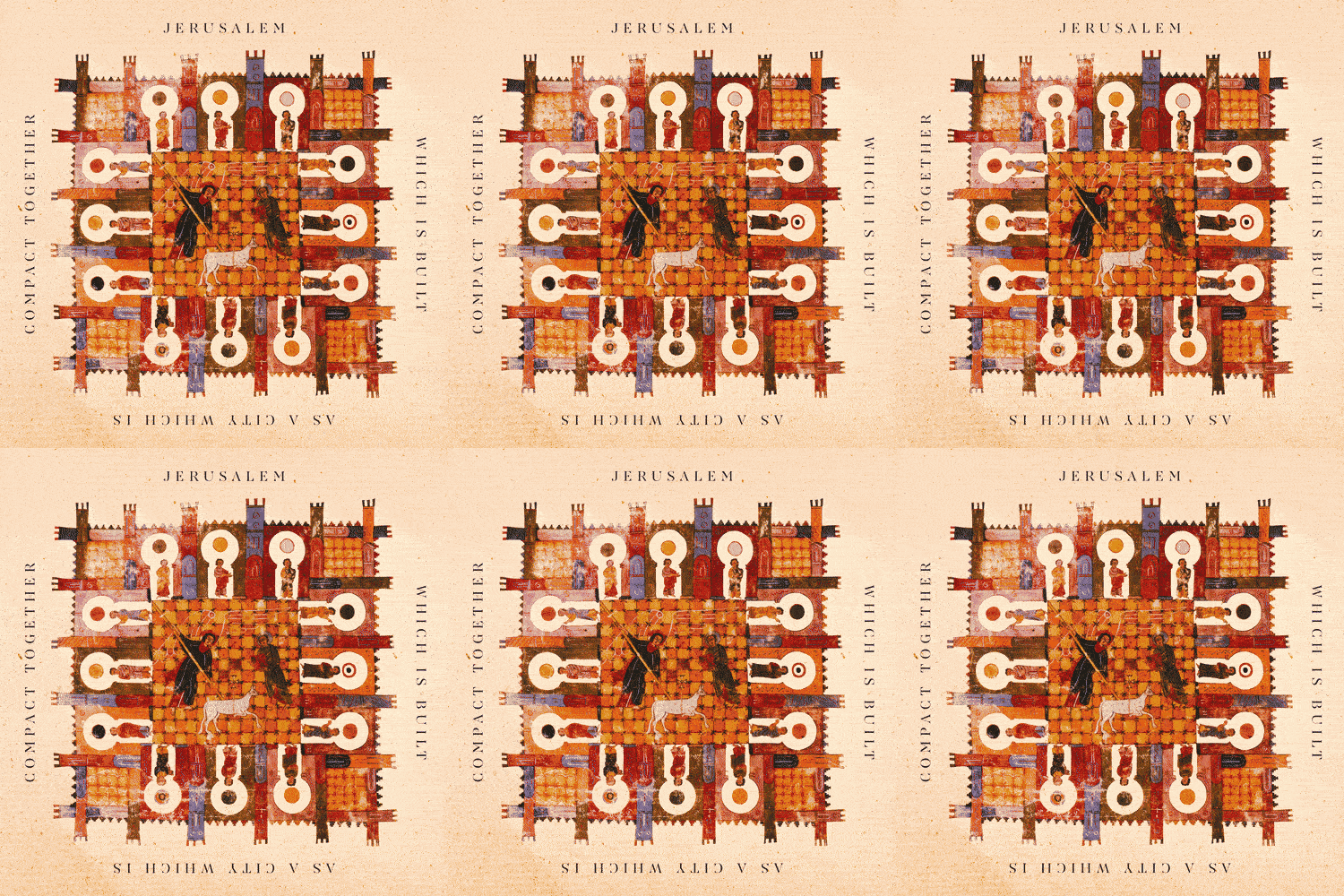
This image comes from a Beatus Apocalypse, and I isolated it and each figure and orb in Photoshop and then precomped them in After Effects. I used AutoSway on each figure to get them to sway, and used a simple looping animation on the orbs. This particular image is of the angel of the Apocalypse measuring the city, and here the artist has each of the Apostles in a gate, this symmetry indicative of the unity of the heavenly city.
Enjoy.
Jerusalem, which is built as a city, which is compact together. (Psalm 121:3 DR)
View a higher quality version of this gif here: