

Psalm 128:1
a long drawn out matter of fisticuffs
Often have they fought against me from my youth, let Israel now say. (Psalm 128:1 DR)
St. Paul urges the Romans to live in peace with all men, as far as is in you (Romans 12:18 DR). The unfortunate corollary of this is that not all men have such a disposition within them, which means that—as the prophet Job declares: “The life of man upon earth is a warfare” (Job 7:1 DR).
The Church in the present time is often spoken of in three simultaneous realities. The members of the Church in Heaven who delight in the Beatific Vision and have received rest from their labors are part of the Church Triumphant. Those who have died yet still require the cleansing fires of Purgatory are part of the Church Suffering. And those who have passed through the salvific laver of Baptism (cf. 1 Peter 3:21) and are working out their salvation (cf. Philippians 2:12) in this life are members of the Church Militant.
This latter title arises from the the nature of the struggle against evil both individually and corporately; when our Lord speaks of the gates of hell not prevailing against the Church, He is using explicitly militaristic language which invokes sieges and warfare. Gates, after all, are meant to keep an enemy out, which implies that an enemy is attempting to get in.
It is a relatively modern phenomenon that our cities do not have gates and that our wars are generally fought (at least in the modern west) by professional soldiers, but such has rarely been the case throughout human history. The city was a place of refuge when the enemy came to conquer, but the land or nation to be defended was not something abstract; it was your farm and livelihood that was being plundered or your family that would be taken into slavery. In this manner it was the duty of all citizens to participate in warfare to some extent or another.
And though our battle is not against flesh and blood (cf. Ephesians 6:12), it is not for that reason any less real, for not only do the evil forces of the devil war against the Church, but they press into service men to do their bidding through their perennial deception, who are often unaware but no less in league.
Thus the Church from the dawn of time has been in constant warfare as is seen in the struggles and persecutions of the saints:
“Many a time have they fought against me from my youth up.” The Church speaks of those whom She endures: and as if it were asked, “Is it now?” The Church is of ancient birth: since saints have been so called, the Church has been on earth. (St. Augustine, Expositions on the Psalms, 128, 1.)
St. Augustine proceeds to list how the Church has been identified throughout salvation history from the very beginning. and this identification is always accompanied by an opposition from evil:
Abel: killed by Cain
Enoch: translated from the unrighteous
Noah: saved from the wicked in the Ark
Abraham: countless persecutions
Lot: oppressed by the men of Sodom
People of Israel: enslaved by Pharaoh
Moses: opposed by some of his own people
All of these singular instances are snapshots, as it were, of the Church Militant throughout history, and our Lord becomes the hinge-point and bridge between the Church as found in the Old Testament and that of the New Testament, and He in His own body endures the full force of wickedness and evil arrayed against the righteous and the Church:
For this reason, lest the Church wonder now, or lest any one wonder in the Church, who wishes to be a good member of the Church, let him hear the Church herself his Mother saying to him, Marvel not at these things, my son: “Many a time have they fought against me from my youth up.” (St. Augustine, Expositions on the Psalms, 128, 1.)
These attacks can certainly come from without, but perhaps even more trying are those that come from within, as heresies and hypocrisy continually crop up and often create crises that are sometimes the providential means of clarifying doctrine, as St. Paul describes (cf. 1 Corinthians 11:19).
In the Gospel for today was the parable of the wheat and the tares which has traditionally been understood as referring to this very reality, that in the human element of the Church there will always exist this admixture of orthodoxy and heterodoxy, as St. Augustine explains in a reading at Matins:
When the Shepherds of the Church wax careless, and since the Apostles sleep the sleep of death, cometh the devil, and soweth them whom the Lord calleth a seed of evil-doers. Now, are these seed of evil-doers the heretics, or Catholics of bad lives? It is possible to call even the heretics a seed of evil-doers because they have sprung up from the seed of the Gospel, and been begotten in the Name of Christ, though afterwards they have turned after crooked ways and lying doctrines. (St. Augustine, Questions on the Gospel of Matthew, XI, Book 4.)
The reason that the tares are not immediately removed is that the proverbial cure would be worse than the disease, for the Church Fathers liken the growing tares (which resemble wheat when growing) to heretics who have private heresy but do not yet publicly expound it. Thus, they have incorrect doctrine, but they are not yet leading others astray by means of it. The same is true of sinners within the Church whose sin is real but not yet notorious. If the Church immediately excommunicated everyone who sinned or held incorrect doctrine, it would scandalize many with weak faith and would potentially break them off as well, which would be equivalent to wheat being uprooted with the tares. Thus these remedies are reserved for notorious sinners (that is, those whose sin is public and thus a cause of scandal) and intransigent heretics (that is, those who have been corrected yet persist in publicly proclaiming their errors).
These very real struggles from external forces or internal divisions are the nature of the Church Militant and will be until the eschaton, for in this world the battle between good and evil is waged in the heart of every man, especially as those who have been baptized are striving for growth in sanctification. The devil does not slink away quietly nor give up his trophies easily, and thus the battle will continue until he is cast into hell forever.
However, despite this constant warfare, there is consolation to be found in this reality, for although the saints have always suffered, they nevertheless became saints, and thus the war against sin is neither futile nor hopeless, for our Lord has bound the strongman and plundered his goods (cf. Mark 3:27). That the Church has always faced troubles and difficulties is a motivation to continue the fight:
God’s people, in trouble, console themselves by the reflection that troubles and difficulties are nothing new to them, and that, through God’s assistance, they have always got through them. This applies to the Jews, and the repeated attacks of the neighboring nations, while the temple and the city were being rebuilt; and it also applies to the Church of Christ, that scarcely ever had a moment’s respite from the assaults of pagans, heretics, or bad Christians. (St. Robert Bellarmine, A Commentary on the Book of the Psalms, 128. 1.)
This “fight” is captured well in the word expugnaverunt in the Vulgate, which comes from expugno. “Pugno” means to fight, and the ex- prefix intensifies the word to give it the sense of assault or storm in the militaristic sense. Thus, this is not merely a fistfight but an all out assault by the enemy upon the Church. The hope, however, is that even though these assaults have occurred through history, they have never succeeded, and our Lord promises that they never will (cf. Matthew 16:18).
That the Church is engaged in warfare entails that her members must also prepare to be militant against the assaults of the devil. The word pugno comes from pugnus meaning “fist,” which is used to form pugil (boxer) from which we get pugilist. St. Paul speaks about the fight against sin as mastering one’s own passions by means of self-denial and mortification, like a boxer pummeling his untoward desires:
And every one that striveth for the mastery, refraineth himself from all things: and they indeed that they may receive a corruptible crown; but we an incorruptible one. I therefore so run, not as at an uncertainty: I so fight, not as one beating the air: But I chastise my body, and bring it into subjection: lest perhaps, when I have preached to others, I myself should become a castaway. (1 Corinthians 9:25-27 DR)
In the fight against the external assaults of the devil, more is needed than raised fists, which is why the training of the interior passions allows for the donning of heavy equipment and armor to withstand the assaults of the evil one and the world:
Put you on the armour of God, that you may be able to stand against the deceits of the devil. For our wrestling is not against flesh and blood; but against principalities and power, against the rulers of the world of this darkness, against the spirits of wickedness in the high places. Therefore take unto you the armour of God, that you may be able to resist in the evil day, and to stand in all things perfect. Stand therefore, having your loins girt about with truth, and having on the breastplate of justice, and your feet shod with the preparation of the gospel of peace: In all things taking the shield of faith, wherewith you may be able to extinguish all the fiery darts of the most wicked one. And take unto you the helmet of salvation, and the sword of the Spirit (which is the word of God). (Ephesians 6:11-17 DR)
Knights of old would master many forms of combat. Fisticuffs and wrestling and constant practice of such martial arts conditioned them to be able to wear their armor and use weapons of warfare effectively in battle. Unlike in the movies where a random person can grab a sword and slay enemies at will, in real life these things take years of training and constant practice to master; rushing into battle with armor and a sword but no training is simply a death sentence.
Similarly in the spiritual life self-mortification, the use of the sacraments, prayer, etc., are all means of training ourselves for the spiritual battle, to be ready to engage temptation when it assaults us, to stand against the world when it demands our acceptance or compliance. These assaults are inevitable, but we have not been left defenseless, and as we cooperate with God’s grace, and strive against sin and for virtue, we have hope that evil will not prevail, but that the Church Militant will—in the end—join the Church Triumphant in the glory of the Beatific Vision for which it strives in this vale of tears:
So the Church says that it has been fiercely warred on from its youth, so that you may realize that it is never brought to an end, since it is under constant attack. So it grows under the persecutions of the wicked and grows through its grief. Even though it seems to lose holy ones in this life, it is seen to gain them for the fatherland to come; so it cannot be brought to an end, since it is clearly increased by the losses that it sustains. (Cassiodorus, Expositions of the Psalms, 128. 2. ACCS.)
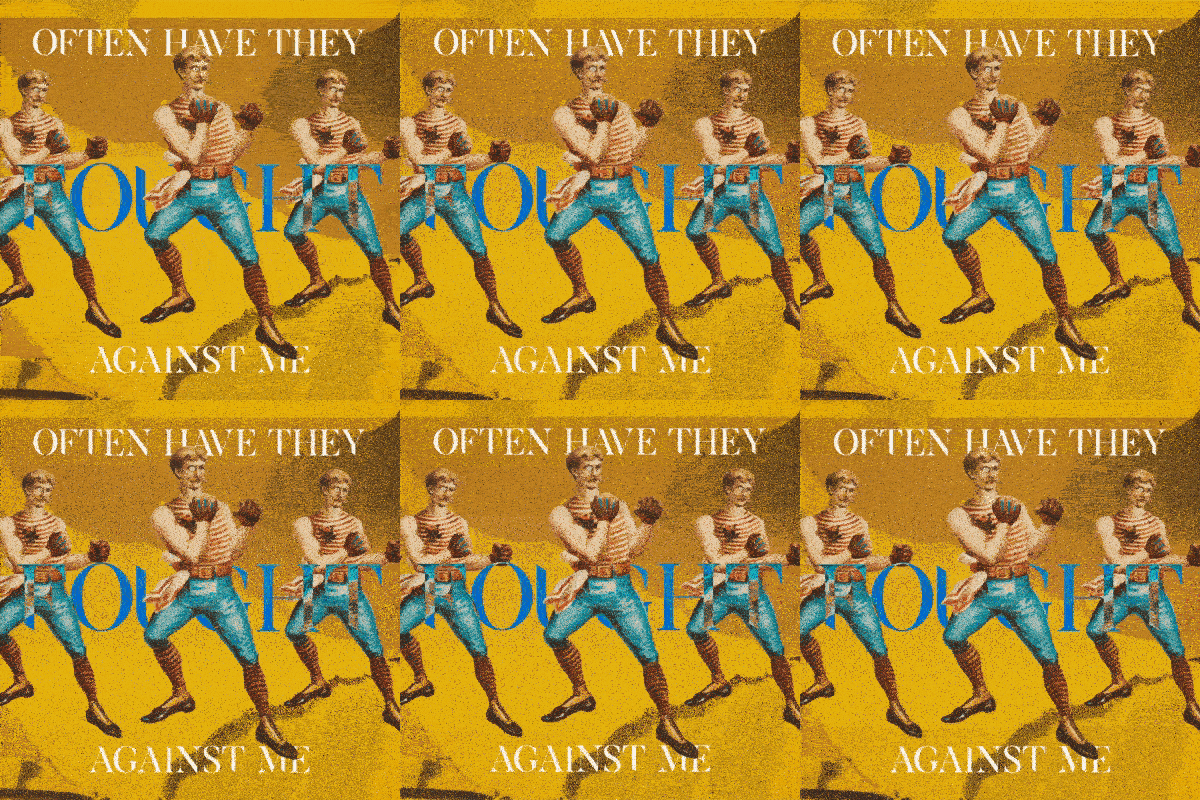
For this animation I knew I wanted to have some kind of boxer, and I was searching for images I found these old boxing cards that were apparently included in cartons of cigarettes. They were generally illustrated and—to my mind—striking in their presentation. I enjoyed how in this one in particular the fighter is wearing a monocle.
I quite tediously separated all the body parts in Photoshop and used Generative Fill to good effect to fill in the missing pixels. In After Effects I precomped all the layers and used a combination of Puppet Pins and Inverse Kinematics by means of Puppet Tools 3 to rig up the bending arms. I then rigged everything together and animated the positions and rotations of the appropriate layers and then applied loopOut() to the keyframes to get a looping animation. I then offset the timing of animations slightly to give it more of an organic, bouncing feel.
In the main composition I duplicated the boxer precomp and applied Time Remapping and looped that so I could offset the duplicates to have them doing different things at different times. I added in some textures and some slight camera wiggle for effect and placed the text with various blending modes to add some visual interest.
Enjoy.
Often have they fought against me from my youth, let Israel now say.
(Psalm 128:1 DR)
View a higher quality version of this gif here: