

Psalm 128:6
a little lawncare for the soul
Let them be as grass on the tops of houses: which withered before it be plucked up: (Psalm 128:6 DR)
I remember being told throughout my life the dubious fact that “grass is actually a weed,” with the irony being that we tend to fill our lawn with weeds and spend an incredible amount of time and effort to maintain these “weeds.” And I—being a lover of irony—have believed this unthinkingly.
However, the term “weed” is not a taxonomic term but rather is based entirely on subjectivity. That is, a plant becomes a “weed” only if it is growing where you do not want it to grow. The unfortunate thing is that what we consider “weeds” tend to grow effortlessly and without any input from us, while non-weeds take far more effort and often have lackluster results, especially if the person in charge of the growing is botanically disinclined. Thus, if you look at my lawn it will become very obvious that grass is not a weed…
The Psalmist continues his imprecations against the wicked, now comparing their happiness and success in this world to the grass on the tops of houses that withers in the heat of the sun. In the ancient world rooftops were often made out of dried mud which would inevitably become a temporary home to grass seed. When some manner of rainfall would come this grass would grow, but since the soil was already caked and dried the grass could not develop a sufficiently robust root system and would quickly wither. Our Lord likens this phenomenon to the enthusiastic reception of the Word of God that goes no deeper:
And some other fell upon stony ground, where they had not much earth: and they sprung up immediately, because they had no deepness of earth. And when the sun was up they were scorched: and because they had not root, they withered away. (Matthew 13:5-6 DR)
This metaphor is thus apt in either case and becomes a fitting prophecy of the end of the wicked, who in their prime seem to flourish in this world but then come to an inglorious end, likened to withered grass that is useless except as kindling for fire, a presaging of the final judgment:
Another imprecation, which, too, is to be read as a prediction, for it conveys to us the briefness of the happiness of the wicked, and, by a very happy idea, compares it to grass, a vile and fragile substance, and, as is said of it, “which is to day, and tomorrow will be cast into the fire;” and, not content with comparing it to grass, he adds, that it is like the grass that grows on the top of a house, a thing of no value, so much so that nobody ever thinks of cutting it, saving it, or making it into bundles, but leaves it where it grows to wither and to rot. (St. Robert Bellarmine, A Commentary on the Book of the Psalms, 128, 6-7.)
St. Augustine makes an even more detailed analysis of this passage, noting that the physical location of the grass speaks to the pride of the wicked:
But what says he of them? The next words are, “Let them be even as the grass of the house tops: that withers before it be plucked up.” The grass of the house tops is that which grows on house tops, on a tiled roof: it is seen on high, and has not a root. How much better would it be if it grew lower, and how much more joyfully would it bloom? As it is, it rises higher to a quicker withering. It has not yet been plucked up, yet has it withered: not yet have they received sentence from the judgment of God, and already they have not the sap of bloom. (St. Augustine, Expositions on the Psalms, 128, 9.)
In their pride the wicked get too close to the sun, as it were, and stretch beyond what the roots of human nature can support. Like Icarus they temporarily shine forth in the glory of their endeavors, but that very endeavor is what leads to their downfall. Similarly, the pride of the unrighteous and their evil deeds can lead to what seems a blossoming of success in this world, as they obtain riches and power and appear to raise themselves up to the heavens, as it were. But all these actions are like grass growing on a tiled roof and they receive the recompence of their misdeeds both in this life and in the next.
For the joys of this world are fleeting, and the hunger of concupiscence is never sated despite our best efforts. The more we indulge them the more we must continue to do so, and the happiness which these things provide diminishes with each indulgence. In this manner the grass of the wicked—that is, their souls—withers even before it is plucked up, and on the day of judgment will be seen to be dried out and fit for the fire:
At present, we don’t see the full extent of this comparison, though we know of nothing, perhaps, more worthless, or of less value than such grass; but when we shall all come to be judged we shall see that such a comparison, instead of being over the mark, is considerably under it. What will be, then, to see those who abounded in the riches and power of this world, and who imagined they had, through such riches, established themselves and their families in their kingdoms and empires, shoved out ignominiously, and hurled into the lowest pit? and, furthermore, to see those who had reveled in pleasures and enjoyments, who knew not how to put up with the slightest inconvenience, consigned to everlasting torments, without the slightest hope of the smallest relief for all eternity? (St. Robert Bellarmine, A Commentary on the Book of the Psalms, 128, 6-7.)
For the ancients, grass was not something you used to make a lawn but rather was only useful as food for livestock or as fuel for fire. The grass on the top of a house could theoretically be used for the more useful purpose of feeding one’s livestock, which has benefits that redound to the good of the entire family. But the Psalmist’s point here is that the wicked in their actions and in their souls dry out, as it were, before they can be of any use to God or man. They spend all their energy and vitality on pursuing the things of this world and their own appetites and thus have roots only as deep as their appetites go.
On the natural level they become fair-weather friends, bad business associates, sluggards, inconstant, vain and self-indulgent and selfish. And on the spiritual level they neglect prayer, do not frequent the sacraments, become irreverent, have no fear of God, and become entangled in all manner of vices. If their energies were directed towards better ends and in humility they submitted themselves to God’s will they could blossom like the grass of the fields, but in their pride they set themselves on high and become chaff blown about by the wind. St. John the Baptist prophesies of the coming Messiah that:
[His] fan is in his hand, and he will thoroughly cleanse his floor and gather his wheat into the barn; but the chaff he will burn with unquenchable fire. (Matthew 3:12 DR)
The harvest will eventually come, and we will either be grass that is green or that is withered. The vitality that gives life to the soul only comes from being constantly united to our Lord as the branch is to the vine (cf. John 15:5). This comes by imitating His humility (cf. Philippians 2:6-11) and not reaching beyond ourselves in pride, which only opens us to the scorching rays of the sun that wither out the soul. The humble and contrite heart (cf. Psalm 50:19) is never despised by God but is that which is planted near running waters (cf. Psalm 1:3) and which will in the end bring forth a harvest of righteousness:
Abandoned buildings often sprout momentarily with grass on their tops. Before it can be gathered it withers and dies because it has insufficient roots to give it strength. Aggressive sinners are linked with such grass in a most apt association, for they also often die off here before they are taken from the world’s light, for they sprout on the heights of pride where they are not firmly based, whereas if they sprouted in the vale of tears, they could with the Lord’s help bring their harvest to fullness. (Cassiodorus, Exposition of the Psalms, 128.6., ACCS.)
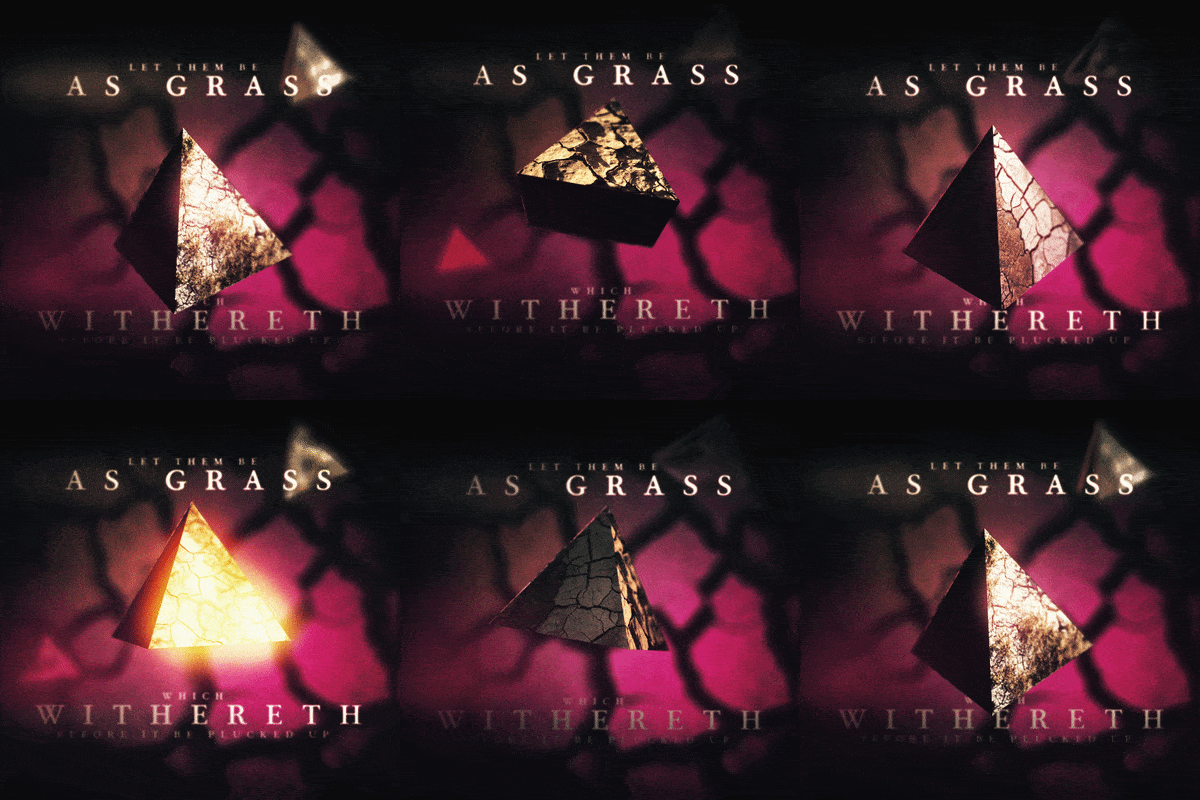
I wanted to do something with parched ground for this animation, but in a somewhat unexpected way. I couldn’t really think of what that way might be, and so I opted for a 3D shape, using 3D Primitives Generator 3 to create all the necessary precomps and save quite a bit of time for reasons of efficiency laziness.
Once the pyramid was generated I added in images of parched ground to each precomp for each fact of the pyramid. Back in the main precomp I animated the rotation of the pyramid for some visual interest and modified the material of the object to be somewhat shiny for whatever reason. I added in some lights to give it a more dramatic presence in the scene and added in a background with some depth of field for more spaciousness. I then duplicated the pyramid a couple times and placed in at various Z-depths for compositional balance.
Lastly I placed the text and added in some shading and color correction.
Enjoy.
Let them be as grass on the tops of houses: which withered before it be plucked up:
(Psalm 128:6 DR)
View a higher quality version of this gif here: