

Psalm 130:2
stop being a baby
If I was not humbly minded, but exalted my soul: As a child that is weaned is towards his mother, so reward in my soul. (Psalm 130:2 DR)
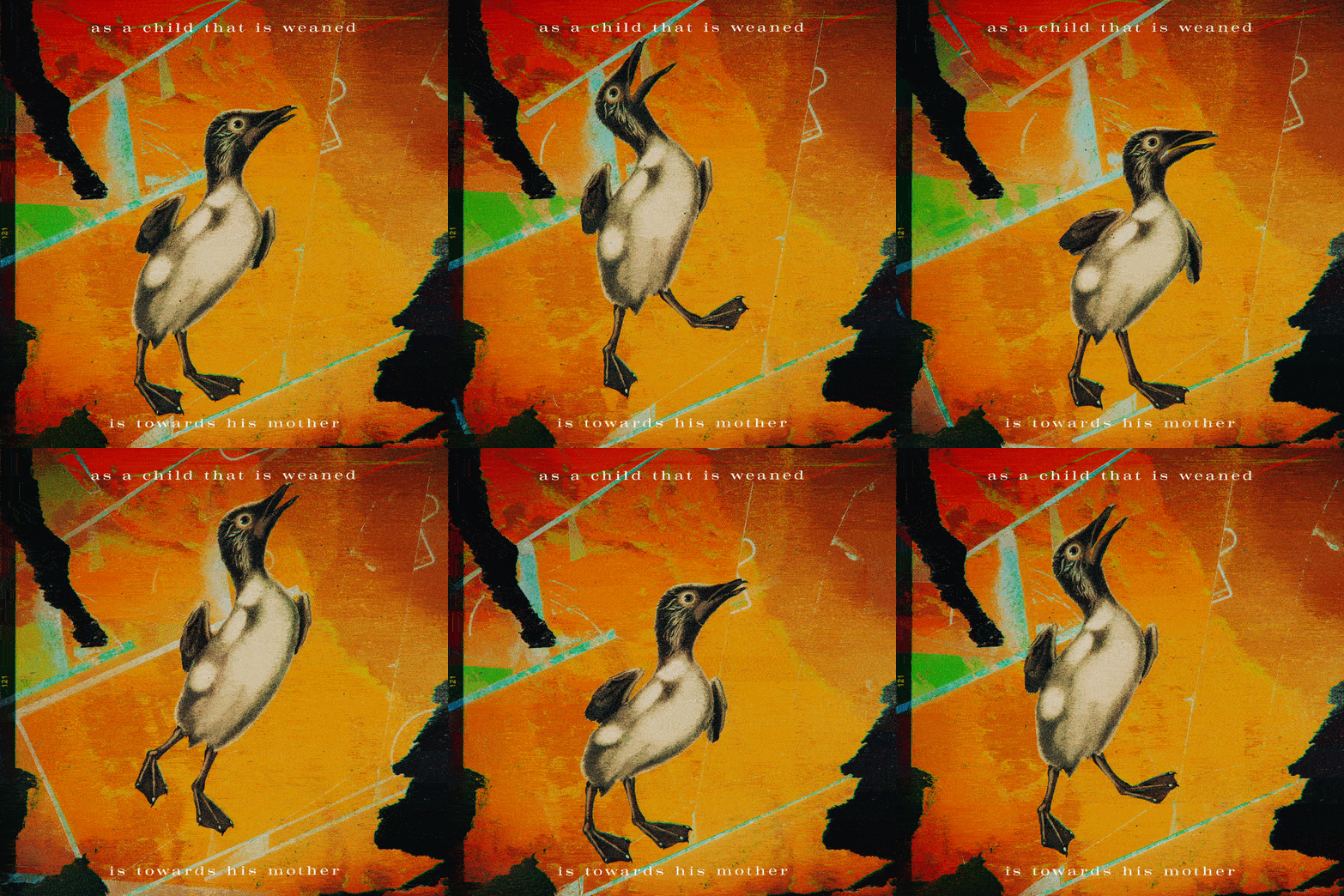
The Psalmist so highly exalts the virtue of humility that he uses a somewhat peculiar and multi-faceted metaphor: that of the weaned child. However, there is an ambiguity here, for the “weaning” can be understood in myriad ways and according to differing interpretations as to whether one takes this weaning as a good thing or not.
St. Augustine lists at least three different interpretations, the first two of which he notes as being possible or at least not contrary to the faith.
The first follows St. Paul’s reproval to the Corinthians (cf. 1 Corinthians 3:2) that he spiritually fed them with milk because they were not able to yet eat meat. Under this gloss the “weaned” are those seek after knowledge or wisdom they are not yet able to grasp:
There are weak persons who are not fit for strong meat; they wish to grasp at that which they cannot receive: and if they ever do receive, or seem to themselves to receive what they have not received, they are puffed up thereby, and become proud thereupon; they seem to themselves wise men. (St. Augustine, Expositions on the Psalms, 130, 4.)
This would preeminently apply to heretics who leave the surety of the teaching of the Church and propose their own imaginations and thus wander off into error.
The second reading follows the same passage from St. Paul but attempts to draw a a distinction between when one should be humble and when one should be lofty; that is, looking at the spiritual growth of the soul in wisdom and knowledge:
It has been evidently explained, my brethren, where God would have us to be humble, where lofty. Humble, in order to provide against pride; lofty, to take in wisdom. Feed upon milk, that you may be nourished; be nourished, so that you may grow; grow, so that you may eat bread. But when you have begun to eat bread, you will be weaned, that is, you will no longer have need of milk, but of solid food. (St. Augustine, Expositions on the Psalms, 130, 5.)
St. Augustine sees this interpretation as having some plausibility but notes that it seems to not take the words of the passage at face value; he notices that this interpretation places too much emphasis on the milk rather than on the source of that milk, which is the mother’s breast:
This interpretation, also, brethren, displeases me not, since it does not militate against the faith. Yet I cannot but remark that it is not only said, “As one taken away from milk, such may be my soul's reward;” but with this addition, “As one taken away from milk when upon his mother's breast, such may be my soul's reward.” Here there is somewhat that induces me to consider it a curse. (St. Augustine, Expositions on the Psalms, 130, 6.)
His point is that the text of the passage is ultimately remarking on the relation of the infant to the mother, and while the milk from the breast is certainly wrapped up in that, it is the disjunction of the weaned child from the mother which the Psalmist is drawing out.
Although weaning in modern times is often accomplished through alternative means, for most of human history (and probably still today in most of the world) the growing infant receives his nourishment from his mother’s breast. And even as he begins to eat solid food there is still this transition period from the breast to only eating solid food. The Psalmist thus pictures an infant who cannot yet eat solid food but has been taken from his mother’s breast and thus left in no-man’s land—as it were—of nourishment. We are thus dealing within a prematurely weaned infant:
For all may be weaned by growing. He who grows, and is thus taken away from milk, it is good for him; but hurtful for him who is still upon his mother's breast. We must therefore beware, my brethren, and be fearful, lest any one be taken away from milk before his time... Let him not therefore wish to lift up his soul, when perchance he is not fit to take meat, but let him fulfil the commandments of humility. (ibid.)
St. Robert Bellarmine picks up on St. Augustine’s reading here about this passage describing a curse and further develops this idea:
[S]o may my soul be deprived of the sweetness of divine consolation, my especial, and nearly my only delight. They alone who have been filled with the same spirit, and have tasted how sweet God is, can form an idea of the amount of punishment the holy prophet thus imprecates on himself; for the Psalms that were composed, like so many amatory ditties, testify to his disregard for the wealth of this world or the glory of a throne, as compared with his love for God. (St. Robert Bellarmine, A Commentary on the Book of the Psalms, 130, 2.)
Humility as a virtue protects the soul from being puffed up and grasping at things beyond itself. It locates the good in the sweetness of virtue and thus of God, Who is the source of all virtue and goodness. In humility we humbly accept from God both what He wants to give to us and what we are capable of receiving. Our desire to grow in the spiritual life then becomes not about seeking great things beyond ourselves but allowing God to direct us as He wills and in His good time.
There is a certain tension here, for humility will not seek things beyond what God desires for the soul, but neither is it content to remain in infancy forever, which would be disordered. The image that the Psalmist utilizes is thus apropos. Just as it would be wrong for a grown man to still nurse at his mother’s breast, so it is not fitting to remain spiritually an infant due to sloth or lack of desire. The elementary teachings of the faith are meant to strengthen us in faith and wisdom and knowledge; they whet our appetite, as it were:
As newborn babes, desire the rational milk without guile, that thereby you may grow unto salvation: If so be you have tasted that the Lord is sweet. (1 Peter 2:2-3 DR)
Infants act as infants and that is good while they are infants, but it becomes disordered if they do not ever grow up or if they still act as infants even when they are beyond infancy. We often colloquially speak to people who are behaving immaturely when they should know better by saying “stop being a baby.”
And just as seeking things beyond oneself can turn into pride, so never desiring to grow up spiritually can be form of false humility, which often serves as a mask for underlying pride or sloth. St. Paul—who chastised the Corinthians for not being ready for spiritual solid food—also urges his readers for refusing to grow up:
Of whom we have much to say, and hard to be intelligibly uttered: because you are become weak to hear. For whereas for the time you ought to be masters, you have need to be taught again what are the first elements of the words of God: and you are become such as have need of milk, and not of strong meat. For every one that is a partaker of milk, is unskillful in the word of justice: for he is a little child. But strong meat is for the perfect; for them who by custom have their senses exercised to the discerning of good and evil. (Hebrews 5:11-14 DR)
Humility thus accepts what is given by the Lord with a humble heart and meditates upon that with gratitude, but also uses that as a means to grow. Just like the infant sucks at his mother’s breast so as to eventually grow and move on to solid food, so we must mediate upon the Scriptures and the Church’s teachings so that we can be brought into greater spiritual depth, neither puffed up in knowledge nor using humility as an excuse for sloth, wherein it ceases to be humility. We must humbly accept what we receive from God, which includes inducements to spiritual growth:
He has wherein he may exercise himself: let him believe in Christ, that he may understand Christ. He cannot see the Word, he cannot understand the equality of the Word with the Father, he cannot as yet see the equality of the Holy Spirit with the Father and the Word; let him believe this, and suck it. He is safe, because, when he has grown, he will eat, which he could not do before he grew by sucking: and he has a point to stretch towards. (St. Augustine, Expositions on the Psalms, 130, 6.)
When thinking about this passage I had in mind little birds chirping in the nest for food from their mother. Birds and fowl wean nurse their young differently than mammals, of course, but I still liked the imagery of young crying for food from their mother.
I couldn’t find a great image of birds in the nest, so I settled on this old illustration of a young duck (I think) which—to be fair—is probably already weaned, but whatever.
I isolated it in Photoshop and then isolated the various limbs. In After Effects I used the Puppet Tool to add some pins to the various joints and used Puppet Tools 3 to rig everything up to Nulls to make it easier to control.
The rest was then just animated this little duckling hopping up and down for food, which was kind of fun. I added in some moving textures and such for visual interest in the background and finished up with some color correction.
Enjoy.
If I was not humbly minded, but exalted my soul: As a child that is weaned is towards his mother, so reward in my soul.
(Psalm 130:2 DR)
View a higher quality version of this gif here: