

Psalm 131:1
meek and humble of heart
O Lord, remember David, and all his meekness. (Psalm 131:1 DR)
In the Vulgate Psalms 119-133 have the title or superscription of Canticum graduum which means Songs of Degrees, but has also variously been rendered as Songs of Ascents or Gradual Psalms (the latter as in the Breviary). In the Office these Gradual Psalms are recited at Vespers Monday through Thursday, excepting Psalm 133, which prior to the reforms of Pius X was said every night at Compline as opposed to only Sundays and Major Feasts after Divino afflatu.
It is not certain to what exactly the term Canticum graduum pertains, although there is some evidence in the Mishnah which links these 15 Psalms to the 15 steps of the temple, with some speculation that these Psalms were chanted on the ascent of these steps, although there is no conclusive evidence. St. Alphonsus provides a spiritual reading:
However this [the 15 steps theory] may be, there are other degrees which the Holy Ghost seems to have particularly desired to put before us, namely, the terrestrial Jerusalem, a figure of the two following; the spiritual Jerusalem, or the Church militant; and the heavenly Jerusalem, or the Church triumphant. It is to this that we should tend by sighing after the end of our exile, and by invoking without ceasing the help of the Lord as the Israelites did in their captivity in Babylon. (St. Alphonsus Liguori, The Divine Office, Explanation of the Psalms and Canticles, 465.)
The Psalmist—here king Solomon preparing to dedicate the temple by bringing the ark within—begins this Psalm by invoking the memory of David and his meekness, this prayer recalling one virtue of his father with which the Lord was pleased. There are many instances of this in David’s life, but one that both St. Augustine and St. Bellarmine bring out in their explanations of this passage is the event (actually two separate instances) in which David was fleeing from King Saul and had an opportunity to kill him without any danger to himself. King Saul was completely unaware and defenseless and David could have easily struck him down and was encouraged to do so by his men. In one account King Saul went into a cave to relieve himself, not knowing David and his men were lying in wait:
And he came to the sheepcotes, which were in his way. And there was a cave, into which Saul went, to ease nature: now David and his men lay hid in the inner part of the cave. And the servants of David said to him: Behold the day, of which the Lord said to thee: I will deliver thy enemy unto thee, that thou mayest do to him as it shall seem good in thy eyes. Then David arose, and secretly cut off the hem of Saul's robe. After which David's heart struck him, because he had cut off the hem of Saul's robe. And he said to his men: The Lord be merciful unto me, that I may do no such thing to my master the Lord's anointed, as to lay my hand upon him, because he is the Lord's anointed. (1 Samuel 24:4-7 DR)
David’s meekness can be seen in that his conscience is stricken even by the act of cutting off a corner of King Saul’s robe, which David seems to have seen as an affront to his honor as the Lord’s anointed. The reason that David was meek in this situation was that he had the power to take Saul’s life, yet restrained himself out of respect for God’s anointed and for his confidence in the Lord’s vindication of his innocence:
The Lord judge between me and thee, and the Lord revenge me of thee: but my hand shall not be upon thee. (1 Samuel 24:13 DR)
St. Bellarmine notes that this mildness and meekness is itself Christ-likeness:
[M]ildness is of great value in the sight of God, being the constant companion of humility and charity, and because it makes man like to God, who is “sweet, and mild, and plenteous in mercy to all that call upon him.” Thus, previous to David, Moses was God’s greatest friend, “because Moses was a man exceeding meek, above all men that dwelt upon earth;” and Christ our Lord, who was full of grace and truth, held up no other virtue more for our imitation. “Learn of me, for I am meek and humble heart.” (St. Robert Bellarmine, A Commentary on the Book of the Psalms, 131, 1.)
David thus becomes paradigmatic for those with whom God will dwell, and it is the friendship of David with the Lord that his son Solomon invokes as the temple of the Lord receives the ark of the covenant and the presence of the Lord fills the temple:
Now therefore, O Lord God of Israel, keep with thy servant David my father what thou hast spoken to him, saying: There shall not be taken away of thee a man in my sight, to sit on the throne of Israel: yet so that thy children take heed to their way, that they walk before me as thou hast walked in my sight. And now, Lord God of Israel, let thy words be established, which thou hast spoken to thy servant David my father. Is it then to be thought that God should indeed dwell upon earth? for if heaven, and the heavens of heavens cannot contain thee, how much less this house which I have built? But have regard to the prayer of thy servant, and to his supplications, O Lord my God: hear the hymn and the prayer, which thy servant prayeth before thee this day… (1 Kings 8:25-28 DR)
It was not due to the splendor of the temple which Solomon had constructed that the Lord came to dwell therein, but rather by reason of the promise he had made to David:
Who hast kept with thy servant David my father what thou hast promised him: with thy mouth thou didst speak, and with thy hands thou hast performed, as this day proveth. (1 Kings 8:24 DR)
This meekness of David was a humility of heart which made him a man after God’s own heart and serves as a prophetic foreshadowing of the humility of our Lord who “emptied Himself” and assumed our nature to save us (cf. Philippians 2:6-11). The temple that the Lord promised David that his son would build was the fruit of this humility and meekness, and also serves as type of the soul in which the Blessed Trinity comes to dwell, for the Lord exalts the lowly (cf. James 4:10) and gives rest to the humble of heart (cf. Matthew 11:29):
In reciting [Psalm 131] let us represent to ourselves that we should be the temple of the Holy Ghost, a sanctuary where Jesus Christ, through holy Communion, comes to live in person with the Holy Trinity. Represent to ourselves also the promises that we have made to God and those that God has deigned to make to make to us. (St. Alphonsus Liguori, The Divine Office, Explanation of the Psalms and Canticles, 479.)
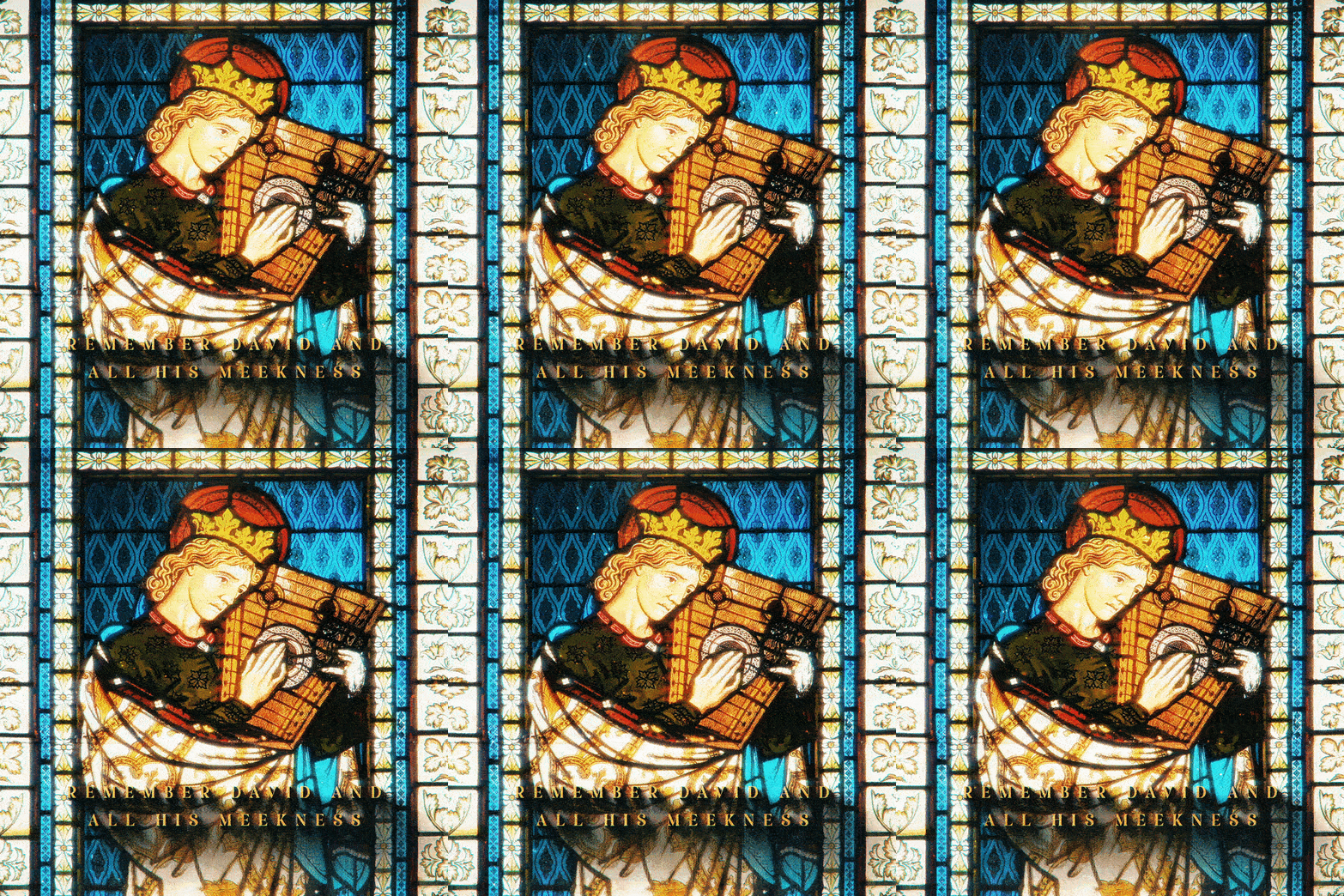
I found this great stained glass window of David playing a harp, and I thought his expression captured that meekness to which this verse alludes. His eyes are cast down which bespeaks his lack of confidence in himself, yet he hymns his praise to God, in which his confidence lies.
I cut out the hand in Photoshop and used Generative Fill to fill in the missing pixels, which it accomplished splendidly. In After Effects I created a simple Puppet Tool rig and animated the hand playing. I was thinking of also adding some sway to the body, but decided to keep it more subtle.
I inserted the text and applied Shadow Studio 3 for some raytraced shadowing to pull it out from the background without looking like the standard AE drop shadows. I then added in some floating particles using Trapcode Particular and finally added in some glow and color correction.
Enjoy.
O Lord, remember David, and all his meekness.
(Psalm 131:1 DR)
View a higher quality version of this gif here: