

Psalm 131:11
the supernatural and the actual
The Lord hath sworn truth to David, and he will not make it void: of the fruit of thy womb I will set upon thy throne. (Psalm 131:11 DR)
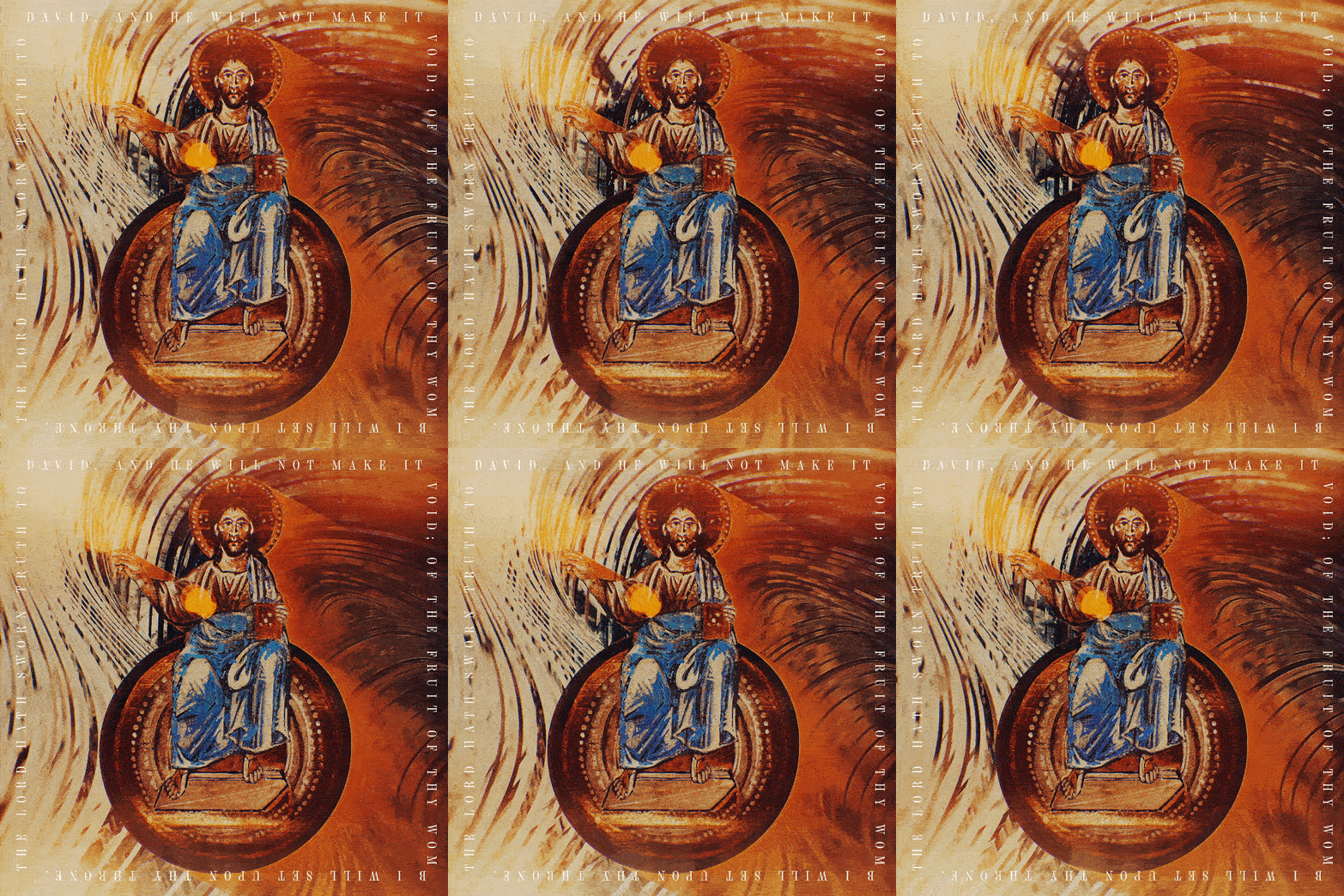
As the Psalmist recalls the Lord’s promise to David, he applies the fulfillment to himself, as he has been set upon the throne of his father. However, this fulfillment is only a type of what is to come in Christ, for the promise to David was not that only his son would reign as king, but that his descendants would reign forever if they followed Him, a promise which—in any case—could not be fulfilled in one mortal man, even less in one who was born in Original Sin.
There is a further oddity, for the promise which the Psalmist recalls also invokes the priesthood of Melchisedek by utilizing similar language (cf. Psalm 109) and links the explication of this promise to the fulfillment coming from the fruit of David’s womb. The oddity here is that David—whether taken literally or figuratively—does not possess a “womb,” and the standard language used for progeny in this sense would be “fruit of thy loins.” St. Augustine notices this:
But He promised this so as not to change it. Just as this passage also says: “The Lord swore, and will not repent, You are a Priest for ever after the order of Melchizedek;” so also since this was promised so that it should not be changed, because it must needs happen and be permanent; he says, “The Lord has made a faithful oath unto David, and He shall not repent; Of the fruit of your body shall I set upon your seat.” He might have said, “of the fruit of your loins,” wherefore did He choose to say, “Of the fruit of your body”? Had He said that also, it would have been true; but He chose to say with a further meaning, Ex fructu ventris, because Christ was born of a woman without the man. (St. Augustine, Expositions on the Psalms, 131, 11.)
The Vulgate has de fructu ventris which is practically identical to ex fructu ventris, although St. Augustine takes it in the more generic sense of “body” rather than how the Douay-Rheims renders it (probably more literally) as “womb.” At any rate he sees the choice of this language as clearly bespeaking a supernatural origin for the fulfillment of this promise, for the reasons noted above. After all, if the one who fulfills this promise to David is a mortal born into Original Sin, then the promise is predicated exclusively on the fidelity of that progeny and only exists as long as he does. The moment he sins or the moment he dies then the promise is broken and “made void.”
But since the Psalmist is prophesying, he looks forward to our Lord Jesus Christ who perfectly fulfills this by being Himself eternal (and thus not subject to ending the promise by death) and All-Holy and without sin (and thus not subject to ending the promise by sin). Further, his human generation is set apart from all others in that he is conceived in the “womb” of the Blessed Virgin, herself of the line of David but—unlike his earthly successors—is also without sin as being herself immaculately conceived.
In this doubly-supernatural manner the promise made to David is fulfilled in our Lord andHis birth of the Blessed Virgin, as the “womb” of David in his descendent Mary brings forth the fulfillment of the promise. The opening of this Psalm wherein the Psalmist invokes the “meekness” David is paralleled and brought to fulfillment in the self-emptying of our Lord (cf. Philippians 2:7) and the words spoken by the Blessed Virgin in the Magnificat:
My soul doth magnify the Lord. And my spirit hath rejoiced in God my Saviour. Because he hath regarded the humility of his handmaid; for behold from henceforth all generations shall call me blessed. Because he that is mighty, hath done great things to me; and holy is his name. And his mercy is from generation unto generations, to them that fear him. (Luke 1:46-50)
In this animation I found this great image of Christ Pantocrator in an old medieval manuscript and cut it out in Photoshop. I brought it into After Effects and added in a background texture to which I applied Stretch. I drew some curvy masks to get the swirl shape and then linked up the masks to the effect to get the swirling motion. I wasn’t intending per se for it to fold in on itself, but it looked cool so I went with it.
And that is the key to any design.
Enjoy.
The Lord hath sworn truth to David, and he will not make it void: of the fruit of thy womb I will set upon thy throne.
(Psalm 131:11 DR)
View a higher quality version of this gif here: