

Psalm 131:15
blessed are the poor in spirit
Blessing, I will bless her widow: I will satisfy her poor with bread. (Psalm 131:15 DR)
Perhaps one of the greatest spiritual dangers of the modern western world is our prosperity. Not without reason did our Lord say that:
It is easier for a camel to pass through the eye of a needle, than for a rich man to enter into the kingdom of heaven. (Matthew 19:24 DR)
St. James likewise minces no words for a similar group:
Go to now, ye rich men, weep and howl in your miseries, which shall come upon you. Your riches are corrupted: and your garments are motheaten. Your gold and silver is cankered: and the rust of them shall be for a testimony against you, and shall eat your flesh like fire. You have stored up to yourselves wrath against the last days. (James 5:1-3 DR)
The reason riches are often railed against is not that riches are evil in and of themselves or create inequity or that those who possess riches necessarily also possess poor character. After all, some of the wealthiest men in the Scriptures (such as Abraham and Job) were blessed with temporal goods because of their fidelity to God and their uprightness.
Instead, riches are often warned against because they have a difficult-to-resist tendency to create within the heart an inflated self-sufficiency wherein one neglects the things of God in favor of the things of this world. Temporal prosperity can easily make one numb to God in that the existential “need” for God can seem blunted; riches allow us to think our blessings come from ourselves or our efforts rather than from the blessings that God freely gives. They also can create within us a misguided sense that they are ours to do with as we please, rather than being something over which God gives us stewardship.
For these reasons our Lord reveals the folly of the rich man who built barns for his wealth:
And he said: This will I do: I will pull down my barns, and will build greater; and into them will I gather all things that are grown to me, and my goods. And I will say to my soul: Soul, thou hast much goods laid up for many years take thy rest; eat, drink, make good cheer. But God said to him: Thou fool, this night do they require thy soul of thee: and whose shall those things be which thou hast provided? So is he that layeth up treasure for himself, and is not rich towards God. (Luke 12:18-21 DR)
In the modern western world we have more prosperity than the world have ever seen in history among more people than at any time in human history. Perhaps unsurprisingly we are also sinking into dreadful godlessness at a seemingly ever-accelerating pace. Most of us do not “feel” any existential need for God; we do not generally worry about what we will eat or other such worries, although as our civilization decays this will become more and more common. Rather, we spend much of our time—an inordinate amount to be sure—chasing after novelties and imagining our technological prowess is a sign of enlightenment and virtue, when in reality it masks (and too often enables) corrupt hearts and depraved minds. Our wealth causes us to completely forget God.
The Psalmist’s words in this passage are directed towards those in great need—the widows and the poor. In most of human history to be widowed was to live on the razor’s edge of life and death. Having large family structures was important so that widows could be provided for, for if they did not have many sons or family close at hand, it was not as if a widow—except in extraordinary circumstances—could just go out and “get a job” or start a business. Her livelihood was generally tied to her husband, whose wealth would usually go to the oldest son or otherwise be divided by her sons. But if she had no sons or if they were no longer living or traveling or lived elsewhere, she did not always receive her husband’s wealth, assuming he had any.
In such a situation widows were often desolate and trusted in God to provide for them. In the early Church the class of “widows” (viduae) was formed to be cared for, and St. Paul gives directions to St. Timothy about how to handle different situations (cf. 1 Timothy 5:3-16). Only those who are truly widows—who have no other familial recourse—are to be included in the viduae for:
She that is a widow indeed, and desolate, let her trust in God, and continue in supplications and prayers night and day. (1 Timothy 5:5 DR)
St. Augustine notes that the defining character of widowhood is to be bereft all all help, save for God alone, and it is this quality which makes the whole Church a widow, as it were:
What then makes a widow? That she has no aid from any other source, save from God alone. They that have husbands, take pride in the protection of their husbands: widows seem desolate, and their aid is a stronger one. The whole Church therefore is one widow, whether in men or in women, in married men or married women, in young men or in old, or in virgins: the whole Church is one widow, desolate in this world, if she feel this, if she is aware of her widowhood: for then is help at hand for her. (St. Augustine, Expositions on the Psalms, 131, 16.)
He also draws a parallel between St. Paul’s admonition that widows continue in prayer day and night with our Lord’s parable about the persistent widow, since this was the entire reason for the parable:
He spoke also a parable to them, that we ought always to pray, and not to faint… (Luke 18:1 DR)
St. Augustine concludes:
If the wicked judge heard the widow, that he might not be molested; hears not God His Church, whom He exhorts to pray? (St. Augustine, Expositions on the Psalms, 131, 16.)
The danger of riches lies in its soporific nature—we get lulled into a sense of spiritual sluggishness and can lose sight of the true end of our lives completely. We can also become overconfident in the ability of our wealth to make problems and struggles go away, and become convinced of our own self-sufficiency. All of these things are deadly poisons to the spiritual life, and great wealth makes an easy point of entry for each of them. Wealth may not make prayer impossible, but it certainly can make it more difficult, and gratitude becomes a virtue increasingly difficult to master.
God may bless us with wealth and possessions, but they are to be used, rather than to use us. They must never become a source of pride or vain-glory, and like St. Paul we must:
I speak not as it were for want. For I have learned, in whatsoever state I am, to be content therewith. I know both how to be brought low, and I know how to abound: (everywhere, and in all things I am instructed) both to be full, and to be hungry; both to abound, and to suffer need. I can do all these things in him who strengtheneth me. (Philippians 4:11-13 DR)
What is not optional is to be “poor in spirit,” wherein we recognize our constant need for the Lord and our entire dependance on Him. In doing so we can receive blessings with gratitude and hold the things of this world in contempt, rather than building bigger barns to contain our prosperity. In each of our hearts a widow should reside who is constant in prayer and fully reliant on God:
Be therefore poor, be ye among the members of that widow, let your help be solely in God alone. Money is nought; not thence will you have aid. Many have been cast headlong down for money's sake, many have perished on account of money; many for the sake of their riches have been marked out by plunderers; they would have been safe, had they not had what made men hunt for them…
Take heed that you presume not in money, in a friend, in the honour and the boasting of the world. Take away all these things: but if you have them, thank God if you despise them. But if you are puffed up by them; think not when you will be the prey of men; already are you the Devil's prey. But if you have not trusted in these things, you will be among the members of that widow, who is the Church, of whom it is said, “I will bless her widow with blessings; you will also be poor, and one of those of whom it is said, And will satisfy her poor with bread.” (St. Augustine, Expositions on the Psalms, 131, 16.)
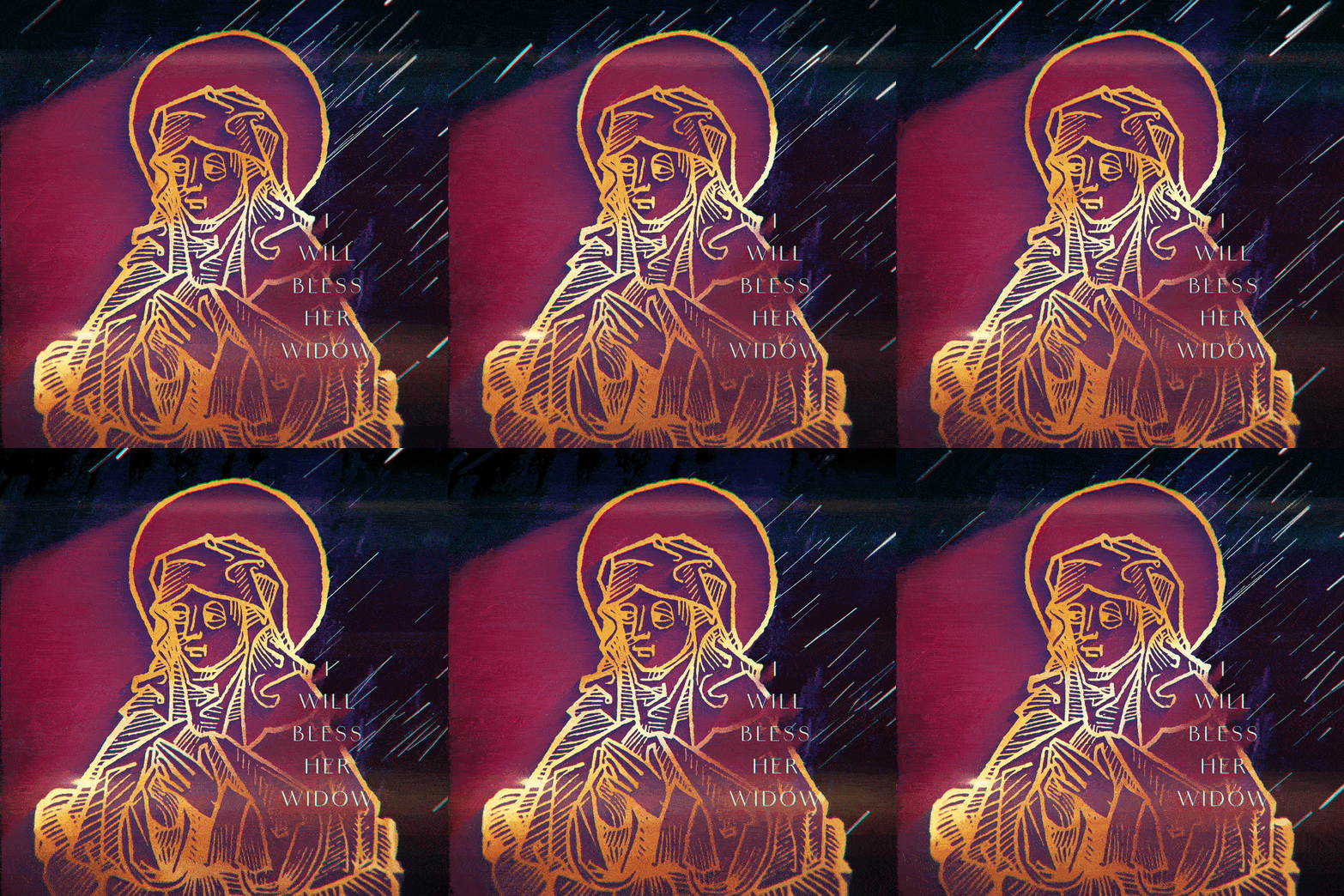
For this animation I found a great woodcut of St. Monica, the mother of St. Augustine, who was herself a widow, although fortunately not destitute. Yet in the fashion of the “widow” mentioned by her son (and perhaps whom he had in mind while writing) she was always fasting and praying, those prayers and supplications being responsible for her son’s conversion. I thought it would thus be appropriate for this animation.
I cut out the woodcut in Photoshop and cleaned it up a little, as Photoshop had a bit of trouble with some of the edges. I then precomped it in After Effects and used the layer as a Matte for some golden texture which I applied Turbulent Displace to for some movement there. Back in the main composition I duplicated that precomp and added Shadow Studio 3 to the bottom precomp and used some blending mode to blend the shadow into the background a bit. I made sure that the matte layer had an alpha channel so that there would be those nice interior shadows as well, rather than just emanating from the outer edges.
I added in some particle streaks using Particular and then finished up with some color correction.
Enjoy.
Blessing, I will bless her widow: I will satisfy her poor with bread.
(Psalm 131:15 DR)
View a higher quality version of this gif here: