

Psalm 131:2
promises made and promises kept
How he swore to the Lord, he vowed a vow to the God of Jacob: (Psalm 3:9 DR)
One of King David’s most pious acts was his attempt to build a temple for the Lord. He had himself just finished the construction of his royal palace and felt the disjunction that he should live in luxury while the ark of the Lord was in a tent. He inquires of the prophet Nathan on what he should do, and Nathan tells him that he should do what he has in his heart, for God is with him.
This Psalm provides a bit of reading in between the lines of the narrative, for we find that David made a vow to build this temple to the Lord, which either implies an actual vow (as St. Alphonsus Liguori thinks) or, as St. Bellarmine proposes, is a hyperbolic depiction of his desire. I would be inclined to the former, for while it does have a hyperbolic character to it (as the following verses will demonstrate), it is framed in the form of a vow, especially as this parallels the promises made to David following his vow.
However, David’s vow was not fulfilled by him, for the prophet Nathan received a word from the Lord that David was not to be the one to build the temple:
Go, and say to my servant David: Thus saith the Lord: Shalt thou build me a house to dwell in? Whereas I have not dwelt in a house from the day that I brought the children of Israel out of the land of Egypt even to this day: but have walked in a tabernacle, and in a tent. In all the places that I have gone through with all the children of Israel, did ever I speak a word to any one of the tribes of Israel, whom I commanded to feed my people Israel, saying: Why have you not built me a house of cedar? (2 Samuel 7:5-7 DR)
That this is not a rebuke of David’s vow nor his intention is clear from what follows in which the Lord reminds David that he raised him from nothing and made him great, and promises to bless his house forever. His desire to build the temple was not wrong by any means, and his vow was prompted by Nathan’s approbation of his desire.
He thus did not vow rashly, even though his vow would not be fulfilled by him. Instead, the meekness of David is once again illustrated as he fully submits his will to the Lord, confident that the Lord will fulfill His promises and will fulfill his vow through his progeny:
And now, O Lord God, thou art God, and thy words shall be true: for thou hast spoken to thy servant these good things. And now begin, and bless the house of thy servant, that it may endure for ever before thee: because thou, O Lord God, hast spoken it, and with thy blessing let the house of thy servant be blessed for ever. (2 Samuel 7:28-29 DR)
In the end David did not allow his own scrupulosity concerning his palace to cause him to rashly disobey the Lord, but instead trusted in God’s promises and goodwill towards him. It would have been easy and natural for him as king to build a splendid temple for the Lord, as kings of the ancient world were often marked in their greatness by the construction projects they undertook. But David in his humility entrusted his legacy and renown to the Lord, finding it in serving the will of God rather than his own.
However, that he himself would not construct the temple did not diminish his desire to do so, which was a pleasing desire to God. He thus rightly interpreted the Lord’s word to him in the strictest possible sense and used his power and wealth to provide for the eventual construction:
And he commanded to gather together all the proselytes of the land of Israel, and out of them he appointed stonecutters to hew stones and polish them, to build the house of God. And David prepared in abundance iron for the nails of the gates, and for the closures and joinings: and of brass an immense weight. And the cedar trees were without number, which the Sidonians, and Tyrians brought to David. And David said: Solomon my son is very young and tender, and the house which I would have to be built to the Lord, must be such as to be renowned in all countries: therefore I will prepare him necessaries. And therefore before his death he prepared all the charges. (1 Chronicles 22:2-5 DR)
He married his faith and his works so that his vow to the Lord would not be in vain, for while he could not himself fulfill the letter of his vow, he nevertheless made good on the spirit in which it was made. When he made his vow he did so in good faith, trusting in the Lord to fulfill his words:
David himself vowed as though he had it in his power, and he prays God to fulfil his vow: there is devotion in the vow, but there is humility in the prayer. Let no one presume to think he fulfilled by his own strength what he has vowed. He who exhorts you to vow, Himself aids you to fulfil. (St. Augustine, Expositions on the Psalms, 131, 2.)
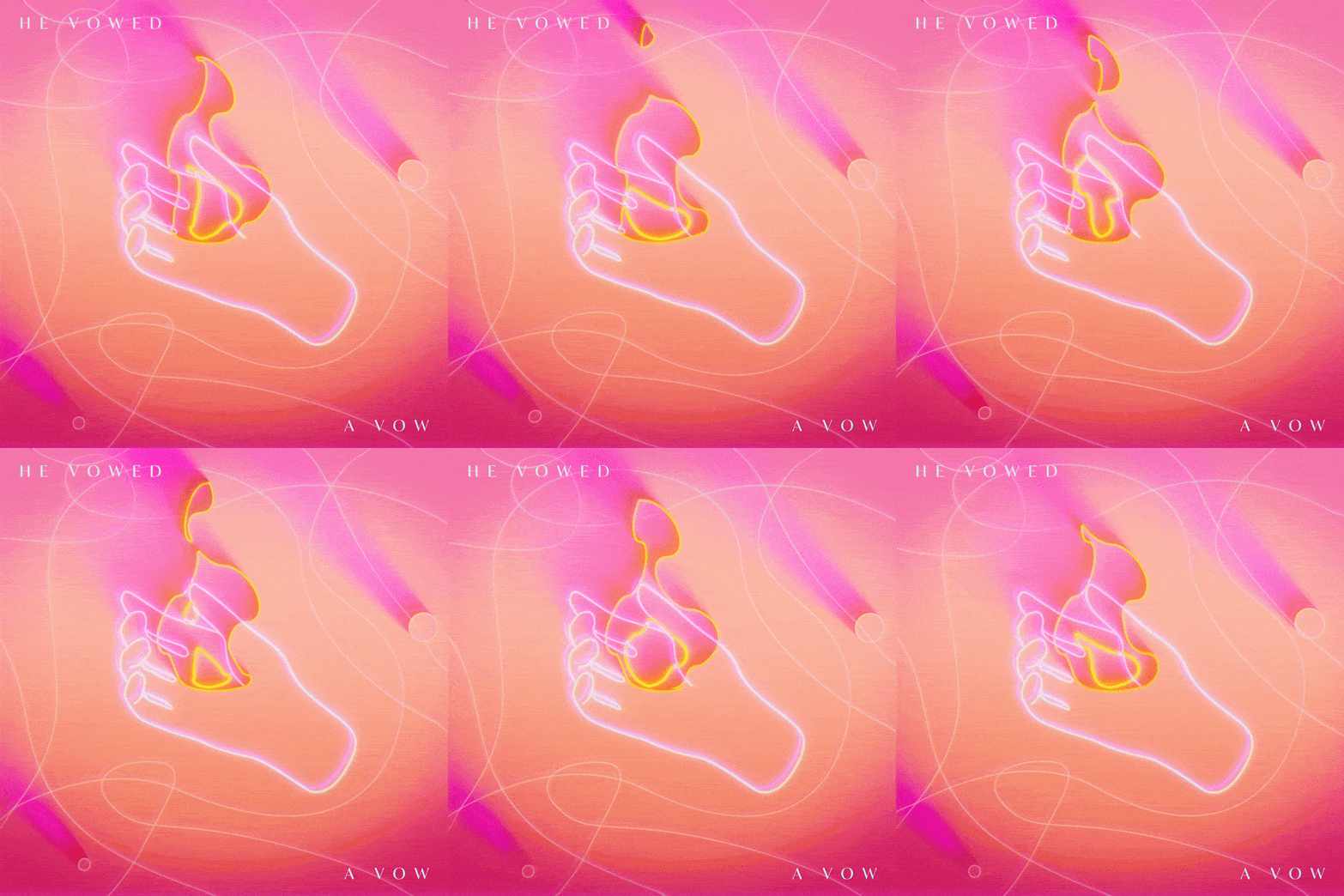
In this passage I was imagining the vow of David to build a temple for the Lord as arising from the ardor within him, which immediately evoked the imagery of fire. I then imagined him lifting up hands in devotion filled with fire, which, to be fair, is an odd mental image, but I decided to run with it.
For some reason I thought a pseudo-neon look might be fun but with a twist. I drew a simple hand in After Effects and reused an animated flame I’ve created before. After pre-composing them in the composition (to ensure they were the same Scale) I applied some strokes via the Layer Styles and reduced the Layer Fill opacity so there was only the stroke. The flame animation is actually much larger than the hand and isn’t even made of strokes, but by having them in precomps the Layer Style applied to the layer scale (in this case, the precomp scale) rather than the pixel size, which makes the strokes identical in width, which is convenient for this purpose.
I then added some glows as well as Shadow Studio 3 to give it a bit of a different look from regular neon effects. I added in some preocomps with moving ellipses and applied the same Layer Styles and effects just to balance out the composition. I also added a slightly distorting swirly line to give a bit of depth. I finally added in the text and some color correction.
Enjoy.
How he swore to the Lord, he vowed a vow to the God of Jacob:
(Psalm 131:2 DR)
View a higher quality version of this gif here: