

Psalm 131:4
watch ye and pray
If I shall give sleep to my eyes, or slumber to my eyelids, (Psalm 131:4 DR)
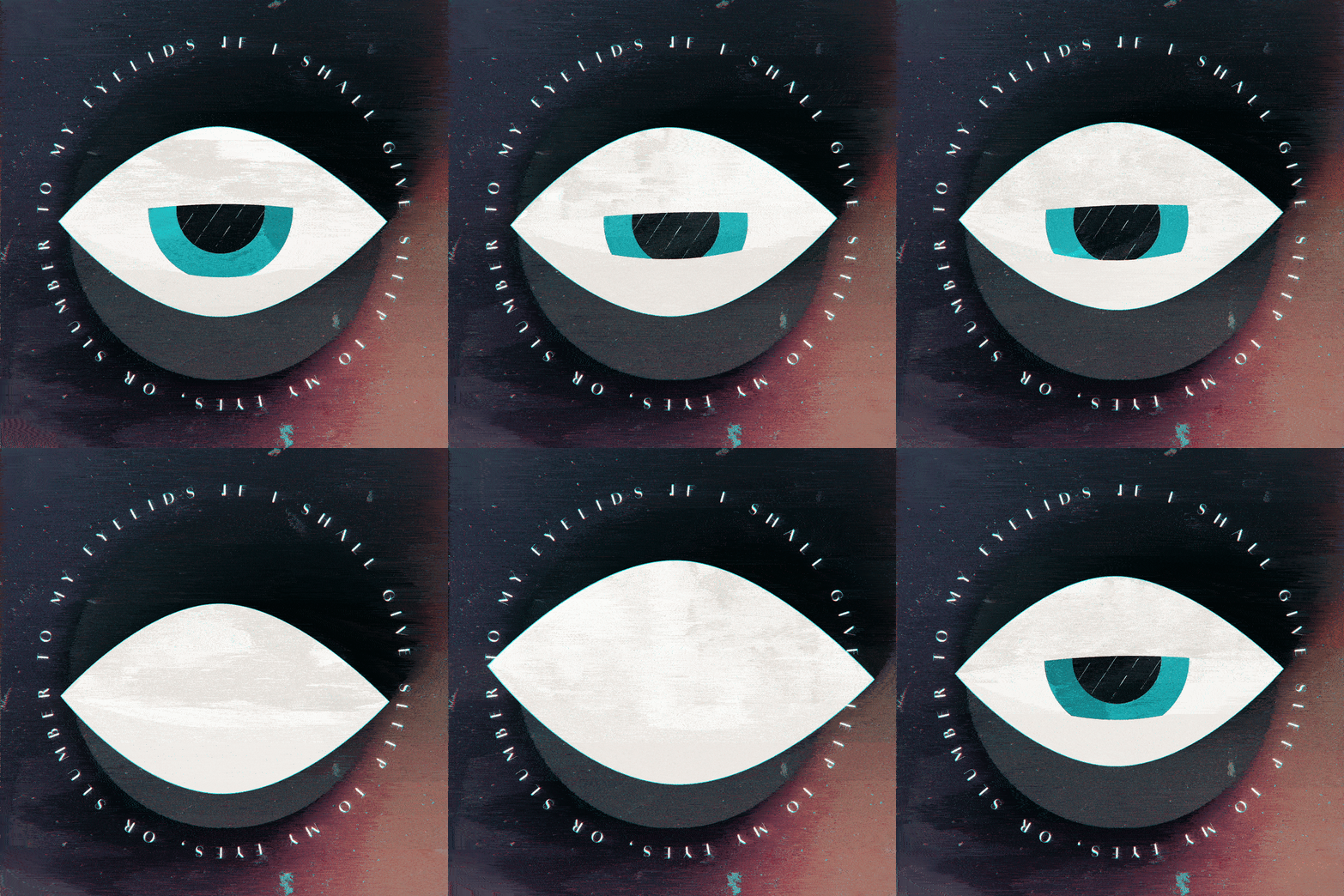
As the Psalmist recalls David’s vow to the Lord in respect to his desire to build the temple, he speaks of how David vowed to not “give sleep to his eyes or slumber to his eyelids.” This parallelism with the previous passage expands upon the idea of not going into his house or going into his bed to lie down, almost as if each successive verse of the vow gets more specific in respect to the idea of rest.
For going to bed certainly communicates the intent to “rest,” but the closing of the eyes is more or less the efficient cause of that. We have all felt the heaviness of the eyes when the body’s fatigue wears upon us, even if in our minds we are wide awake. That draw of the catharsis of rest as felt in the drooping eyelids is a powerful force and difficult to overcome without extreme vigilance. We can intend to not fall asleep but then suddenly awake and realize we have been asleep for some time. One is reminded of Jesus’ disciples while in the Garden of Gethsemane who were told to watch and pray:
And he cometh to his disciples and findeth them asleep. And he saith to Peter: What? Could you not watch one hour with me? Watch ye: and pray that ye enter not into temptation. The spirit indeed is willing, but the flesh is weak. (Matthew 26:40-41 DR)
No doubt the disciples had every intention of staying awake and praying, but the weakness of the flesh prevented them. The link here between not entering into temptation and staying awake is not meant to be purely literal (although it can be) but is more seen from the inside out: when we are sober-minded and diligent in prayer we can more effectively resist temptation, for in this watchful prayer we are aligning our wills with God and reliant upon his grace. Every night at Compline the Hour begins with this fitting exhortation from St. Peter, who no doubt had this previous failure in mind:
Be sober and watch: because your adversary the devil, as a roaring lion, goeth about seeking whom he may devour. Whom resist ye, strong in faith… (1 Peter 5:8-9 DR)
David’s vow to the Lord prefigures this watchfulness, for while he will certainly literally go to sleep and close his eyes (in sleep and in death) long before the temple is ever built, he has set the gaze of his interior sight upon the house of the Lord and intends to keep it fixed there, never allowing it to slumber or get distracted or fatigued.
It is interesting in reading the narrative of David’s life to note that when he gets slothful in prayer is when he falls into great sin. His sin with Bathsheba occurred because he was neglecting his duties as king in leading his armies, and this pride and self-serving made him equally negligent in prayer. When he took the census of his nation he became concerned with his own renown and in pride neglected seeking the will of the Lord and even ignored the advice of his otherwise unscrupulous general against it.
In all these instances he let the eyes of his spirit get heavy and indulge in sleep, as it were, and became blinded to God’s will, unaware of the dangers of the temptations which surrounded him.
However, when he considered that he wanted to build a temple to the Lord, the first thing he did was to seek out the prophet Nathan’s advice to see if God desired this of him or not. It will be remembered that he previously had tried bringing the ark to Jerusalem and the Lord had struck Oza (Uzzah) dead for touching the Ark (cf. 2 Samuel 6:1-11). And while David was eventually able to bring the Ark into Jerusalem, this incident so terrified him that he waited three months to try again the proper way. He had his interior eyes wide open, and in by doing so sought the Lord and was heard.
He purified his intentions, for in the ancient world kings often built grand temples as a sign of their renown and prestige and power and glory. It is not impossible that David’s original motive in bringing the Ark into Jerusalem was partially colored by such motives, and in such haste did not do things in the proper liturgical manner. But three months later things were done properly and God blessed him. The memory of this perhaps caused him to consider his own motives in wanting to build the temple. He did not have confidence in himself but instead entrusted his desires to the Lord (cf. Proverbs 3:5-6).
This is the meekness for which he was known, and the watchfulness of spirit which made him a man after God’s heart.
The mental image of sleepy eyes was too good to pass up, and so I went pretty literal with this one. I drew the eyes in After Effects with Shape Layers and used some of the shapes as mattes for some textures. I animated the paths of the shapes to give the effect of drooping eyelids, with the final closing of the eyes in sleep and the sudden realization that one has fallen asleep to close out the loop. I realize that eyes don’t move around like this, but I added in the movement to help sell the effect a bit more, especially since it’s basically a disembodied eye.
Question: can an eye—which is part of the body—actually be disembodied?
Enjoy.
If I shall give sleep to my eyes, or slumber to my eyelids,
(Psalm 131:4 DR)
View a higher quality version of this gif here: