

Psalm 131:5
this is no time for sleeping
Or rest to my temples: until I find out a place for the Lord, a tabernacle for the God of Jacob. (Psalm 131:5 DR)
The Psalmist now comes to the conclusion of David’s vow in which the latter lays down the condition for his abstaining from rest: that he would “find out a place for the Lord.” As noted previously, the vow gets more precise as it progresses in its depictions of sleep, from rest generically in the first part to the physical act of sleep in the second. Here the fullness of sleep is intimated in giving “rest to my temples.”
The origin of “temple” for the side of the forehead is not certain. The Latin root is tempus which normally refers to time, but in anatomy is used of what we think of as the temples. The reason for this isn’t certain; some propose that since it is the part of the face where the skin is most stretched, then a potential etymological root would come from -temp which means “to stretch.” Others derive the etymological meaning from the Greek loan word ta kairia, which is the “vital place” in the head (i.e., to deal a mortal blow since it is the thinnest part of the skull). (cf. tempus, Wikitionary.)
It eventually came into English via the Old French temple from the Vulagr Latin’s tempula, itself from tempora, the plural of tempus (Online Etymological Dictionary, tempus). The first recorded uses date from the early 14th century, one of the earliest the legend of St. Margaret defeating a dragon:
Sche ȝede to þat foule wiȝt,
wiþ þe croice in hir hond,
& þurth þe miȝt of Jhesu Crist
wiþ hir wimpel sche him bond.
Sche toke him bi þe temples,
about sche him swong,
Sche set hir fot in his nek,
to þe erþe sche him þrong.She went to that foul wight (creature),
With the cross in her hand,
And through the might of Jesus Christ
With her wimpel (sash) she bound him.
She took him by the temples,
And she swung him;
She set her foot on his neck;
To the earth she thrust him.
Etymological tangents aside, the temples are the place of the head whereupon one rests, and thus become a stand-in for the entire intentionality of sleeping. Sometimes the heaviness of the eyes overcome the desire to stay awake and one falls asleep without wanting to, but to lay down upon one’s temples in an act of the will; that is, the entire purpose is to sleep. We have thus moved from entering the house to rest, to the eyes closing, to finally the will fully engaging. All of this elongated poetic vow is meant to underscore the deliberate-ness of his desire to find out a place for the Lord over against even the most basic needs like sleep. By stacking the clauses one upon another, he binds himself in every aspect of being and will to this purpose.
St. Augustine draws out this desire to build a house for the Lord into the spiritual sense of the soul becoming this temple of God. David took great pains to prepare for the temple’s eventual building—even though he would not live to see it—and thus we must be even more diligent in preparing a place for the Lord in our souls:
Desire the friendship of Christ without fear: He wishes to be entertained at your house; make room for Him. What is, make room for Him? Love not yourself, love Him. If you love yourself, you shut the door against Him; if you love Him, you open unto Him: and if you open and He enter, you shall not be lost by loving yourself, but shall find yourself with Him who loves you... (St. Augustine, Expositions on the Psalms, 131, 4.)
The exemplar is our Lord and Savior Jesus Christ who in His divine life in word and deed raised up the temple of His Body, both in making Himself the pure and infinite sacrifice to the Father but also in purifying His Bride, the mystical Body of Christ:
Now, these were all types and figures of Christ, the true David, who, in his desire of raising a living temple, and an everlasting tabernacle to God, spent whole nights in prayer, and, truly, neither entered his house, nor went up into his bed, nor gave slumber to his eyelids nor rest to his temples, and presented to himself “a glorious Church, not having spot nor wrinkle, nor any such thing,” nor built “with corruptible gold or silver,” but with his own precious sweat and more precious blood; it was with them he built that city in heaven that was seen by St. John in the Apocalypse, and “was ornamented with all manner of precious stones.” Hence, we can all understand the amount of care, cost, and labor we need to erect a becoming temple in our hearts to God. (St. Robert Bellarmine, A Commentary on the Book of the Psalms, 131, 2-5.)
The happy coincidence of both meanings of the English “temple” works in our favor here to draw this out. Our flesh desires this rest to our temples; that is, the sloth of spirit which wants the pleasures of this world and desires to make as little effort as possible for spiritual growth. But the temple of soul requires foregoing giving rest to the temples; that is, we must be diligent in prayer, fasting, mortification of the flesh, stay close to the Sacraments, etc. These two “temples” are in many ways opposed to each other, just as the flesh is to the spirit (cf. Galatians 5:16-17) and thus we must—like David—seek out a place for the Lord before giving ourselves over to rest.
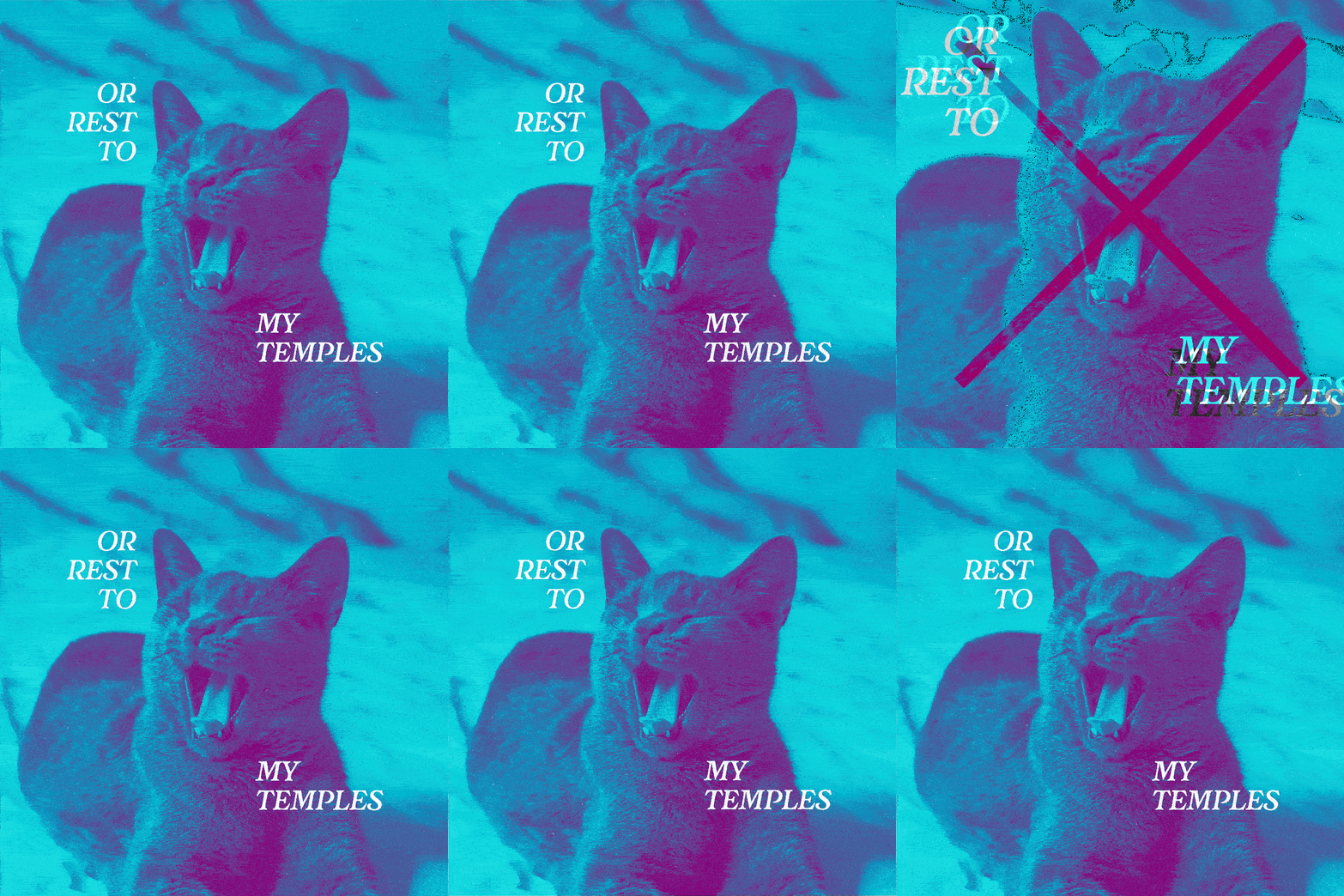
For this animation I happened upon this image of a yawning cat and simple had to use it. I brought it into After Effects and applied some tinting to create the duo-tone effect. I added a Transform distortion effect to an Adjustment Layer and a couple Expression sliders to that. I then applied a Wiggle expression to the Position parameter of the Transform Effect and linked the two values (Time and Amount) to the expression sliders. The time slider I set to 12 (i.e., 12x per second) and I then animated the Amount slider from 0 to whatever it ended up being to go from not moving to shaking. I also animated the scale with some Hold keyframes. I added in the X over the cat when it was zoomed in and finally added in some Chromatic Aberration on the zoom in to sell the shaking even more.
Kind of silly but also kind of fun.
Enjoy.
Or rest to my temples: until I find out a place for the Lord, a tabernacle for the God of Jacob.
(Psalm 131:5 DR)
View a higher quality version of this gif here: