

Psalm 131:9
the clothes you wear
Let thy priests be clothed with justice: and let thy saints rejoice. (Psalm 131:9 DR)
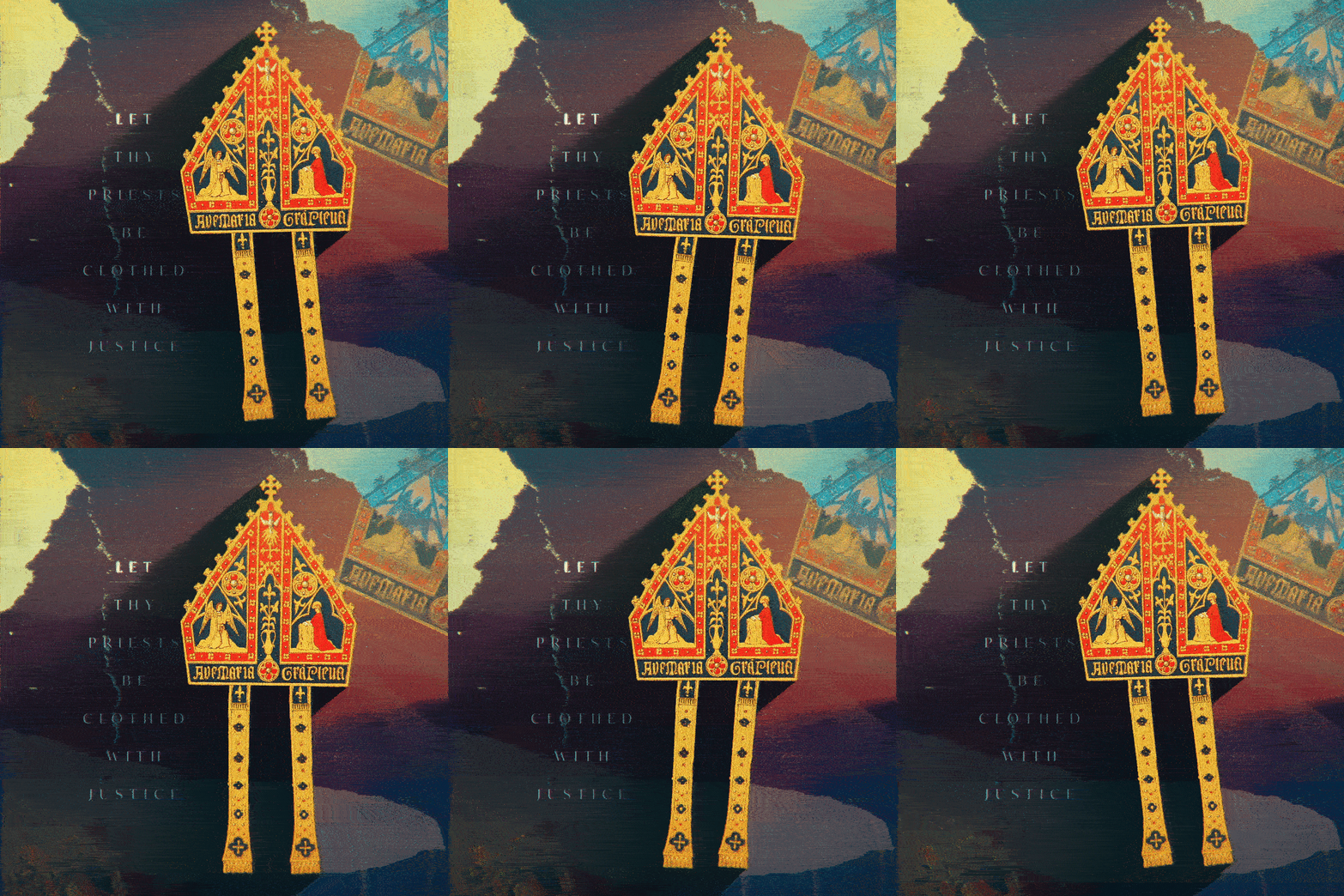
When the Ark was finally brought into the temple, the presence of God filled it in a thick cloud, so much so that the priests could not perform their duties. It is within this context that the Psalmist—paraphrasing Solomon’s prayer of dedication—invokes holiness and justice for the priests who will be offering sacrifice. In the Old Covenant these sacrifices entailed the offering of bulls and lambs and other such animals, but the Psalmist elsewhere notes that it was understood that these sacrifices are not the totality of what God desires:
For if thou hadst desired sacrifice, I would indeed have given it: with burnt offerings thou wilt not be delighted. A sacrifice to God is an afflicted spirit: a contrite and humbled heart, O God, thou wilt not despise. (Psalm 50:18-19 DR)
The unapproachable-ness of the altar in the temple at its dedication underscores the holiness of God and the need for those who minister before him to have that “contrite and humbled heart” without which these sacrifices are offered in vain. Thus the Psalmist asks that the priests be clothed with justice. He is speaking both literally and metaphorically, for while as priests they will be clothed with particular vestments, those outer raiments are meant to be an expression of an inward purity of heart:
I beg of you, O Lord, that “thy priests be clothed with justice,” interior and exterior, within and without; that justice may appear in their lives, words, and actions, and that nothing disgraceful should turn up in those who are to minister to you and to teach your people. The metaphor of a robe is used here to give us to understand, that as such an article not only covers the deformities, but also adds to the appearance of those who wear it, and distinguishes them too; so should priests, through their virtues, and their extreme sanctity, not only rise above the imputation of anything mean or disgraceful, but should hold themselves up as a bright model and example to the flocks they have in charge, so that it may not be said of them, that “the people are as bad as the priest.” (St. Robert Bellarmine, A Commentary on the Book of the Psalms, 131, 9.)
The sacrifices of the temple as a shadow of what was to come, the perfect sacrifice of our Lord Jesus Christ to God the Father. Our Lord combines the sacrifice of His own body with the humbled and contrite heart that God desires so as to effect in His own sacrifice that which was pleasing to the Father:
Wherefore when he cometh into the world, he saith: “Sacrifice and oblation thou wouldest not: but a body thou hast fitted to me: Holocausts for sin did not please thee. Then said I: Behold I come: in the head of the book it is written of me: that I should do thy will, O God.” (Hebrews 10:5-7 DR)
The Old Covenant sacrifices could make one exteriorly and ceremonially clean, but they could not effect a transformation in the heart. But our Lord’s one perfect sacrifice which is re-presented in the Mass cleanses the soul from sin:
For if the blood of goats and of oxen, and the ashes of an heifer being sprinkled, sanctify such as are defiled, to the cleansing of the flesh: How much more shall the blood of Christ, who by the Holy Ghost offered himself unspotted unto God, cleanse our conscience from dead works, to serve the living God? (Hebrews 9:13-14 DR)
St. Augustine applies this to the entire “royal priesthood” of faith who live in this reality because of our Lord’s victory over sin and death:
When You rise from the dead, and go unto Your Father, let that royal Priesthood be clothed with faith, since “the righteous lives by faith;” [Romans 1:17] and, receiving the pledge of the Holy Spirit, let the members rejoice in the hope of resurrection, which went before in the Head: for to them the Apostle says, “Rejoicing in hope.” [Romans 12:12] (St. Augustine, Expositions on the Psalms, 131, 9.)
The justice or righteousness with which the priests of God—whether the ordained priesthood or the royal priesthood—is not of our own undertaking of effort but is obtained through faith as we cooperate with God’s grace. A primary channel of this grace is the sacraments, which is why the ordained ministerial priesthood is of such vital importance. And while the sacraments do not as a matter of doctrine depend upon the holiness of the ministers for their efficacy, it is important for them to strive after holiness given the great charge under the care and as men who will one day have to give account for their priesthood:
“And let thy saints rejoice.” Let the same priests, who, strictly speaking, are your saints, at least they ought to be, as being consecrated and segregated to you, let them exult and rejoice in praising you, and thus properly discharge their duty. If such was the justice, holiness, and promptness required of the priests who sacrificed but sheep and oxen, what amount of those virtues will be required of the priests who sacrifice the Lamb? Woe to us wretched, who have been called to so sublime a ministry, and are so far short of the fervor that Solomon required in the priests who were but foreshadows of the priests of the new law! (St. Robert Bellarmine, A Commentary on the Book of the Psalms, 131, 9.)
But even for those of us of the laity, God equally desires that we be clothed with justice, for without holiness “no man shall see God” (Hebrews 12:14 DR).
For this animation I knew I wanted to find some sort of vestments to use, and I found this mitre which I found quite striking. I cut it out in Photoshop and in After Effects precomped the mitre itself and then parented the tassels to it. I then animated the position and rotation of the mitre and then the rotation of the tassels to give it a bit of movement. I the precomped the mitre and tassels and applied Shadow Studio 3 to give it some separation from the background.
Enjoy.
Let thy priests be clothed with justice: and let thy saints rejoice.
(Psalm 131:9 DR)
View a higher quality version of this gif here: