

Psalm 136:4
a creature of extremes
How shall we sing the song of the Lord in a strange land? (Psalm 136:4 DR)
The fallenness of our nature is wont to take what is good and turn it into something of a lesser good, to take what is holy and make it profane. This usually occurs not necessarily because we do something evil per se, but rather that we subvert or inhibit the end of a good or holy thing or turn it towards a lesser end.
An example of this is prayer, which is a good thing per se. But if we make prayer merely into a box to check or a means whereby we conceive of God as a cosmic vending machine, then we have turned it from tis proper end to something lesser.
Even here there can a be a deception, as we are prone to go to extremes. On the one hand we can perceive prayer as something that is only a duty and turn it into a box to check without ever achieving communion with God, or on the opposite end we can abandon any idea of duty and frame it entirely around our emotional state.
The reality is that while God is not a cosmic vending machine, we are to come to God with our petitions in prayer. And while prayer is not a box to check, it is a duty incumbent upon us. The reality of our embodied nature always entails there is going to be a balance between affection and discipline, for the two are not mutually exclusive but rather complementary.
In our worship as in our prayer (and the two are not necessarily distinct) there also exists this tension of sorts in which the delights of the body can stand on one side and the desires of the spirit on the other. The liturgy of the Mass with its chant and incense, its beauty and sublimity do speaks to our earthly nature in a profound way, but not so as to delight the senses for the sake of delight but rather to elevate them and bring them into the service of adoration. In our natures there is certainly a hierarchy of the soul ordering the flesh, but that does not entail that the latter has no role to play in worship, as if we are bifurcated entities. Rather the bodily nature can both inhibit and enable adoration; ideally the latter is the case.
The Psalmist continues the theme of exile, wondering how the captives can sing their songs in a strange land. On the one hand there is a natural reticence, for they do not wish to expose the songs of Sion to the ridicule of their captors. But on the other hand they long to express the anguish in their spirit by recalling to mind the joys of the past by means of their songs. The latter motivation is not wrong per se, but the danger lurks of using the songs of Sion as a means of mere catharsis, of turning them into delights for the ear rather than melodies in adoration of the Most High. St. Robert Bellarmine notes this tension:
They, too, sing the song of the Lord in a strange land, who sing sacred hymns and chants in such a manner as to please the ear, seeking only to catch it by various inflections and variations, never considering that sacred music was intended to raise the soul to God rather than please the senses. There are to be found too, some who will bring the songs of Babylon into the house of God and into holy Sion, who so adapt sacred words to profane tunes as to cause the audience to attend exclusively to the air, and overlook the meaning of such hymns. (St. Robert Bellarmine, A Commentary on the Book of the Psalms, 136, 4.)
And lest this be seen as one-sidedly applied in the modern experience only towards more modern expressions of music in which the delights of the ear seem to be the driving force behind their composition and use, even the sublime and time-honored chants of the liturgy can be occasions of this inversion of ends.
St. Augustine in particular described in his Confessions the internal tension he felt, for although he was moved to tears by the sweetness of the chant, he also recognized the tendency in himself to be rapt by the music itself and forget about the words that were offered to God. He thus vacillated between the goodness of the chant in its ability to draw him into contemplation and his own struggle to not be overtaken by it.
He first describes his tendency to be enraptured:
For at one time I seem to myself to give them more honour than is seemly, feeling our minds to be more holily and fervently raised unto a flame of devotion, by the holy words themselves when thus sung, than when not; and that the several affections of our spirit, by a sweet variety, have their own proper measures in the voice and singing, by some hidden correspondence wherewith they are stirred up. But this contentment of the flesh, to which the soul must not be given over to be enervated, doth oft beguile me, the sense not so waiting upon reason, as patiently to follow her; but having been admitted merely for her sake, it strives even to run before her, and lead her. Thus in these things I unawares sin, but afterwards am aware of it. (St. Augustine, Confessions, 49.)
He thus admits that the chants of the liturgy have a particular quality of being able to life the spirit to contemplation by means of the body; this “hidden correspondence” is thus when both are working in concert and properly ordered. For the reality is that as embodied beings, anything that is in the mind if first in the senses, and thus there is a fittingness between the words that are sung and the way in which they are sung. When they have this congruity they can lift the mind and heart to adoration and contemplation.
But as he notes, the danger exists in giving free reign to the flesh and its desires, even when the desires are in and of themselves good. What he has in mind here is to be so taken by the beauty of the music as music that one never gets beyond the delight it gives to the ear and mind. The words that the music is meant to exalt and beautify never are brought to the mind for contemplation, but remain hidden behind a veil, which—it should be noted—in this case is not the fault of the music but of the hearer, as St. Augustine admits.
The other extreme to which we are prone is to dispense with the chants altogether, which can seem pious but which underneath lurks a disdain of what God has freely given and which is actually a help in worship. It can also manifest a sort of pride in that one can begin to think that one is satisfied with the text alone and doesn’t need the chant. St. Augustine himself struggled with the thought of chucking the entire corpus of chant:
At other times, shunning over-anxiously this very deception, I err in too great strictness; and sometimes to that degree, as to wish the whole melody of sweet music which is used to David’s Psalter, banished from my ears, and the Church’s too; and that mode seems to me safer, which I remember to have been often told me of Athanasius Bishop of Alexandria, who made the reader of the psalm utter it with so slight inflection of voice that it was nearer speaking than singing. (St. Augustine, Confessions, 50.)
We can see in his autobiographical account of his inner struggles this tension which swings from a healthy appraisal of himself and his struggles to a hyper-scrupulosity in which he begins to set himself above everything else as the arbiter of what is right and good and prudent so as to ease the struggles of his own temptation. He even enlists a saint to justify this thought. He does, however, come to himself, realizing the error of this line of reasoning:
Yet again, when I remember the tears I shed at the Psalmody of Thy Church, in the beginning of my recovered faith; and how at this time, I am moved, not with the singing, but with the things sung, when they are sung with a clear voice and modulation most suitable, I acknowledge the great use of this institution. Thus I fluctuate between peril of pleasure and approved wholesomeness; inclined the rather (though not as pronouncing an irrevocable opinion) to approve of the usage of singing in the church; that so by the delight of the ears, the weaker minds may rise to the feeling of devotion. (ibid.)
He thus at least at some times finds in himself a resolution to the tension, although in this vale of tears it will never fully go away. But he at least has to come to acknowledge the poles between which he can swing, this self-knowledge being a major step toward self-mastery while in exile:
Yet when it befalls me to be more moved with the voice than the words sung, I confess to have sinned penally, and then had rather not hear music. See now my state; weep with me, and weep for me, ye, who so regulate your feelings within, as that good action ensues. For you who do not act, these things touch not you. But, Thou, O Lord my God, hearken; behold, and see, and have mercy, and heal me, Thou, in whose presence I have become a problem to myself; and that is my infirmity. (ibid.)
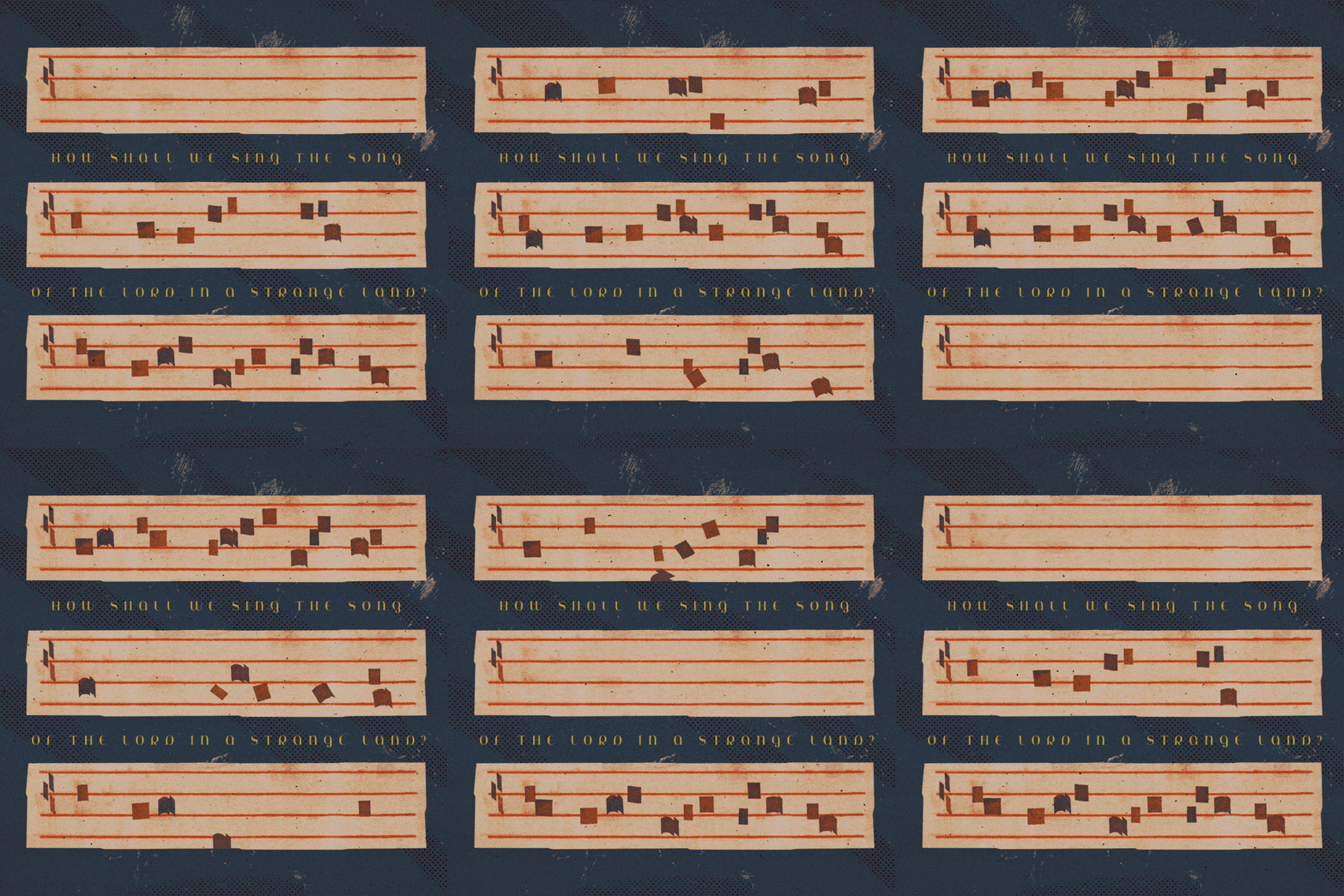
In this animation I took a section of chant from a medieval antiphonal and isolated all the various neumes in Photoshop, using Content Aware Fill and other healing tools to fill in the pixels after cutting them out.
I then brought all these individual layers into After Effects created a precomp with all the notes and animated the Y position of each one, doing some overshoot at the end of the upward movement for visual interest. I then animated them falling off the staff. o be fair, when I say I did this for all of them, what I really mean is I did this for one of them and then copied and pasted the animation to the rest. I then sorted them randomly and used the great tool Lazy to ease distribute the layers in the timeline over time.
After doing this I then duplicated the precomp and randomly mixed up the notes to create probably terrible melodies (although I haven’t tried it out…) using the same layers. Finally I did this a third time.
To finish off the animation I brought all three precomps into a main composition and applied time remapping to them so I could offset the animations and retain the loop.
Enjoy.
How shall we sing the song of the Lord in a strange land?
(Psalm 136:4 DR)
View a higher quality version of this gif here: