

Psalm 136:9
dashing concupiscence against the rocks
Blessed be he that shall take and dash thy little ones against the rock. (Psalm 136:9 DR)
In the exile of this life we have seen the sorrows that our captivity brings upon us, so that the joy of our true country seem far from the words of our lips. This deferred hope brings a bittersweetness to our sojourning in this world, for while it is good insofar as God brought this world forth as good, the corruption of our hearts and thus of creation makes us long for our heavenly home that yet lies afar off.
On the other hand the allures of this world, of the spiritual Babylon are ever present and seek to draw our hearts from our true home to make our home in Babylon. The oppression of our captivity in sin can create a sort of spiritual Stockholm syndrome wherein we begin to sympathize with the things of this world and its lusts and desires.
It is this which the Psalmist in the final verse deals with. For while in the macro sense it can be in some sense easier to reject Babylon and all its pomp and works, on the day to day level we face temptations in even the seemingly innocuous and mundane. We are tempted to dip our toes into the waters of Babylon, not recognizing we might get swept away the further we venture in.
The apostle James well describes the birth cycle of sin, which starts off small but eventually germinates into full bloom:
But every man is tempted by his own concupiscence, being drawn away and allured. Then when concupiscence hath conceived, it bringeth forth sin. But sin, when it is completed, begetteth death. (James 1:14-15 DR)
Concupiscence in its broadest sense is the desire of something good, but in terms of the hierarchy of our being is the appetite of our sensual nature which exists prior to and often contrary to reason. It is that movement of the sense towards what it “perceives” as good, irrespective of whether it will be good in a particular situation.
In this sense then concupiscence is in and of itself not sinful, but is the first movement towards sin. A good is presented to our senses and we feel a movement towards it. Animals do not have concupiscence per se since they do not have a rational nature; they are drawn towards a good by their appetites and unless prevented by some other exterior force move towards it so as to obtain it.
But as rational beings our reason is meant to order our appetites so that when a good is presented to them we can determine whether it is a good and thus to be obtained or not. Our appetites are not in and of themselves moral, but become so based on our reason’s ordering of them. It is the strong pull of the appetites towards the inordinate that becomes concupiscence, and the weakened state of our reason by means of sin makes concupiscence difficult to overcome. This is why St. Paul describes the struggle against sin and concupiscence in such vivid terms:
I say then, walk in the spirit, and you shall not fulfill the lusts of the flesh. For the flesh lusteth against the spirit: and the spirit against the flesh; for these are contrary one to another: so that you do not the things that you would. (Galatians 5:16-17 DR)
Our concupiscence is where Babylon generally seeks to work its way into our hearts. A blatantly obvious temptation is in some ways easier to overcome because it is so out in the open. But it is the day-to-day grind of those small temptations which constantly hammer against us, the temptation to compromise ever so slightly. These tiny cracks in our defenses may individually be of little account, but if not dealt with can open up holes in the wall until the whole edifice comes crashing down.
The Psalmist thus ends this Psalm with a note of vigilance: we must always be ready to fight against Babylon and its allures, never forgetting our true home in Sion. St. Augustine applies a spiritual reading to this final verse and how from our birth we are trained in the ways of Babylon:
For when we were born, the confusion of this world found us, and choked us while yet infants with the empty notions of various errors. The infant that is born destined to be a citizen of Jerusalem, and in God's predestination already a citizen, but meanwhile a prisoner for a time, when learns he to love ought, save what his parents have whispered into his ears? They teach him and train him in avarice, robbery, daily lying, the worship of various idols and devils, the unlawful remedies of enchantments and amulets. What shall one yet an infant do, a tender soul, observing what its elders do, save follow that which it sees them doing. Babylon then has persecuted us when little, but God has given us when grown up knowledge of ourselves, that we should not follow the errors of our parents. (St. Augustine, Expositions on the Psalms, 136, 12.)
This world and all its allures can seem good to us, and in this world we may find success and other such worldly attainments. But the reality is that we are born into exile and become ever more a captive the more we let Babylon make its home in our hearts. As we mature in Christ and set our hearts on our heavenly home, we must learn to put aside evil desires in their infancy, as it were, to dash them against the rock. The world has trained us in the ways of sin; our vengeance is to reject its ways completely:
How shall they repay her? As she has served us. Let her little ones be choked in turn: yea let her little ones in turn be dashed, and die. What are the little ones of Babylon? Evil desires at their birth. For there are, who have to fight with inveterate lusts. When lust is born, before evil habit gives it strength against you, when lust is little, by no means let it gain the strength of evil habit; when it is little, dash it. But you fear, lest though dashed it die not; “Dash it against the Rock; and that Rock is Christ.” [1 Corinthians 10:4] (ibid.)
In the exile of this life we remain captives by succumbing to the world and its lusts, to allow it to be the source and center of our will. But the goods of this life are ever fleeting, like mists which evaporate in the light of the sun. As we long for the heavenly Jerusalem we sorrow and weep in the vale of tears, longing for the day when our captivity shall come to an end:
Howsoever the world shine happily on you, presume not, parley not willingly with your lusts. Is it a grown-up enemy? Let it be slain upon the Rock. Is it a little enemy? Let it be dashed against the Rock. Slay the grown-up ones on the Rock, and dash the little ones against the Rock. Let the Rock conquer. Be built upon the Rock, if you desire not to be swept away either by the stream, or the winds, or the rain. If you wish to be armed against temptations in this world, let longing for the everlasting Jerusalem grow and be strengthened in your hearts. Your captivity will pass away, your happiness will come; the last enemy shall be destroyed, and we shall triumph with our King, without death. (ibid.)
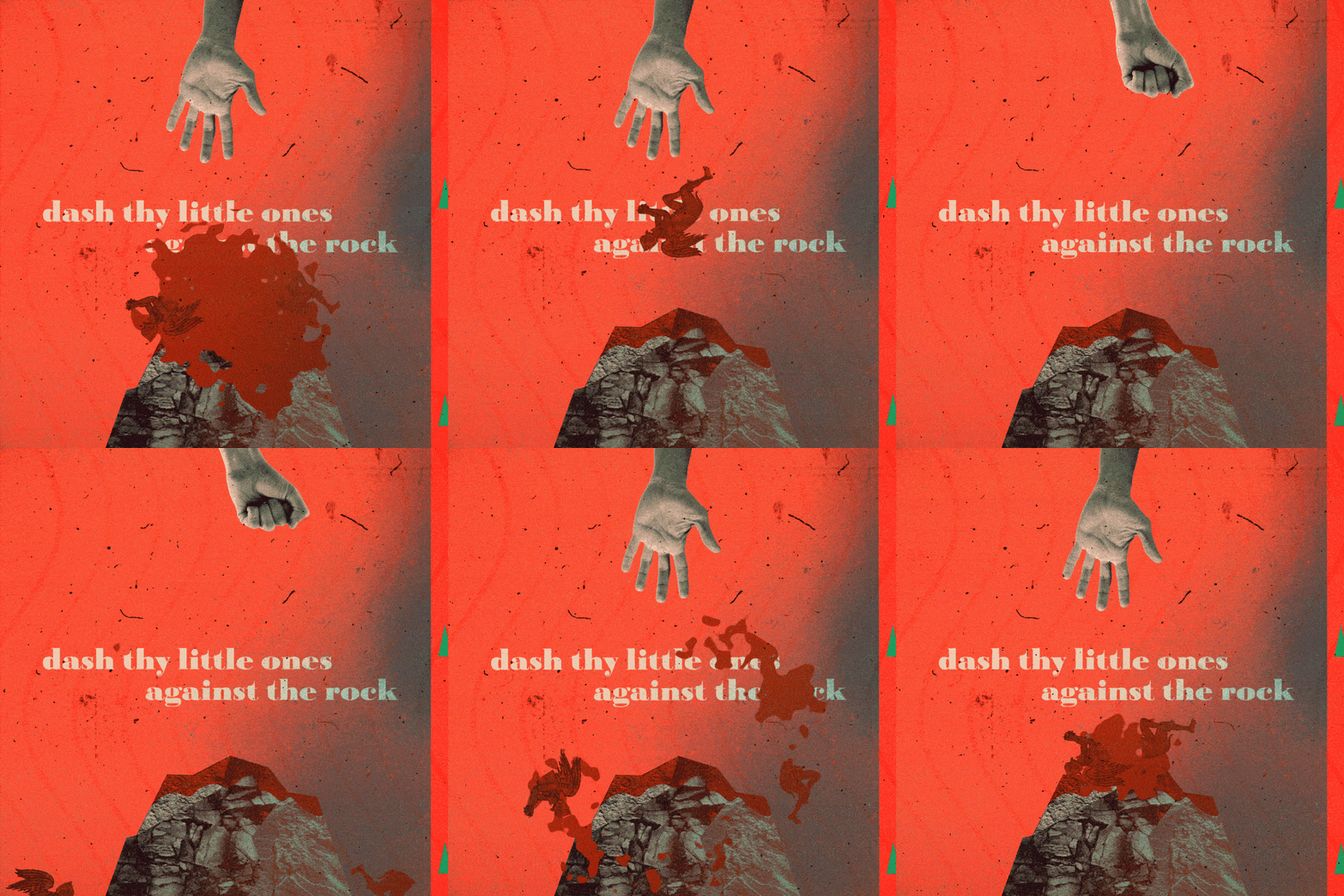
This animation was pretty straightforward, and I knew I wanted to build off of St. Augustine’s spiritual reading of this verse.
I found a couple images of a hand that were from the same shoot, and so I cut them out in Photoshop. I also found an image of little devils from a medieval manuscript which I thought would be a good illustration for the “little ones” on Babylon, that is, the lusts which tempt us.
In After Effects I precomped the two hand images and animated the throwing motion in the main comp. Then in the precomp I simply switched the images on or off at the appropriate time. I then animated the little devil being flung towards the rock.
For the blood spatter I simply animated a circle growing larger and then applied the Roughen Edges effect and animated some of the parameters to get the dispersion.
Enjoy.
Blessed be he that shall take and dash thy little ones against the rock.
(Psalm 136:9 DR)
View a higher quality version of this gif here: