

Psalm 137:4
corruptio optimi pessima
May all the kings of the earth give glory to thee: for they have heard all the words of thy mouth. (Psalm 137:4 DR)
Of all the vices to which man is tempted, pride is perhaps fittingly the preeminent one, a source of all others. Pride is that vice whereby we seek to exalt ourselves above what we are—a reaching beyond our grasp, as it were. In the garden Adam and Eve were tempted to become like God in their knowledge of good and evil, the irony being, of course, that they were already like God as being made in His image and given knowledge of good and evil from Him directly through His commands to them. It is this from Him that the serpent tempted them to discard, to make themselves a law unto themselves, and the stretching forth of the hand to grasp the fruit becomes a type of the soul reaching beyond itself to grasp at what it desires:
Pride [superbia] is so called because a man thereby aims higher than he is; wherefore Isidore says (Etymologiae, X): “A man is said to be proud, because he wishes to appear above (super) what he really is”; for he who wishes to overstep beyond what he is, is proud. Now right reason requires that every man’s will should tend to that which is proportionate to him. Therefore it is evident that pride denotes something opposed to right reason, and this shows it to have the character of sin, because according to Dionysius (On the Divine Names, IV, 4), “the soul’s evil is to be opposed to reason.” (St. Thomas, ST, 2.2, Q. 162, A. 1.)
Rightly ordered reason will see itself in proper relation to God, the creature in respect to its creator, but once reason reaches beyond this proper relation and seeks to usurp this order, it lifts itself up beyond itself and falls into pride. Without the chastening of humility, this fall into pride will have the effect of increasing the pride, and the further one falls, the further one seeks to rise beyond what one is.
The fallen angel Beelzebub thus addresses Satan in Paradise Lost following their aborted attempt at a coup of Heaven:
What though the field be lost?
All is not lost; the unconquerable will,
And study of revenge, immortal hate,
And courage never to submit or yield:
And what is else not to be overcome?
That glory never shall his wrath or might
Extort from me. To bow and sue for grace
With suppliant knee, and deify his power
Who, from the terror of this arm, so late
Doubted his empire—that were low indeed;
That were an ignominy and shame beneath
This downfall; since by fate the strength of gods
And this empyreal substance cannot fail;
Since, through experience of this great event,
In arms not worse, in foresight much advanced,
We may with more successful hope resolve
To wage by force or guile eternal war,
Irreconcilable to our grand foe,
Who now triumphs, and in the excess of joy
Sole reigning holds the tyranny of Heaven. (Paradise Lost, Book 1, 105-124)
In Latin there is the well-know axiom corruptio optimi pessima, which translates to “the corruption of the best is the worst.” In English this is idiomatically expressed in the phrase “the higher they climb, the harder they fall.” The pride of man or of fallen angels takes what was a great gift of God that was given to them so as to be able to contemplate God, and turns it into a ruin of that very gift, for pride turns the contemplation from God onto the creature himself. Instead of using his intellect to rise to divine things, he tries to raise himself to divinity so as to contemplate divine things in himself, distorting the end of the intellect altogether. There is a dark irony in that what promises freedom and grandeur ends up self-limiting the intellect, for instead of contemplating the infinite in God—Who is infinite—the prideful intellect is circumscribed by a finite object, which is itself and its desires. And the further the prideful heart turns in on itself, the more constrained the horizon of its gaze.
Humility is the only antidote to pride, for it orders reason properly in its relation both to itself and to God. Lucifer was one of the highest of God’s creation yet in his pride sought to reach beyond himself and his nature, and in doing so fell into eternal ruin and became less than what he was created to be. St. Michael, on the other hand, opposed Lucifer with what became his very name—Quis ut Deus?—Who is like God? St. Michael in his humility understood that there is none like God, and that he was a servant of God whose purpose in being was to do God’s will.
In a similar manner, man as a rational creature is created to know, love and serve God, which the Psalmist has been describing thus far in this Psalm. The “I will” statements that he has made give expression to this end of man as both a creature and as a rational being.
All creatures serve God by reason of their existence; the Psalmist in Psalm 148 sets forth a litany of how creation praises the Lord, from the irrational beasts to the elements themselves.
Rational creatures, however, choose to serve God, for in their rational nature they can contemplate the world itself as creation and themselves within that creation, as well as God as Creator and their duties towards Him in worship and service. But along with intellect is will, by which rational creatures conform themselves to what their intellect perceives and to the truth of reality that they can contemplate.
Humility thus is when a rational creature understands the proper relation of himself to God and creation and then chooses to conform his mind, heart and will to that. The Psalmist thus chooses—“I will”—to confess to the Lord, to sing praise, to worship, to give glory. As was seen in the previous passage, this conformity of himself and his intellect and will to God’s law and God’s will becomes the means by which the grace of God multiplies virtue in his soul. Humility becomes a gateway to all other virtues, for humility opens up the soul to God’s grace:
But He giveth greater grace. Wherefore He saith: God resisteth the proud, and giveth grace to the humble. (James 4:6 DR)
Humility is thus an indispensable virtue for the soul that wishes to draw near to God, and this is implied as the Psalmist continues in this passage: May all the kings of the earth give glory to thee. The same praise or confession that the Psalmist has already given is thus desired and prophesied for the kings of the earth.
This is truly a staggering prophecy, for if confession and humility is the gateway to virtue, it seems difficult to imagine that the kings of the earth would come to the Lord in such a manner, as kings are generally not known for their humility. In fact, the opposite is generally the case:
But neither let them, when they confess to You, when they praise You, desire earthly things of You. For what shall the kings of the earth desire? Have they not already sovereignty? Whatever more a man desire on earth, sovereignty is the highest point of his desire. What more can he desire? It must needs be some loftier eminence. But perhaps the loftier it is, the more dangerous. And therefore the more exalted kings are in earthly eminence, the more ought they to humble themselves before God. (St. Augustine, Expositions on the Psalms, 137, 9)
Kings in the temporal sense must therefore exercise even greater humility, for on the earthly level they have already risen high above other men. There is a concomitant and proportional increase in danger from falling into pride the higher one rises in any earthly endeavor or position, for the very appetites that drive men to great things can in the end enslave them, and can open up the heart to the shackles of pride.
In this manner all men are meant to be kings, for man’s reason is intended to govern and rule over his passions and appetites. The kings who give glory to God are thus those who in humility order themselves to virtue and God’s will by cooperating with His divine gift of grace:
He comes to the second part, in which the people of the blessed pray that the kings of the earth may, in humility, confess to the Lord, because all pride is shown to be hateful to him. The kings of the earth are those who rule over their own bodies by the divine gift. For that man is not truly called a king who is shown to be a slave to vices. But when I added, “all,” it specifically designates religious and moderate men, since we see many kings of the nations either submitting to savage vices or being defiled by a false religion. (Cassiodorus, Explanation of the Psalms, 137, 5.)
The economy of grace thus overturns how this world conceives of power and glory. Men who in their pride seek after power or chase after their own desires must reach beyond what they presently have, grasping towards that primordial fruit in the garden while the ancient serpent whispers in their ears. The same temptation that caused the fall of our race is repeated in every act of pride. Everyone wants to be a king, but that appetite for glory or delight or whatever else which lies beyond oneself or within oneself only leads to a greater fall.
The kings of the earth who come to give glory to the Lord will thus be characterized by their humility of heart and the virtues that flow forth from the workings of grace that humility enables. The Psalmist links this to their hearing the words of the Lord, which is not simply hearing the words but also acting on them, just as the virtues are not abstractions to be contemplated but borne out in the works of one’s hands:
And the Gentiles shall leave their idols, and shall come into Jerusalem, and shall dwell in it. And all the kings of the earth shall rejoice in it, adoring the King of Israel. Hearken therefore, my children, to your father: serve the Lord in truth, and seek to do the things that please him: And command your children that they do justice and almsdeeds, and that they be mindful of God, and bless him at all times in truth, and with all their power. (Tobit 14:8-11 DR)
And since these kings who come to glorify the Lord are those who listen to the word of the Lord and do it, that kingdom of which the Psalmist prophesies is ultimately the Holy Catholic Church, for St. Peter speaks of how those who are in the Church are:
[A] chosen generation, a kingly priesthood, a holy nation, a purchased people: that you may declare his virtues, who hath called you out of darkness into his marvellous light: Who in time past were not a people: but are now the people of God. Who had not obtained mercy; but now have obtained mercy. (1 Peter 2:9-10 DR)
The marvelous light of God is the eternal refulgence of His glory and divinity, which those who are united to Christ have a participation in:
And that the kingdom, and power, and the greatness of the kingdom, under the whole heaven, may be given to the people of the saints of the most High: whose kingdom is an everlasting kingdom, and all kings shall serve him, and shall obey him. (Daniel 7:27 DR)
And the city hath no need of the sun, nor of the moon, to shine in it. For the glory of God hath enlightened it, and the Lamb is the lamp thereof. And the nations shall walk in the light of it: and the kings of the earth shall bring their glory and honour into it. (Apocalypse 21:23-24 DR)
The Psalmist thus fully connects the virtues which are multiplied in the humble soul with the kings who give glory to God on account of having heard and practiced the words and commands of God. Unlike the fallen angels who seethe in their pride for having God as Creator, and unlike fallen man who is ever grasping after the forbidden fruit of his desires, the humble man recognizes his nothingness before the Lord, not in a feigned humility but in reality; as our Lord said, “without Me you can do nothing.” Humility becomes the locus of grace, the gateway to the transformation of one’s heart and soul into conformity with God’s will, and in this manner paradoxically becomes—at least from the point of view of the world—the true means of greatness in man, not because he is great in himself, but because he is elevated by grace beyond natural human nature. In the view of the world this is foolishness, but “the foolishness of God is wiser than men; and the weakness of God is stronger than men.” (1 Corinthians 1:25) The lowliest soul in the eyes of the world can become—through humility—a king in the kingdom of God, giving glory to the Lord as the Psalmist prophesies, no longer a slave to his appetites and desires, which is the tragic end of all pride:
The soul that is most humble will also have the greatest courage and the most generous confidence in God; the more it distrusts itself, the more it will trust in Him on whom it relies for all its strength, saying with Saint Paul: I can do all things in Him who strengtheneth me. Saint Thomas clearly proves that true Christian humility, far from debasing the soul, is the principle of everything that is really noble and generous. He who refuses the work to which God calls him because of the honor and éclat that accompany it, is not humble but mistrustful and pusillanimous. We shall find in obedience light to show us with certainty that to which we are called and to preserve us from the illusions of self-love and of our natural inclinations. (R. P. Quadrupani, Light and Peace, Part 2, Chapter 11, 7.)
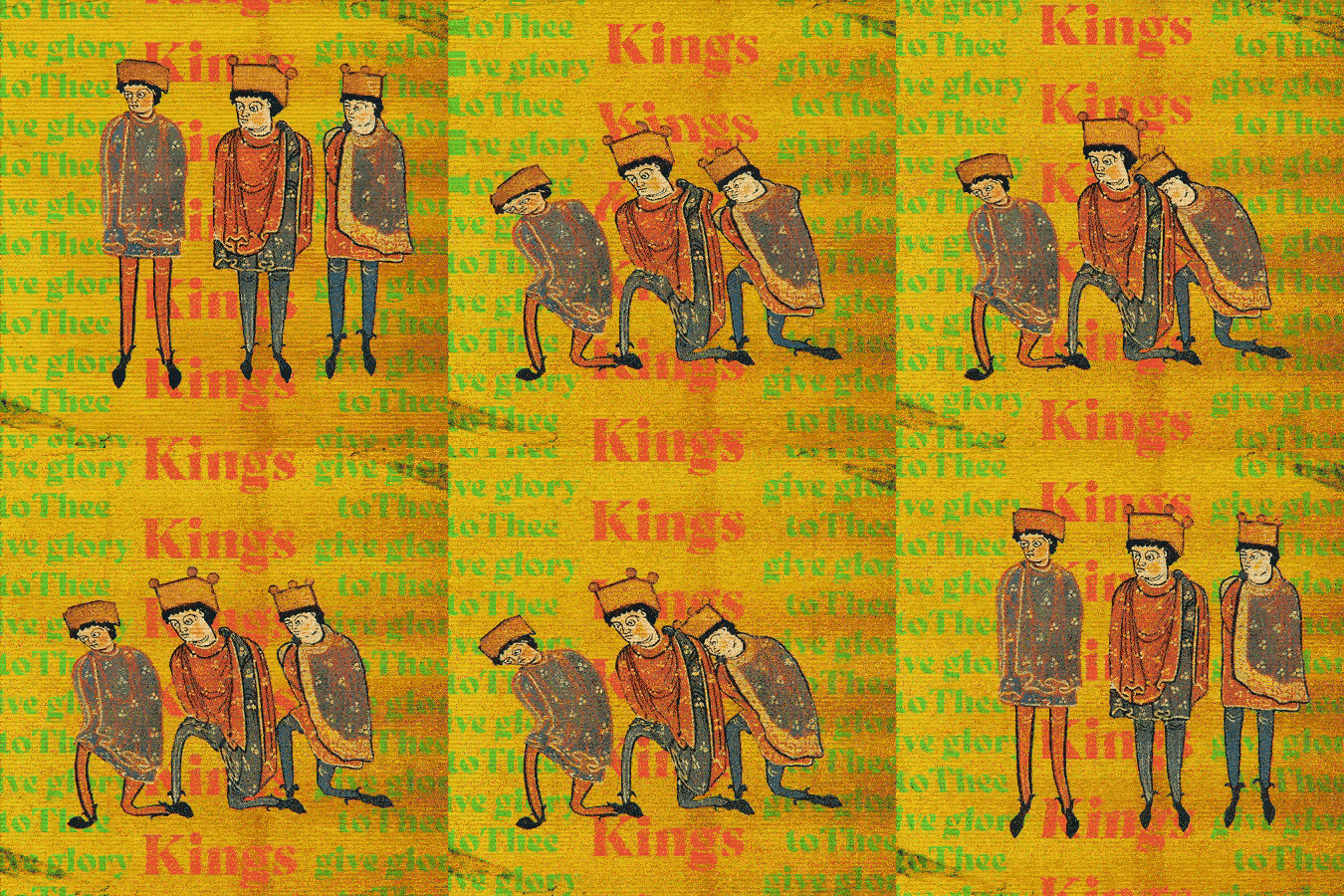
I found the “king” figures from a medieval Beatus Apocalypse, which I think are some of the most striking medieval illuminations in existence. I isolated the kings in Photoshop and precomped each one in After Effects, and then rigged them using the puppet tool and Puppet Tools 3, which is helpful in linking the Puppet Pins to Nulls, which for whatever reason After Effects doesn’t have as a built-in feature yet, even though they are far more difficult to control natively.
At any rate, after completing the rig I animated each king performing a “kneeling” action for obvious reasons related to this passage.
In the main composition I brought in these three precomps and arranged them accordingly, and then created two text precomps of “kings” and of “give glory to Thee.” I then used Motion Tile on these precomps to duplicate the text and then animated them to loop in their vertical motion.
I finally added in some textures and color correction and some glitch effects to finish off this piece.
Enjoy.
May all the kings of the earth give glory to thee: for they have heard all the words of thy mouth. (Psalm 137:4 DR)
View a higher quality version of this gif here: