

Psalm 137:8
giving up your rights
The Lord will repay for me: thy mercy, O Lord, endureth for ever: O despise not the work of thy hands. (Psalm 137:8 DR)
One of the first conversations in the book, The Great Divorce, that the narrator overhears after disembarking the bus from Hell is between a Ghost—the Big Man— and a Solid man who murdered an associate of his while he was on earth, for the murderer in the end had a conversion and now begins his journey to the mountains of heaven. In this conversation the Solid man is trying to convince the Ghost to join him, but the Ghost is obsessed with getting the “rights” due to him and cannot fathom that Heaven would send a murderer to bring him to glory:
Ghost: I never asked for anything that wasn’t mine by rights. If I wanted a drink I paid for it and if I took my wages I done my job, see? That's the sort I was and I don't care who knows it... But I got to have my rights same as you, see?
Solid Man: Oh no. It’s not so bad as that. I haven’t got my rights, or I should not be here. You will not get yours either. You'll get something far better. Never fear.
Ghost: I only want my rights. I'm not asking for anybody’s bleeding charity.
Solid Man: Then do. At once. Ask for the Bleeding Charity. Everything is here for the asking and nothing can be bought.
Ghost: Tell them I’m not coming, see? I’d rather be damned than go along with you. I came here to get my rights, see? Not to go sniveling along on charity tied onto your apron-strings. If they’re too fine to have me without you, I’ll go home.
(C.S. Lewis, The Great Divorce)
In the modern world we have been inculcated with a similar obsession about our “rights,” and this becomes so expansive that we have come to expect and demand that we have a “right” to all that we desire, that every appetite and movement of our wills must be affirmed or else we are somehow deprived of what is owed to us. Absent the “rights regime” of the modern mind is any concomitant notion of “responsibility”; we are always owed but never owe, we always must receive but need never give. And while on the one side there is the maddening mentality of entitlement, on the other is the problem of the Ghost getting off the bus from Hell, that we imagine the world as a strict system of credits and debits, never minding that the balance sheet is never in our favor, although we become experts at cooking the books. Yet pride enjoys this sort of arrangement as it precludes any need for charity in the soul and allows the self to assemble to itself all the things owed to it; after all, it’s always everyone else who is a terrible driver.
As the Psalmist concludes this fine Psalm he avoids the temptation to take matters into his own hands in the midst of his tribulation. When we suffer injustice or persecution or any sort of wrong or slight, the desire of our flesh is to—like the Ghost—assert our rights, to get our rights, to bring the balance of justice back into balance, at least as we conceive of it. In our pride we can be blinded to the fact that we often do not understand everything, or even most things, and thus our attempts at getting our “rights” only ends up drawing our souls closer to the realms of Hell. As the Solid man noted to the Ghost, in Heaven no one gets their “rights,” for, if they did, Heaven would be empty.
It is thus that the Psalmist extends his confidence even further towards God, for while he might be tempted to get his “rights” against his enemies, instead he notes that “the Lord will repay for me.” He has given up on securing justice or good or his “rights” through his own efforts, for by doing so he will become like his enemies. For what he desires is something that that he cannot acquire for himself, for it is ultimately a gift from God, rather than a reward that is owed to him:
Lord Christ, “Thou shalt repay for me.” For I, if I repay, have seized; Thou hast paid what Thou hast not seized. Lord, “Thou shalt repay for me…” He then hath repaid for us, thanks to His mercy. He owed nothing: He repaid not for Himself: He repaid for us. “Behold,” He saith, “the prince of this world cometh, and shall find nothing in Me.” What is, “shall find nothing in Me?” He shall find no sin in Me: he hath not wherefore he should put Me to death. “But that all may know,” He saith, “that I do the will of My Father: arise, let us go hence.” I suffer not of necessity, but of free-will, paying that I owe not. “Thou, Lord, shalt repay for me.” (St. Augustine, Expositions on the Psalms, 137, 16)
The debt of sin that we owe cannot be repaid by us, and thus our works cannot in themselves bring about the repayment of sin, cannot justify us apart from sanctifying grace. This truth is evidenced by the second clause of this passage, which connects the first and third clauses. The Lord will repay for me, the Psalmist says, and this repayment is guaranteed by the mercy of the Lord which endures forever. That is, the mercy of the Lord is the ground of the repayment of sin. If the Psalmist were to try and repay through his own efforts, he would—as St. Augustine notes—be trying to seize that which is not his. For the mercy and grace of God is not something owed by rights nor as a reward but is gratuitous, flowing forth from the ineffable and fathomless charity that binds the Blessed Trinity in eternal unity. Thus when our Lord takes upon Himself our nature and suffers so as to repay, He does not seize what is not His but rather lays hold of it as it flows forth from His very Being, the Godhead of which He is consubstantial with the Father and the Holy Ghost. He unites, as it were, both creditor and debtor in Himself, repaying that which He did not owe, His sacrifice of love through the outpouring of His life as infinitely greater than the debt to be paid.
This mercy of the Lord which “endureth for ever” and which “repays for me” culminates in the sanctification of man who is brought into union with Christ through Baptism into His Holy Catholic Church. The Psalmist concludes with a prayer that God would not despise “the work of Thy hands,” which points to himself as united to Christ in the unity of the Holy Ghost through charity, but also to the ground of that union, the self-same charity of God dwelling in his soul. The Psalmist’s confidence is not in himself and his own efforts or goodness, but rather in the operation of God’s grace in his soul, that charity which transforms him, transferring him from the kingdom of darkness into the kingdom of light, the merits wrought by God crowning the very gifts that He freely gives:
“Despise not Thou the works of Thine own hands.” I say not, Lord, “despise not the works of my hands:” of mine own works I boast not. “I sought,” indeed, “the Lord with my hands in the night season before Him, and have not been deceived;” but yet I praise not the works of mine own hands; I fear lest, when Thou shalt look into them, Thou find more sins in them than deserts. This only I ask, this I long to obtain, “Despise not Thou the works of Thine own hands.”
Behold in me Thy Work, not mine: for mine, if Thou seest, Thou condemnest; Thine, if Thou seest, Thou crownest. For whatever good works there be of mine, from Thee are they to me; and so they are more Thine than mine. For I hear from Thine Apostle, “By grace are ye saved through faith, and that not of yourselves, it is the gift of God; not of works, lest any man should boast: for we are His workmanship, created in Christ Jesus unto good works.” Therefore whether in regard that we are men, or in regard that we have been changed and justified from our iniquity, Lord, “despise not Thou the works of Thine own hands.” (St. Augustine, Expositions on the Psalms, 137, 17)
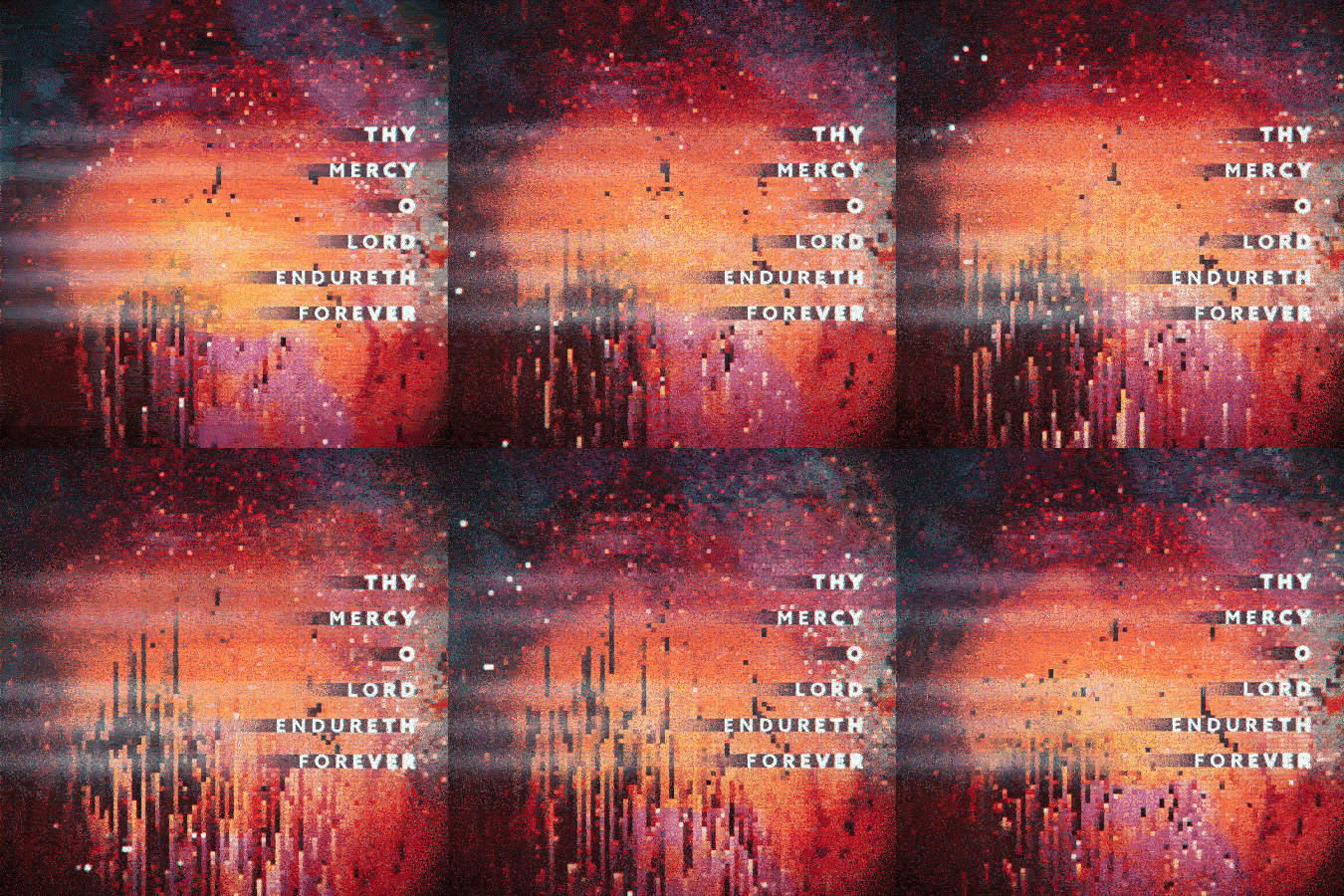
I grabbed a sunset image of some sort and applied Pixel Sorter Studio to it, animating the cycle parameter to have the pixels move. I then applied the CC Ball Action effect to create the pseudo-mosaic look. I added in some color correction, soft edges and Shadow Studio on the text to finalize.
Enjoy.
The Lord will repay for me: thy mercy, O Lord, endureth for ever: O despise not the work of thy hands.
(Psalm 137:8)
View a higher quality version of this gif here: