

Psalm 140:10
i'm learning to be alone
The wicked shall fall in his net: I am alone until I pass. (Psalm 140:10 DR)
In this concluding verse the Psalmist recognizes that the persecutions he faces from others—those who would fatten his head with oil—will eventually be the snares into which they fall. Elsewhere the Psalmist expresses his thanks for deliverance:
For he hath delivered me from the snare of the hunters: and from the sharp word. (Psalm 90:3 DR)
St. Robert Bellarmine deftly notes that those who hunt after the just do not realize that they are also hunted:
“The wicked,” all those who take pleasure in sin, that is, who are at present, and wish to remain, sinners, “shall fall in his net,” in the net of the archhunter, the devil… (St. Robert Bellarmine, A Commentary on the Book of the Psalms, 140, 10.)
But a “hatred of sin” (ibid.) is the cause of the Psalmist’s escape, for “thou hast upheld me by reason of my innocence” (Psalm 41:12 DR). By placing himself in God’s will and desiring what God desires and hating what he hates, his steps are secure even with snares and stumbling-blocks surrounding him (cf. Psalm 140:9, Psalm 90:7).
There is a further significance in his safety, which is that he is alone until he passes. By this is understood that he rejects the things and desires of this world from whence these temptations arise. This will, naturally, place him in a position of solitude, for most of the world gladly chases after them. Conflict is a natural consequence, for even if the righteous man is silent, his refusal to participate in the things of this world is a condemnation of their actions:
He is grievous unto us, even to behold: for his life is not like other men's, and his ways are very different. We are esteemed by him as triflers, and he abstaineth from our ways as from filthiness, and he preferreth the latter end of the just, and glorieth that he hath God for his father. (Wisdom 2:15-16 DR)
The upshot is that the righteous might try their best to live a quiet life, but a life of virtue which sincerely aims to reject and resist temptation will inevitably raise the ire of the world. In our present time this is perhaps even more vividly felt as the simple refusal to perform certain acts or to affirm certain things is decried as bigotry, hatred and all of the many forms of mindless slander meant to dull the pangs of conscience of those who hurl them. As the Scriptures go on to say:
Let us see then if his words be true, and let us prove what shall happen to him, and we shall know what his end shall be. For if he be the true son of God, he will defend him, and will deliver him from the hands of his enemies. Let us examine him by outrages and tortures, that we may know his meekness and try his patience. Let us condemn him to a most shameful death: for there shall be respect had unto him by his words. Wisdom 2:17-20 DR)
This prophetic import is, according to St. Augustine, present in this final verse of Psalm 140, for the Psalmist stating that he is alone until I pass is a reference to the Passover, itself typological of the Pascha of the Christ:
We hear then of Pascha in this verse, “I am alone, until I pass over.” After Pascha I shall no longer be alone, after passing-over I shall no longer be alone. Many shall imitate Me, many shall follow Me. And if afterward they shall follow, what shall be the case now? “I am alone, until I pass over.” What is it that the Lord says in this Psalm, “I am alone, until I pass over?” What is it that we have expounded? If we have understood it, listen to His own words in the Gospel. “Except a grain of wheat fall into the ground and die, it abides alone; but if it die, it bears much fruit.” (St. Augustine, Expositions on the Psalms, 140, 14.)
The Psalmist thus prophetically speaks of Christ’s Passion and Resurrection by which he defeats death and sin. The power to resist and overcome the temptations mentioned in this Psalm comes from this very act of our Lord and is the promissory note, as it were, of our following in his footsteps. He was alone in defeating sin, but by giving of His life on the cross and thus of Himself to us in the sacraments were are like the wheat which the solitary seed brings forth. His Passover becomes our passing over sin until we arrive at home country forever:
Though I may be kept an exile for a time in this world, I will not belong to it. “I am alone,” until I shall have passed to my country, where I shall have no shares or stumbling blocks to encounter. (St. Robert Bellarmine, A Commentary on the Book of the Psalms, 140, 10.)
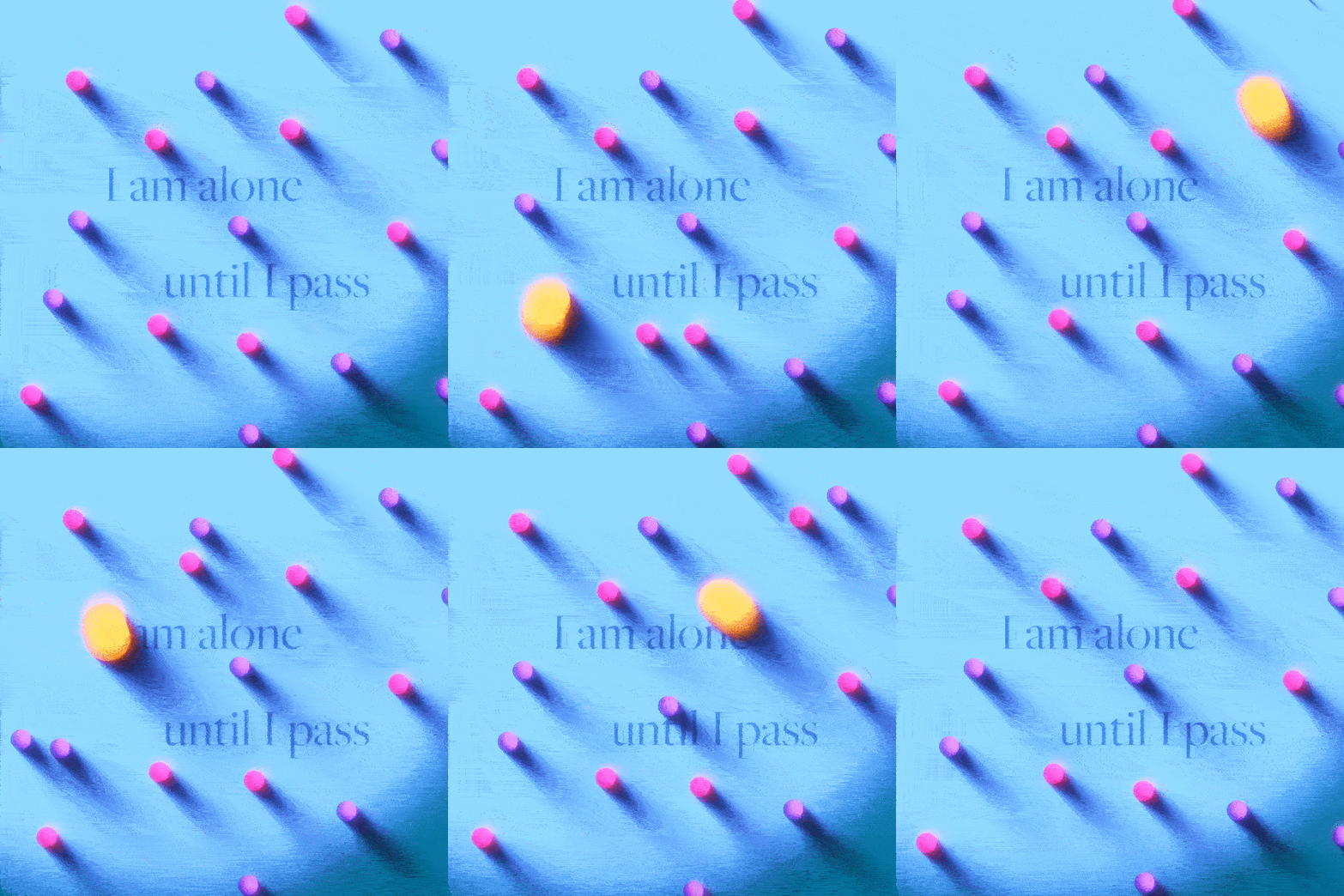
This animation was almost entirely expression-driven.
It’s too complex to describe here, but essentially it is set up so that each of the pink circles calculates the pixel distance to the yellow circle, and if the yellow circle gets to within a certain pixel range it causes the pink circles to move to maintain the minimum specified distance. Once that threshold is returned the expression has the circle return to its original position.
I also placed some looping wiggle on the position of the pink circles to keep them always moving about. After getting everything set up it was just a matter of animating the yellow circle in an interesting manner. I would like in the future to figure out if there can be a gradation of the threshold, rather than just was is practically a forcefield, so that the repelling gradually happens rather than just on/off.
A few more tests.
Enjoy.
The wicked shall fall in his net: I am alone until I pass.
(Psalm 140:10 DR)
View a higher quality version of this gif here: