

Psalm 140:3
how to silence a screaming cat
Set a watch, O Lord, before my mouth: and a door round about my lips. (Psalm 140:3 DR)
The greatest strength of our race is that we are always judicious with our words and never say things we don’t intend or later regret. Of course, anyone reading that past sentence would be inclined to think I am either being facetious or have just suffered a stroke. The former is true, the later is njjsdyhfsdkyhnnkdj.
In fact, the tongue is one of our deadliest weapons, and we tend to wield it rather freely. Whether up close and personal like an assassin with a knife or from the shadows with a well-place shuriken, we use words to overthrow and to kill. And then, from time to time—if it’s convenient—we will sometimes be nice, if for no other reason than variety is the spice of life. Although sometimes even our praise is like scorpion pepper salt on un-sauced pasta (which, incidentally, is pretty amazing…).
St. James points out the obvious, that we generally have the most trouble controlling our tongues. In fact, such is the difficulty in taming the tongue that if one can do that, every other vice of the flesh is relatively easy to overcome:
For in many things we all offend. If any man offend not in word, the same is a perfect man. He is able also with a bridle to lead about the whole body. (James 3:2 DR)
He also speaks of the tongue as being set on fire by hell itself (James 3:4) and “an unquiet evil, full of deadly poison.” (James 3:8 DR) But the greatest disjunction lies in the potential of the tongue for good or for evil, for “[b]y it we bless God and the Father: and by it we curse men, who are made after the likeness of God” (James 3:9 DR).
The reason this elicits such reprobation lies in the relation of “word” to our minds. For the external word that we speak proceeds firstly from an internal word, the thoughts and conceptions that our words give expression to. Our intellects are fashioned in some manner in God’s image and likeness (cf. James 3:9). Thus, our words are to some extent an outflowing of that image of God, which we either magnify with words consonant with that or which disfigure it.
What makes the external word so important lies in our embodied nature. We can of course act internally, such as willingly thinking of something, but in a sense our internal word is only brought to completion when it becomes external in word or act. I can intend charity towards someone all I want, but if it is never externalized in word or deed then it is never perfected as an act. That external word becomes the expression of the internal word. This is why St. James notes the extreme disjunction of wielding the tongue in such an inconsistent manner:
Out of the same mouth proceedeth blessing and cursing. My brethren, these things ought not so to be. Doth a fountain send forth, out of the same hole, sweet and bitter water? Can the fig tree, my brethren, bear grapes; or the vine, figs? So neither can the salt water yield sweet. (James 3:10-12 DR)
The Psalmist understands the danger of the tongue and the way in which the mouth can offend, and thus prays for a guard to be placed before his mouth, and a door about his lips. The figures used here are fascinating and hold a deeper significance than may appear at first blush.
St. Robert Bellarmine sees in this figure the Psalmist uses the means to purify the tongue and use it in justice. He notes that the image of the guard/porter implies that there is a time to open the door and time to keep it closed. And to have a door of any kind which allows entrance or exit requires someone to open it:
Two things are necessary to ensure freedom of exit to those entitled to it, and detention to those not entitled to it; and the two things are, gates, and a porter to stand by the gates; for a gate without a porter will not suffice, for it must, of necessity, in such case, be always shut or always open; nor will a porter without a gate do the business, unless he keep guard at all hours and be strong enough to prevent any forcible ingress or egress; but with a gate and a porter all is right and safe. (St. Robert Bellarmine, A Commentary on the Book of the Psalms, 140, 3.)
These two things (i.e., porter and gate) are, he argues, two gifts of the Holy Ghost:
The porter and the gate signify two gifts of the Holy Ghost, one pertaining to the understanding, that man may know when, how, and what to say, or to do; and the other having reference to the will; that is to say, that one should have the courage to speak when they ought to speak, and fear to speak when they should be silent; these are the gifts which Isaias calls “the spirit of counsel and fortitude,” which are nearly identical with prudence and charity. (ibid.)
Growth in virtue is thus indelibly linked with being able to control the tongue. It is important to see that it is not merely not speaking ill words that is in view—that is, sins of commission—but also speaking good or true words when they are necessary, the failure of which is a sin of omission. Given St. James’s admonition we are generally safest in defaulting to restraining our tongues, for: “In the multitude of words there shall not want sin: but he that refraineth his lips is most wise.” (Proverbs 10:19 DR) But as we grow in prudence and self-control we learn when to speak and how to choose our words with discretion and judiciousness, for there is “a time to keep silence, and a time to speak” (Ecclesiastes 3:7 DR).
In the end we are reliant on God’s grace to help us extinguish the flames of hell in our tongues and can only ask for help to cooperate with his grace while striving as we are able to use our tongues wisely:
Now, we are not to ask these gifts of God without doing all in us lies to cooperate with his grace, at the same time that we are also to bear in mind that such cooperation is also a gift from God; and, therefore, that we should glory in nothing, when, in point of fact, we have nothing. (St. Robert Bellarmine, A Commentary on the Book of the Psalms, 140, 3.)
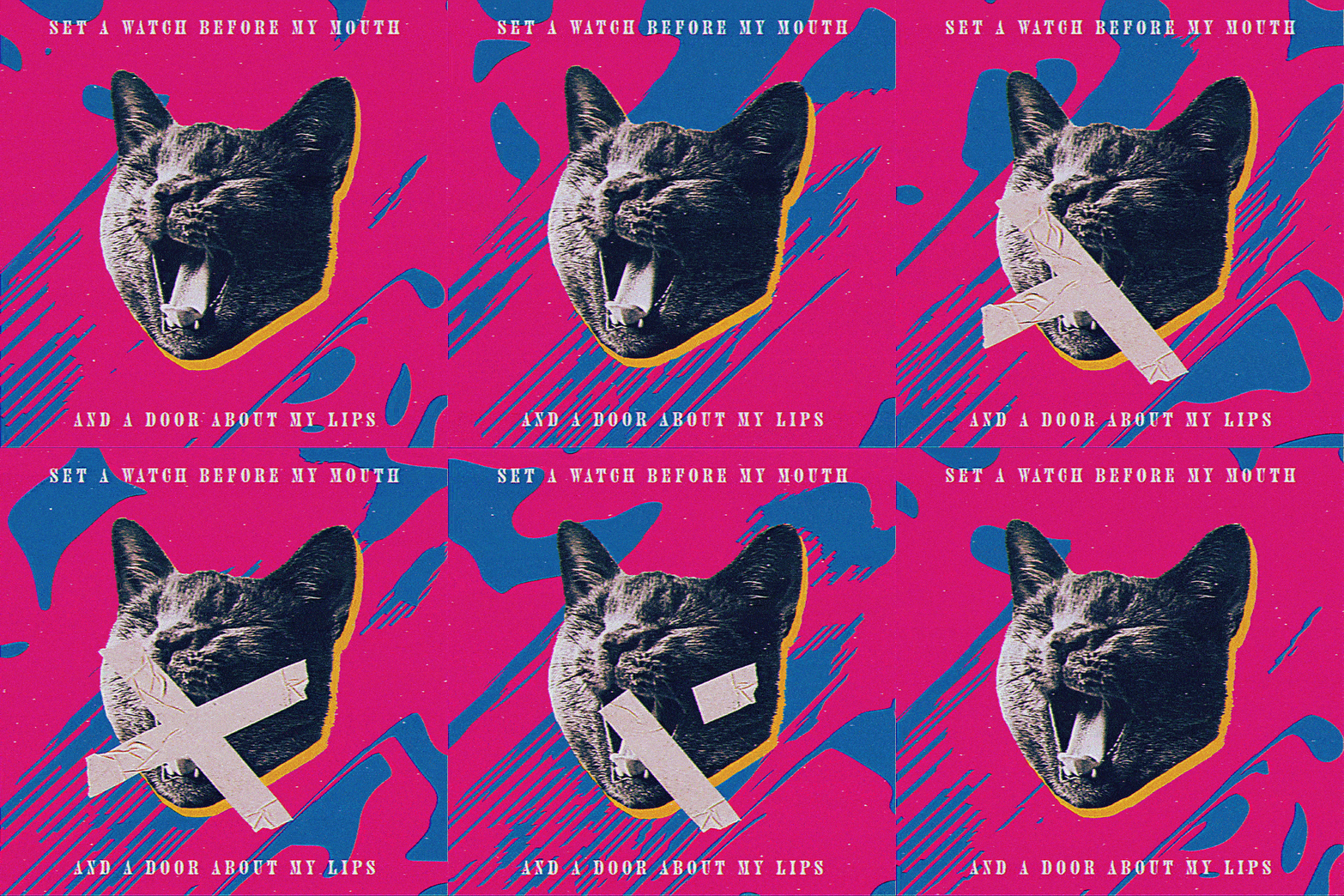
I’m not sure why the idea of this animation is what it is, but for some reason I had the idea of a screaming cat in my head as I was thinking about this verse. I did some searching for a good image and found this one, which I thought was perfect.
I cut out the head in Photoshop and brought it into After Effects. I applied a Wiggle Hold expression to both the Position and Rotation to give it some random movement, upping that of the Rotation to make it a bit more frenetic. I then duplicated the layer (which helpfully randomizes the Wiggle expression seeds) and placed it below the original and added a solid color fill so it could act as a Drop Shadow of sorts.
I brought in some nice masking tape pieces and animated some masks on them to reveal them on and hide them for the loop. I then placed a background in and applied some fractal noise to get the blotchy background. I also added some slight pixel sorting to glitch it up a bit and finally added some color correction and an effect to make it feel a bit like old analogue TV signals.
All in all it has a very 90’s vibe which I kind of like.
And who doesn’t like a screaming cat? Or at least shutting up a screaming cat?
Enjoy.
Set a watch, O Lord, before my mouth: and a door round about my lips.:
(Psalm 140:3 DR)
View a higher quality version of this gif here: