

Psalm 15:10
wake up o sleeper

Because thou wilt not leave my soul in hell; nor wilt then give thy holy one to see corruption. (Psalm 15:10 DR)
Waking Up
In the Gospel of Luke chapter 24 is recounted one of Jesus’ post-resurrection appearances to His disciples. According to St. Luke, the Eleven are gathered together and Jesus appears in their midst after some disciples explain their previous encounter with Jesus with unambiguously Eucharistic imagery. After proving to them that He is flesh and blood and not simply a spirit, He says:
These are the words which I spoke to you, while I was yet with you, that all things must needs be fulfilled, which are written in the law of Moses, and in the prophets, and in the psalms, concerning me. Then he opened their understanding, that they might understand the scriptures. And he said to them: Thus it is written, and thus it behoved Christ to suffer, and to rise again from the dead, the third day: And that penance and remission of sins should be preached in his name, unto all nations, beginning at Jerusalem. (Luke 24:44-47 DR)
With the two disciples on the road to Emmaus He had done the same, explaining from the Scriptures all the things that had been written and prophesied concerning Him. Which leads the modern reader to perhaps wonder: what exactly were all these passages from the law of Moses and the prophets and the Psalms which He expounded to them and opened their understanding to? One might wish for a list or a commentary, and while perhaps not systematic, the writers of the New Testament constantly point back and link the Lord Jesus Christ to the law and the prophets and the Psalms, just as He Himself did in the Gospels. And at least from His recorded words, the most cited portion of the Old Testament from His lips was the book of Psalms.
It is thus fitting that St. Peter follows in his Master’s footsteps while giving his first sermon on the day of Pentecost, proving from the Psalms that Jesus had to rise from the dead:
Whom God hath raised up, having loosed the sorrows of hell, as it was impossible that he should be holden by it. For David saith concerning him: I foresaw the Lord before my face: because he is at my right hand, that I may not be moved. For this my heart hath been glad, and my tongue hath rejoiced: moreover my flesh also shall rest in hope. Because thou wilt not leave my soul in hell, nor suffer thy Holy One to see corruption. Thou hast made known to me the ways of life: thou shalt make me full of joy with thy countenance. Ye men, brethren, let me freely speak to you of the patriarch David; that he died, and was buried; and his sepulchre is with us to this present day. Whereas therefore he was a prophet, and knew that God hath sworn to him with an oath, that of the fruit of his loins one should sit upon his throne. Foreseeing this, he spoke of the resurrection of Christ. For neither was he left in hell, neither did his flesh see corruption. (Acts 2:24-31 DR)
St. Peter makes the point here that David speaks prophetically, both because God had sworn to him that his heir would sit upon the throne in this Messianic fulfillment—which is, incidentally, also prophesied in the Psalms—but also because of the obvious fact that David had died and was buried; everyone knew where his tomb was. Thus, on the literal level the Psalm could not be about David himself but had to be forward looking, prophetic of the fruit of his loins which was to come. The language the Psalmist uses, as St. Peter makes clear, is of death, that the prophesied Messiah will truly die but will not bear the corruption of death:
But the Jews do not expect that the Christ whom they expect will die; therefore they do not think ours to be Him whom the law and the prophets announced, but feign to themselves I know not whom of their own, exempt from the suffering of death. Therefore, with wonderful emptiness and blindness, they contend that the words we have set down signify, not death and resurrection, but sleep and awaking again. But the 15th Psalm also cries to them, Therefore my heart is jocund, and my tongue has exulted; moreover, my flesh also shall rest in hope: for You will not leave my soul in hell; neither will You give Your Holy One to see corruption. Who but He that rose again the third day could say his flesh had rested in this hope; that His soul, not being left in hell, but speedily returning to it, should revive it, that it should not be corrupted as corpses are wont to be, which they can in no wise say of David the prophet and king? (St. Augustine, City of God, Book 17, Chapter 18)
There is perhaps an irony here, for the sense of sleep as a euphemism for death will be taken up by the early Christians, for, after the Resurrection, the power of death is broken forever, and for those united to Christ in this hope, death is more like unto sleep than corruption, for while the body will decay, it will be raised again unto incorruption:
Behold, I tell you a mystery. We shall all indeed rise again: but we shall not all be changed. In a moment, in the twinkling of an eye, at the last trumpet: for the trumpet shall sound, and the dead shall rise again incorruptible: and we shall be changed. For this corruptible must put on incorruption; and this mortal must put on immortality. And when this mortal hath put on immortality, then shall come to pass the saying that is written: Death is swallowed up in victory. (1 Corinthians 15:51-54 DR)
Prophetic Awakening
In a previous passage the sense of foreseeing the Lord always in his sight or before his face takes on new significance, as David as prophet sees through Christ’s eyes, as it were, sees that his descendent according to the flesh will be greater than him, will be the One Whom death will not conquer. St. Peter will go on to preach that David sees this union of God and Man in the Lord Jesus Christ:
For David ascended not into heaven; but he himself said: The Lord said to my Lord, sit thou on my right hand, until I make thy enemies thy footstool. (Acts 2:34-35 DR)
Jesus, in the weakness of the assumed human nature, is nevertheless divine in His Personhood as the Incarnate Word, which vouchsafes His soul to not be left in hell, nor his body to see corruption:
So at this place, too, Christ the Lord in human fashion says, “Constantly supported by the divine nature, I am in the midst of my saving passion and find gladness in the hope of resurrection. My soul, you see, will not be abandoned in Hades, nor will my flesh suffer natural corruption: I shall achieve a rapid resurrection and return to life, giving all people a glimpse of this path.” (Theodoret of Cyrus, Commentary on the Psalms, 15, 7)
The prophetic witness of the Resurrection as prophesied in this passage also safeguards the integrity of the hypostatic union, for Christ in assuming human nature assumes all that is proper to human nature, not merely the flesh of human nature but also a human soul. He thus truly experiences the severing of the union of body and soul in death, for his body remains in the tomb while His soul descends to Hades:
Because thou wilt not leave my soul in hell: nor wilt thou give thy holy one to see corruption. Where are the misguided Apollinarians who say that the Lord Christ had not a rational soul? See how He himself cries out and gives thanks to the Father because His soul is not in the usual way left abandoned in hell, but is glorified by swift resurrection, and has passed to the kingdom of heaven. This is attested in the gospel in various passages: “My soul is sorrowful even unto death,” and elsewhere: “I have the power of laying down my life and of taking it up again.” You must not think that this is to be accepted complacently, because you find in Psalm 29 what seems to be the opposite view: “What profit is there in my blood, whilst I go down to corruption?” The objection is resolved by this reasoning: in that passage He says that He goes down to corruption when pierced by the impact of the impressed nails and lance, for transfixion of solid flesh is reasonably accounted corruption. But in the present passage He says justly that the corruption of putrefaction which ravages the generality of human flesh does not take place, for when on the third day it happened that His flesh was given fresh life, it was demonstrated that it could not have suffered corruption. (Cassiodorus, Explanation of the Psalms, 15, 10)
The Triumph
As David prophetically foresees God always in his sight through the eyes of Christ, he foresees this defeat of death for both body and soul. In western medieval and modern Easter-related imagery there is often a focus on the body of Jesus, in that we often see Him rising triumphantly from the sepulchre. Yet another powerful image common in iconography is that of Christ in hell, in Hades, rescuing the spirits held captive. One of the most famous is that of the Anastasis, of the Harrowing of Hell, in which the soul of Christ stands upon the broken gates of death and is literally dragging Adam and Eve out of their graves.
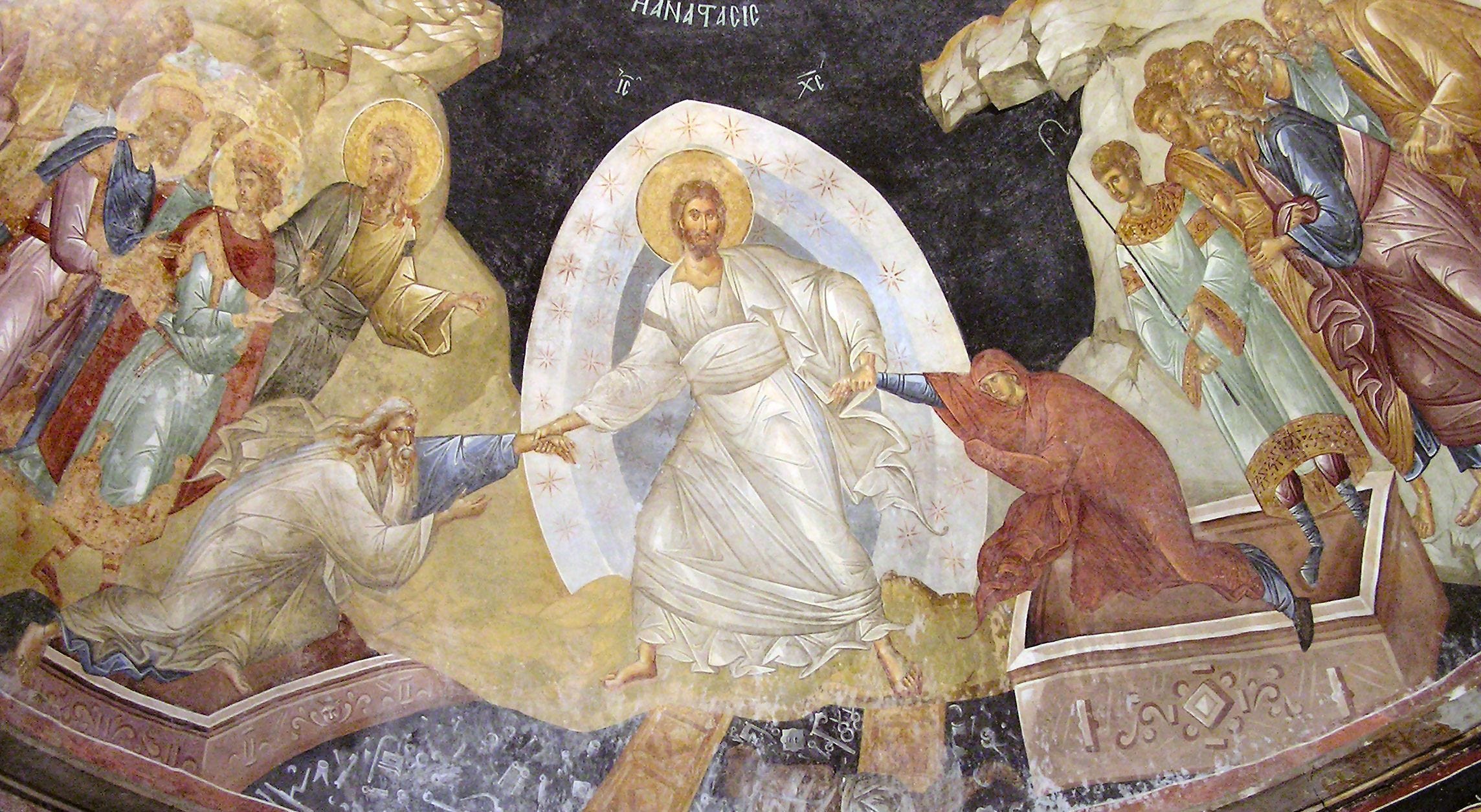
David speaks of this event in the negative sense—Thou wilt not leave my soul in hell. The Vulgate has non derelinques animam meam in inferno, the term derelinques translating the Greek ἐγκαταλείψεις (egkataleipseis), both of which mean to forsake, abandon, leave behind. However, Christ’s soul is not abandoned in hell because it is united to the Divine Word, and thus Jesus’ soul enters into the realm of the dead as a conquerer, as the Anastasis imagery depicts.
David sees obscurely a great mystery, the mystery of the Incarnation in which the certainty of the freedom from hell and the resurrection of the body are assured because they are united hypostatically to the Divine Word. Previously he said that he set the Lord always in my sight, for he is at my right hand, that I be not moved. It is this sight of our Lord in which the human nature is always united to the Divine nature which ensures that His soul will not be given to see corruption. Death has no room, so to speak, to claim Him, for the vision of God is ever before Him, ever present in Him precisely because He assumed our nature. Even in the throes of suffering and death that divine vision was before His sight, and thus our Lord freely and willingly gives up His soul unto His Father, speaking yet again the prophetic words of the Psalmist: Father, into Thy hands I commend My spirit.
Easter in View
The pain and desolation of the cross conceal within it the promise and reality of Easter, for in submitting Himself to death our Lord Jesus Christ defeated it forever. His body did not lie in the tomb subject to the decay and corruption of time, but reposed in hope of the resurrection. In the same manner His soul did not descend to hell into captivity to death but entered it united to the Divine Word to break down its gates, to loose the bonds of those held in captivity, to break the power of death and hell forever:
What is happening? Today there is a great silence over the earth, a great silence, and stillness, a great silence because the King sleeps; the earth was in terror and was still, because God slept in the flesh and raised up those who were sleeping from the ages. God has died in the flesh, and the underworld has trembled.
Truly he goes to seek out our first parent like a lost sheep; he wishes to visit those who sit in darkness and in the shadow of death. He goes to free the prisoner Adam and his fellow-prisoner Eve from their pains, he who is God, and Adam’s son.
The Lord goes in to them holding his victorious weapon, his cross. When Adam, the first created man, sees him, he strikes his breast in terror and calls out to all: ‘My Lord be with you all.’ And Christ in reply says to Adam: ‘And with your spirit.’ And grasping his hand he raises him up, saying: ‘Awake, O sleeper, and arise from the dead, and Christ shall give you light.
‘I am your God, who for your sake became your son, who for you and your descendants now speak and command with authority those in prison: Come forth, and those in darkness: Have light, and those who sleep: Rise.
‘I command you: Awake, sleeper, I have not made you to be held a prisoner in the underworld. Arise from the dead; I am the life of the dead. Arise, O man, work of my hands, arise, you who were fashioned in my image. Rise, let us go hence; for you in me and I in you, together we are one undivided person.
‘For you, I your God became your son; for you, I the Master took on your form; that of slave; for you, I who am above the heavens came on earth and under the earth; for you, man, I became as a man without help, free among the dead; for you, who left a garden, I was handed over to Jews from a garden and crucified in a garden.
‘Look at the spittle on my face, which I received because of you, in order to restore you to that first divine inbreathing at creation. See the blows on my cheeks, which I accepted in order to refashion your distorted form to my own image.
‘See the scourging of my back, which I accepted in order to disperse the load of your sins which was laid upon your back. See my hands nailed to the tree for a good purpose, for you, who stretched out your hand to the tree for an evil one.
‘I slept on the cross and a sword pierced my side, for you, who slept in paradise and brought forth Eve from your side. My side healed the pain of your side; my sleep will release you from your sleep in Hades; my sword has checked the sword which was turned against you.
‘But arise, let us go hence. The enemy brought you out of the land of paradise; I will reinstate you, no longer in paradise, but on the throne of heaven. I denied you the tree of life, which was a figure, but now I myself am united to you, I who am life. I posted the cherubim to guard you as they would slaves; now I make the cherubim worship you as they would God.
‘The cherubim throne has been prepared, the bearers are ready and waiting, the bridal chamber is in order, the food is provided, the everlasting houses and rooms are in readiness; the treasures of good things have been opened; the kingdom of heaven has been prepared before the ages.’
(Ancient Homily for Holy Saturday)
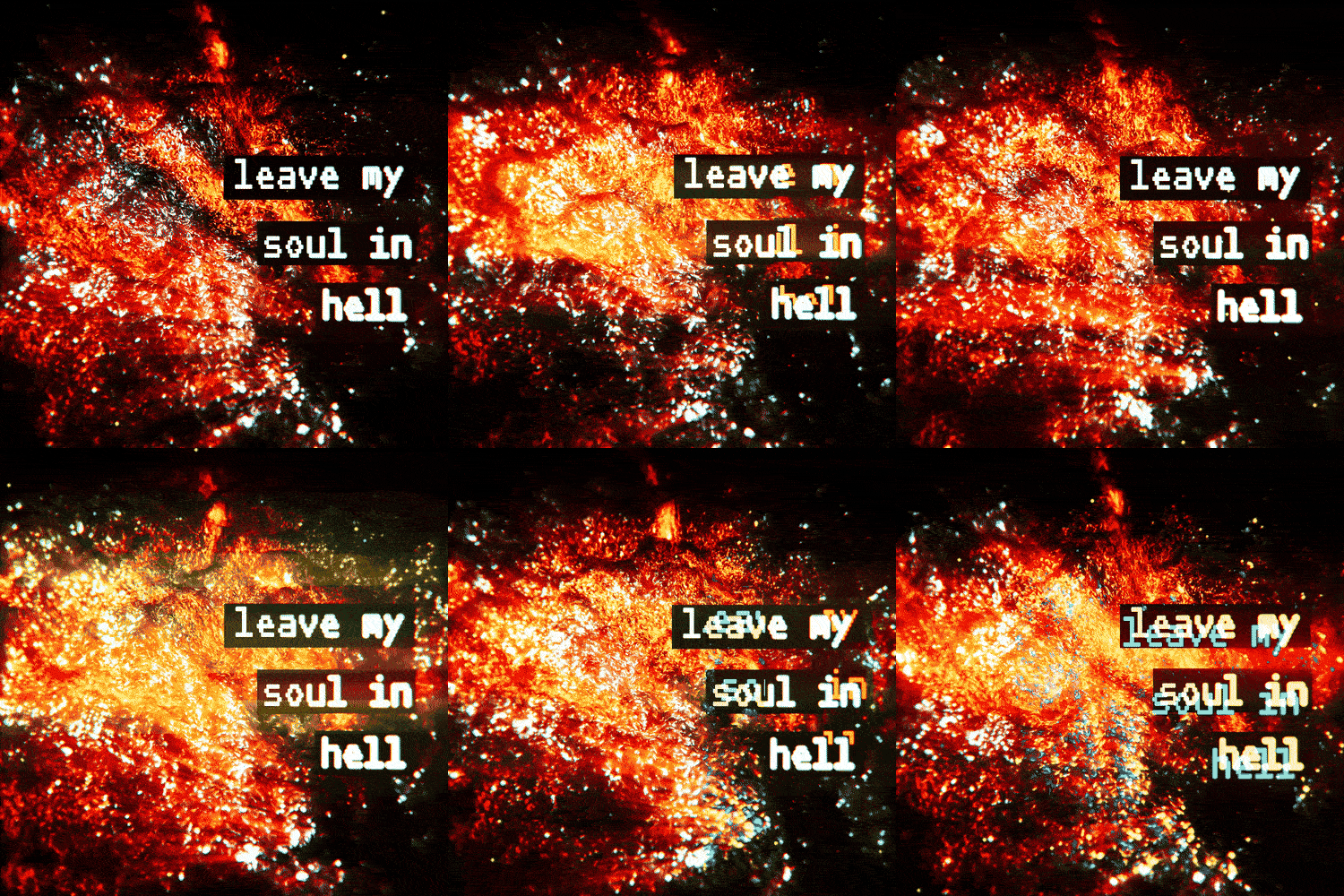
I used Trapcode Mir along with an image texture map to create the flowing, fiery background. I added in some glitch effects and glow and light rays and color correction to finalize this.
Enjoy.
Because thou wilt not leave my soul in hell; nor wilt then give thy holy one to see corruption. (Psalm 15:10 DR)
View a higher quality version of this gif here: