

Psalm 16:13
we're going to need more swords
Arise, O Lord, disappoint him and supplant him; deliver my soul from the wicked one: thy sword (Psalm 16:13 DR)
If the lions of the previous passage now surround the Psalmist’s soul, lying in wait and in ambush to destroy him, the only hope he can turn to is One stronger than the lions, to God Who can deliver his soul. In the case of David, in one instance he was in flight from King Saul whose sought after his life, who sought to destroy his soul, and David found himself surrounded, forced to hide in a cave with no path for escape, the only natural hope to lie undetected in the darkness of the depths. He likens this darkness to that of death, and in Psalm 141 describes the abandonment and helplessness that surrounds him:
Of understanding for David. A prayer when he was in the cave. I cried to the Lord with my voice: with my voice I made supplication to the Lord. In his sight I pour out my prayer, and before him I declare my trouble: When my spirit failed me, then thou knewest my paths. In this way wherein I walked, they have hidden a snare for me. I looked on my right hand, and beheld, and there was no one that would know me. Flight hath failed me: and there is no one that hath regard to my soul. (Psalm 141:1-5 DR)
His enemies actually do have some regard for his soul, but not for its good; they wish to utterly destroy him. The Psalmist speaks of how they hide a snare for him in the paths he walks, which harkens to the lions who now surround him in ambush.
It is is from this need and seeming hopelessness that he now cries to the Lord: Arise, O Lord, disappoint him and supplant him. The Latin phrase used here is exsurge Domine, which is often used in the Psalms in response to the Psalmist complaining of the wicked who surround him or the troubles which encompass him. In Psalm 9 it is used twice:
Exsurge, Domine; non confortetur homo: judicentur gentes in conspectu tuo.
Arise, O Lord, let not man be strengthened: let the Gentiles be judged in thy sight. (Psalm 9:20 DR)
Exsurge, Domine Deus, exaltetur manus tua; ne obliviscaris pauperum.
Arise, O Lord God, let thy hand be exalted: forget not the poor. (Psalm 9:33 DR)
The picture presented by exsurge is of someone who is presently sitting or lying down or sleeping, imploring him to arise or get up so that the requested action can be performed. In this sense God can seem to men to be sleeping when evil is allowed to occur and when the righteous are permitted to suffer those evils. Thus the Psalmist cries exsurge, that God will arise and show forth His power and salvation and disappoint the machinations of his enemies:
Having explained the malice of his enemies, he asks of God, who alone can do it, to come and free him. “Arise, O Lord;” do not defer your help any longer, “disappoint him;” that wicked man, who like a lion laid hold on me to devour me, disappoint his teeth, that he may not fasten them in me and kill me. And, in fact, it is God alone that can “disappoint” the action of any one or thing, however violent; as he disappointed the teeth of the lions from hurting Daniel, and the fury of the fire from consuming the three thrown into the furnace; a source of consolation to the just, who know God’s power to be equal to protect them from either the teeth of the lion or the flames of the furnace. (St. Robert Bellarmine, A Commentary on the Book of the Psalms, 16, 13)
The Psalmist thus recognizes that only God can arise and have mercy on him, can arise and disappoint the hunger of the lions who are ravening after his soul to destroy it. In Psalm 141 he speaks of how he looked all around and there was no one to help him, and no one that had regard to his soul. That is, there is no earthly help coming, no power of man that can deliver him. Only a supernatural intervention can assist, that God may show forth his power, that He alone has regard for the Psalmist’s soul:
“Arise, O Lord, prevent them, and cast them down.” Arise, O Lord, Thou whom they suppose to be asleep, and regardless of men’s iniquities; be they blinded before by their own malice, that vengeance may prevent their deed; and so cast them down. (St. Augustine, Expositions on the Psalms, 16, 12)
The prevention of their deeds comes from the phrase praeveni eum, which the Douay-Rheims renders as disappoint, but which can be translated as prevent in both the archaic sense of to come before or in the more modern figurative sense of interrupt or keep from happening. God’s assistance thus precedes the machinations of the wicked, such that even their intentions against the Psalmist are not outside of the scope of God’s providence, and the Psalmist hopes in the Lord that He will frustrate the designs of the wicked against His soul. God will thus supplant or overthrow them, as the Old Latin has it—subverte eos—meaning to cast down, overthrow, overturn. Lucretius applies this poetically to the overthrow of kings:
And therefore kings were slain,
And pristine majesty of golden thrones
And haughty sceptres lay o’erturned (subversa) in dust;
And crowns, so splendid on the sovereign heads,
Soon bloody under the proletarian feet,
Groaned for their glories gone—for erst o’er-much
Dreaded, thereafter with more greedy zest
Trampled beneath the rabble heel. (Lucretius, De Rerum Natura, 5.1136)
Cassiodorus extends this by analogy to the action of God which not only prevents the wicked from carrying out their evil deeds, but also to the work of grace within the soul that overthrows the tyranny of sin within the righteous:
Disappoint, that is, so that they can be overthrown before they can perpetrate their sins. In earlier Psalms I have demonstrated that this meaning is well suited to the wicked when they are not permitted to involve themselves in unlawful pursuits. They too are happily overthrown who are brought back to the right path from debased vices. (Cassiodorus, Explanation of the Psalms, 16, 13.)
The wicked who refuse to be converted are disappointed and supplanted, and have their own wickedness come back upon them, for while they believe themselves to be hurting the the just whom they persecute, in reality they are only harming their own souls, for the Psalmist says that those who love iniquity hate their own souls (cf. Psalm 10:6).
We are thus left morally with two options.
We can allow the sin and concupiscence within our souls to be overthrown or supplanted by God’s grace, to allow His charity within our souls as poured out by the Holy Ghost in baptism to crowd out—as it were—our vices and evil desires, to go before us in our actions so as to disappoint or prevent the lusts of the flesh from having dominion over us in our intents and actions.
Or we can be ourselves overthrown by those same sins, deceived by our own desires in that we think the satiation of our appetites and sinful inclinations is a win for us, when in fact it becomes the fire and brimstone and storms of winds in the cup of vengeance that we will drink (cf. Psalm 10:7), the reward for those that love iniquity:
But the wicked shall be punished according to their own devices: who have neglected the just, and have revolted from the Lord. For he that rejecteth wisdom, and discipline, is unhappy: and their hope is vain, and their labours without fruit, and their works unprofitable…
For dreadful are the ends of a wicked race. (Wisdom 3:10-11, 19 DR)
The second part of this exsurge or arising on God’s part is that He will deliver the Psalmist’s soul, His sword. There is slight a difference in the reading of this final clause thy sword, as some commentators connect it to the first line of the following passage, where as some connect it (as the Vulgate does) with deliver my soul:
“Thy sword;” some connect it with the preceding; others make it the beginning of the next sentence. If we adopt the reading of the Vulgate, the meaning is, deliver my soul from the wicked; to do which you must take “thy sword” from your enemies; meaning their power of harm. (St. Robert Bellarmine, A Commentary on the Book of the Psalms, 16, 13)
Many of the Church Fathers and early Christian writers in their Christological readings of this Psalm naturally understand this sword as the soul of our Lord Jesus Christ. To have this sword delivered from the enemies of God would thus relate to our Lord’s Passion and Death and ultimately His glorious Resurrection, in which He arises from the grave—an example of exsurge—conquering its power through that very rising from the dead. His soul as this sword thus is the very power of God:
“Deliver My soul,” by restoring Me after the death, which the ungodly have inflicted on Me. “Your weapon: from the enemies of Your hand.” For My soul is Your weapon, which Your hand, that is, Your eternal Power, has taken to subdue thereby the kingdoms of iniquity, and divide the righteous from the ungodly. This weapon then deliver from the enemies of Your hand, that is, of Your Power, that is, from Mine enemies. (St. Augustine, Expositions on the Psalms, 16, 13)
The word sword in the Vulgate is framea, originally a Germanic term for their long spears or javelins, but framea eventually came into Latin as a word for sword. Sometimes this could refer to other weapons such as a club, a breastplate, or a two-edged weapon (cf. Cassiodorus, 16, 13), but is often used (especially in Late Latin) as synonymous with gladius, the standard short Roman sword. St. Augustine further expounds how this image is relevant to Christ, even though He wasn’t physically killed with a sword:
“Deliver my soul from the sword.” A framea is a sword (framea gladius est); and Christ was certainly not killed by such an iron weapon, but by the cross, nor did they strike His side with a sword, but with a lance. Therefore, by a transferred meaning (translato verbo), He called the “sword” the tongue of His persecutors, just as it is said in another psalm, “And their tongue is a sharp sword” (Psalm 57:4). Whence, because the tongue of the malicious prevailed against His flesh, He prays that it might not harm His soul when He says, “Deliver my soul from the sword.” Thus, this prayer in the prophecy, if you refer it to the Head of the Body, should not be seen as the petition of one in need, but rather as a figurative prediction of a future reality. (St. Augustine, Letter 140, 41.)
Christ as the sword of God is also set forth in St. Paul’s epistle to the Hebrews, in which he speaks of how the word of the Lord is more piercing than any two-edged sword (gladius ancipiti), and St. John declares that our Lord Jesus Christ is Himself the Word (cf. John 1:1-14). Christ is also our justice or righteousness (cf. 1 Corinthians 1:30), and righteousness is also as a sword:
He calls the righteousness of God a sword, which like a blade cuts down the entire battle lines of demons. (Hesychius of Jerusalem, Commentary on the Psalms, 16, 13.)
And since those who are members of the Holy Catholic Church are members of Christ’s mystical body, their souls as filled with righteousness and justice through the outpouring of the Holy Ghost share in this sword-like quality, who by uniting themselves in charity to God carry out His will and thus have confidence in the face all adversity and tribulation, even in the face of demonic assault:
“Your sword from the enemies of your hands.” The soul of any just person, and especially of those who call sinners back from impiety to piety, is like a sword sharpened against malignant spirits. This sword, therefore, O Lord, which you yourself have sharpened against your enemies, deliver from the enemies of your hand. For who are the enemies of the hand of God, if not those who oppose faith in the Only-Begotten, who is His hand? (Pseudo-Athanasius, Exposition on Psalm 16, Patroligiae Graeca, Vol. 27)
The just who are in union with Christ as the branch is to the vine thus join their voice with the Psalmist, confident in hope for deliverance from the slings and arrows of this world and its lusts and desires, as well as its ministers who seek to do them evil. Our Lord says to not fear those that can only kill the body but cannot kill the soul, and in that lies our expectation in God’s goodness, for all the machinations of the devil and his ministers cannot steal away or harm one’s soul. God will not allow us to face temptations beyond what we can bear, but will provide a way of escape, for: “The Lord keepeth thee from all evil: may the Lord keep thy soul. May the Lord keep thy coming in and thy going out; from henceforth now and for ever.” (Psalm 120:7-8 DR)
And as we are united to Christ, we are not merely on the defensive, but in submitting our wills to God can also become that sword, as it were, for the gates of hell will not prevail against the Church. In her travails in this vale of tears the Church constantly cries out for help to God, asking Him to “arise” and overthrow her enemies, to perfect the promise Christ made to the Church. And as her members in the Church Militant daily strive against the machinations and temptations of the wicked one—not to mention the lust of the eyes and the concupiscence of the flesh and the pride of life—they also lift up their prayer to the Lord to deliver them from all evil, to keep their coming in and going out, that they would be preserved from all stain of sin unto the last day:
But the souls of the just are in the hand of God, and the torment of death shall not touch them. In the sight of the unwise they seemed to die: and their departure was taken for misery: And their going away from us, for utter destruction: but they are in peace. And though in the sight of men they suffered torments, their hope is full of immortality. Afflicted in few things, in many they shall be well rewarded: because God hath tried them, and found them worthy of himself. As gold in the furnace he hath proved them, and as a victim of a holocaust he hath received them, and in time there shall be respect had to them. The just shall shine, and shall run to and fro like sparks among the reeds. They shall judge nations, and rule over people, and their Lord shall reign for ever. They that trust in him, shall understand the truth: and they that are faithful in love shall rest in him: for grace and peace is to his elect. (Wisdom 3:1-9 DR)
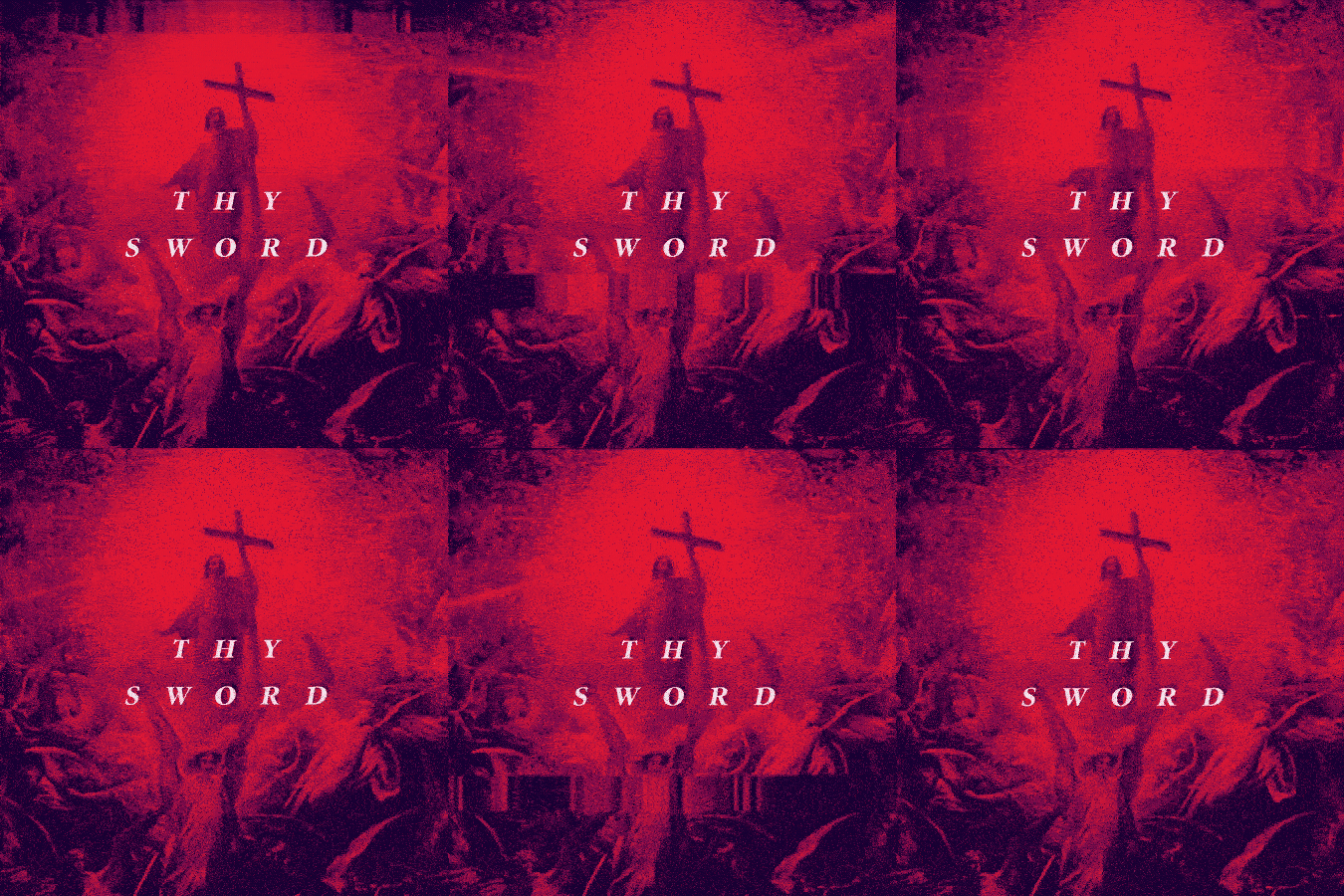
I found this excellent vintage woodcut of Christ’s victory over the demons and brought it into Photoshop. I colorized it using a Tint effect and then added Shine on an adjustment layer to create the flickering lights coming from the cross.
I then added in a bunch of glitch effects and some camera shake, as well as some final overall color correction.
Enjoy.
Arise, O Lord, disappoint him and supplant him; deliver my soul from the wicked one: thy sword
(Psalm 16:13 DR)
View a higher quality version of this gif here: