

Psalm 16:5
the marks we leave
Perfect thou my goings in thy paths: that my footsteps be not moved. (Psalm 16:5 DR)
In Psalm 76 the Psalmist recounts the awesome works of the Lord by which He redeemed His people, with particular poetic emphasis on the parting of the Red Sea. This dramatic rescue from bondage in Egypt became a pivotal moment in the history of God’s people Israel, and this miraculous bending of nature to the will of the Lord a paradigm for His care and rule over them. Yet the Psalmist cloaks it in due mystery:
Thy way is in the sea, and thy paths in many waters: and thy footsteps shall not be known. (Psalm 76:20 DR)
These footsteps in the Vulgate are vestigia, which mean footsteps or tracks, traces or vestiges, as the English cognate suggests. In this Psalm the vestigia or footsteps of the Lord shall not be known, not because it was not known that the Lord had done this great act on behalf of His people, but rather because His power and might and majesty are so far beyond comprehension that they cannot be fathomed by the human mind. The Lord’s way is in the sea and His paths in many waters; that is, the Lord is not constrained to act as men act or to know as men know. A man cannot walk upon the paths of the waters, and thus cannot know the ways of the Lord.
However, in Psalm 16 the Psalmist seemingly contradicts this impression of God’s paths, for he implores that the Lord will “perfect my goings in Thy paths.” Yet if the paths of the Lord are “in many waters,” how does the Psalmist presume to have his goings in these paths, let alone have them perfected?
Cassiodorus examines this passage in respect to the various terms employed, noting that the perfecting of the goings of which the Psalmist speaks has reference to the end, and thus to have one’s goings perfected entails perseverance:
“Perfect” has the sense of “preserve to the end,” when merits and reward are wholly complete. Our beginning is when we live in this world in commendable association with each other, but when our dutiful observance reaches its end we are then perfected, wholly fulfilled and entire. As the Gospel says: “He that shall persevere unto the end shall be saved.” (Cassiodorus, Explanation of the Psalms, 16, 5.)
The other terms used flow forth from this perfecting:
Goings: human actions
Thy paths: commandments
Footsteps: The marks we leave as we pass along
He then interprets this as primarily referring prophetically to Christ, in that the perfection of His goings relates to His humans actions, (which were perfected or consummated on the Cross) and the perfection of His footsteps in the preservation of the Church:
So the Lord Christ asks for protection for both His goings, or human actions, and His footsteps, which we can fittingly interpret as the faithful apostles, in whom after His glorious ascension, He left the marks of the Catholic religion. So the meaning is of this kind: “Guard me by your commandments, so that those who imitate Me may be dislodged by not so much a fraction from You.” He follows faithfully in the footsteps of Him who shows the example and walks straight. (Cassiodorus, Explanation of the Psalms, 16, 5.)
St. Augustine likewise follows this interpretive framework, seeing the footsteps of Christ as marks upon the Scriptures and the Sacraments, which then serve as the path for the Church to follow unto perfection:
“To perfect My steps in Your paths.” That the love of the Church might be perfected in the strait ways, whereby she arrives at Your rest. “That My footsteps be not moved.” That the signs of My way, which, like footsteps, have been imprinted on the Sacraments and Apostolical writings, be not moved, that they may mark them who would follow Me. Or at least, that I may still abide fixedly in eternity, after that I have accomplished the hard ways, and have finished My steps in the straits of Your paths. (St. Augustine, Expositions on the Psalms, 16, 5.)
The Psalmist thus prophetically looks forward to Christ as the trailblazer, so to speak, of the Church, leaving the marks and footsteps for her to follow as she journeys through this vale of tears. In Psalm 76 the footsteps of the Lord could not be known, but here they are imprinted on the Scriptures and the Sacraments, given to the Church as her inheritance. On a human level God’s ways are unknown, but in the Incarnation our Lord took upon Himself our nature and thus left us—both in His own actions and in His own Body and Blood in the Blessed Sacrament of the Altar—the vestiges or footsteps of His goings, that we might walk in them. The Church as the Body of Christ thus both follows in those footsteps and herself bears the marks of those footsteps. The way of the Lord is in the sea and His paths are in many waters, which signify the waters of Baptism by which the members of His Body are brought into those paths.
What was formerly unknown outside of Our Lord’s Body the Church is now made manifest in her as she is united to her Head—our Lord Jesus Christ—whose “goings” are from eternity, yet gave up Himself for the sake of His Bride, the Holy Catholic Church:
The mystery which hath been hidden from ages and generations, but now is manifested to his saints, to whom God would make known the riches of the glory of this mystery among the Gentiles, which is Christ, in you the hope of glory. (Colossians 1:26-27 DR)
There is perhaps a certain fittingness in the juxtaposition between Psalm 76 and Psalm 16 in terms of footsteps, for the apparent tension is reconciled perfectly in our Lord Jesus Christ in His Incarnation and even foreshadows the establishment of the Church. The way of God is in the sea and His paths in many waters, and His footsteps could not be known, for man cannot walk upon the water. Our Lord, however, did walk upon the water, and told St. Peter—the Rock upon whom he founded the Church—to come out to Him on the water, thus calling the Church to walk in His footsteps that formerly could not be known, to follow in the ways in the sea and the paths in many waters.
St. Peter quickly discovered that taking his eyes off of our Lord prevented him from walking in those paths, and that it was a lack of faith—rather than the circumstances surrounding him—which caused him to sink. The paths of the Lord in the sea are thus not something that can be walked in without the assistance of grace, and the Church is the Body of Christ for a reason, always connected to her Head who leads her in His footsteps:
For unto this are you called: because Christ also suffered for us, leaving you an example that you should follow his steps. (1 Peter 2:21 DR)
St. Peter uses the Greek word ὑπογραμμός for “example,” in the Vulgate “exemplum,” which can also be rendered as “model” or “pattern.” Sometimes in the winter you might see a child trying to walk in the footprints in the snow that his father has already made, and that is the type of image that St. Peter is using here. We might even imagine him reflecting on his own attempt to walk in the footsteps of the Lord in the sea, and failing miserably. But after the Resurrection and the coming of the Holy Ghost at Pentecost, he learned to keep his eyes fixed on the Savior, and following after that example would eventually lead him to his own cross in which his would literally mirror his Lord in death.
The paths of the Lord thus go through the cross, and the seas in which His footsteps are found will be the roiling waves and tumult of this world and its troubles and sorrows and persecutions. To follow in His steps will be to follow a trail of bloody footprints, the vestiges of our Lord’s sufferings in which He calls us to walk. Like St. Peter who learned he could not walk these paths in his own power or wisdom, so the path of the Lord in the waters is the path of the cross, in which we face not only the trials and tribulations of this world, but also the assaults of the devil and the passions of our own flesh which constantly war against us. Only by relying on and cooperating with His grace can our own goings be perfected in His paths:
But it is well for us to be sure that although we practice every virtue with unceasing efforts, yet with all our exertions and zeal we can never arrive at perfection, nor is mere human diligence and toil of itself sufficient to deserve to reach the splendid reward of bliss, unless we have secured it by means of the co-operation of the Lord, and His directing our heart to what is right. And so we ought every moment to pray and say with David: “Order my steps in your paths that my footsteps slip not:” and “He has set my feet upon a rock and ordered my goings:” that He Who is the unseen ruler of the human heart may vouchsafe to turn to the desire of virtue that will of ours, which is more readily inclined to vice either through want of knowledge of what is good, or through the delights of passion. (John Cassian, Conferences, 3.12.)
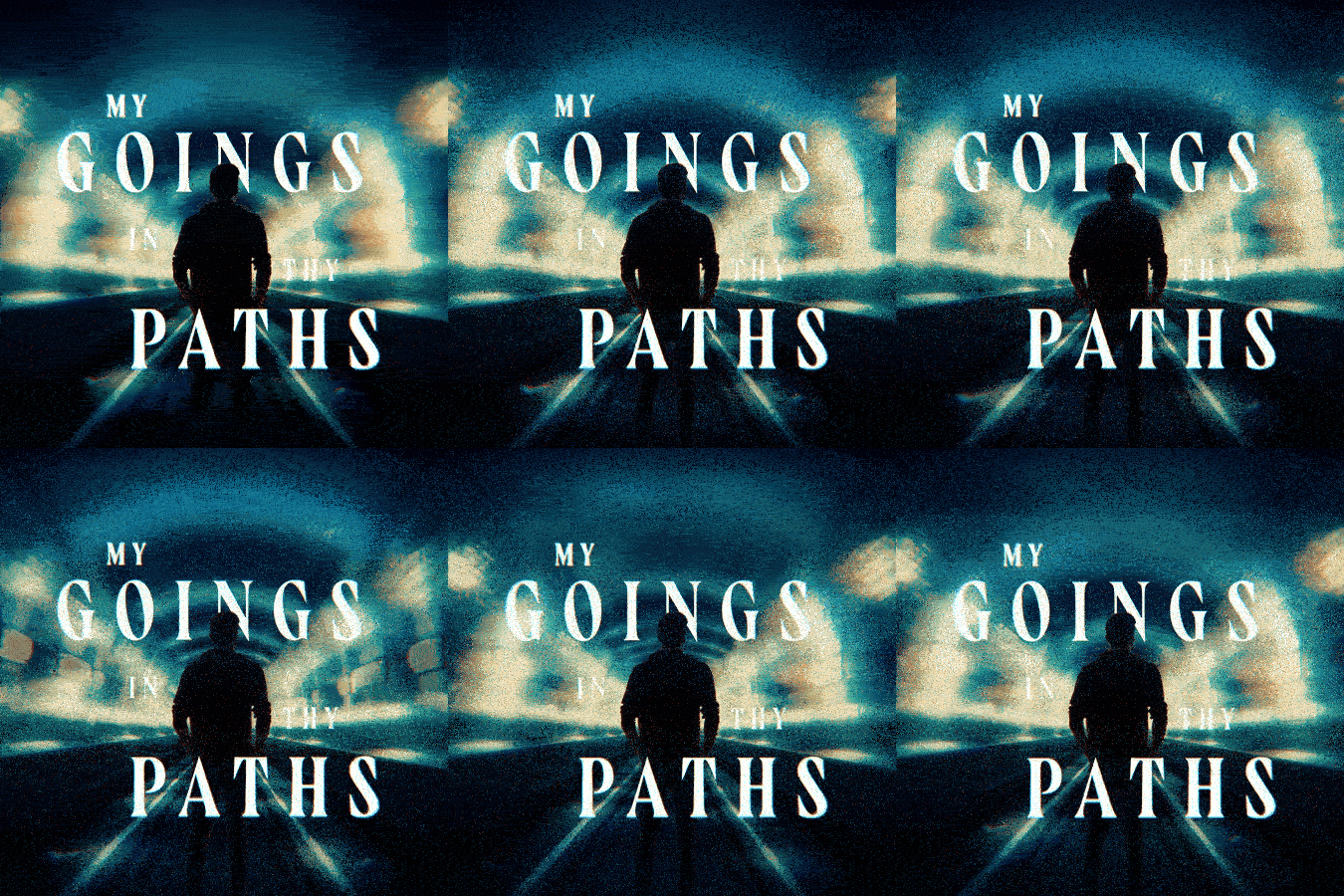
I found this image of a guy standing in a tunnel and used a variety of masks in conjunction with LoopFlow to get the sides of the tunnel to move. I added in a bunch of chromatic glow and some camera shake and color correction to finish this project.
Enjoy.
Perfect thou my goings in thy paths: that my footsteps be not moved.
(Psalm 16:5 DR)
View a higher quality version of this gif here: