

Psalm 16:7
the hope that does not confound
Shew forth thy wonderful mercies; thou who savest them that trust in thee. (Psalm 16:7 DR)
In a letter to his sister written on Easter, A.D. 385, St. Ambrose relates the harrowing events of a conflict in which he nearly suffered martyrdom. The Arians had been demanding that they be given a basilica in Milan, and the young emperor Valentinian II (under the influence of his Arian mother, Justina), attempted to apply imperial pressure upon St. Ambrose to hand over two basilicas. To this pressure was added the voice of local officials who wished to avoid a direct confrontation and civic disturbance.
St. Ambrose refused, and the largely Catholic populace of Milan agreed with him. A Prefect came to negotiate a compromise of one basilica, but St. Ambrose and the people again refused. The Prefect left threatening that his report would go straight to the emperor.
The emperor’s men began hanging up the imperial regalia in the basilica, and the people of the city set forth to confront them. While St. Ambrose was celebrating mass, he was told that an Arian priest had been accosted by the people of Milan, and St. Ambrose began to implore God that blood would not be shed in the cause of the Church. St. Ambrose sent priests and deacons to rescue the man and was successful.
The city seemed on the brink of violence and sedition, and counts and tribunes were sent to implore St. Ambrose to agree to give up the basilicas. He responded that he would gladly give up what was his to the emperor, but that the Church was not his to give away:
If my patrimony is required, enter upon it, if my body, I will go at once. Do you wish to cast me into chains, or to give me to death? It will be a pleasure to me. I will not defend myself with throngs of people, nor will I cling to the altars and entreat for my life, but will more gladly be slain myself for the altars. (St. Ambrose, Letter 20, 8.)
Eventually Valentinian II’s soldiers occupied one of the basilicas, and St. Ambrose had commanded the people to not associate with them, and so the people came to St. Ambrose in the new basilica. However, the soldiers on the whole were not on Valentinian II’s side, as St. Ambrose relates:
It is said that the soldiers had intimated to the Emperor that if he wished to go forth he could do so; that they would be in attendance, if they saw him go to join the Catholics; if not that they would go to the assembly which Ambrose had convened. (St. Ambrose, Letter 20, 11.)
The soldiers eventually heard that St Ambrose was at the new basilica and had commanded the people not to associate with them, and then proceeded to enter the new basilica. This almost led to a terrible misunderstanding, but they assured St. Ambrose that they had come to pray, rather than to fight. It was at this point that St. Ambrose began to preach a homily drawn from the book of Job and his temptation, with St. Ambrose connecting Job’s acceptance of suffering at the hand of God with their own situation:
But thanks be to our God, who has so established you with faith and patience. I had mounted the pulpit to praise Job alone, and I have found in you all Jobs to praise. In each of you Job lives again, in each the patience and valor of that saint has shone forth again. For what more resolute could have been said by Christian men, than what the Holy Spirit has today spoken in you? We request, O Augustus, we do not fight, we do not fear, but we request. This beseems Christians both to wish for peace and tranquility, and not to suffer constancy of faith and truth to be checked by fear. For the Lord is our Leader, Who is the Savior of them that hope in Him. (St. Ambrose, Letter 20, 14.)
As St. Ambrose was concluding his homily, word was sent that the imperial regalia had been taken down from the old basilica, and the following day the emperor commanded the soldiers to remove themselves from the basilica. The people rejoiced exceedingly and the disaster was averted, although it portended future conflict:
Lastly, too, Calligonus, the chief chamberlain, ventured to address me in peculiar language. “Do you,” said he, “while I am alive treat Valentinian with contempt? I will take your head from you.” My reply was, “God grant you to fulfil your threat; for then I shall suffer as bishops do, you will act as do eunuchs. Would that God might turn them away from the Church, let them direct all their weapons against me, let them satisfy their thirst with my blood.” (St. Ambrose, Letter 20, 28.)
St. Ambrose’s quotation from this passage in Psalm 16 in his homily at the peak of uncertainty and danger was not simply a nice-sounding platitude, but rather the full confidence of faith in the Lord, joining his voice and that of the Catholics of Milan with the Psalmist who looks for and expects the salvation of the Lord.
In St. Ambrose’s case, the salvation he looked for was not necessarily to get out of this situation alive. On the human level he had no power, no arms with which to fight, and his opponent had soldiers and imperial power. St. Ambrose could have potentially turned the crowds of people into a frenzied mob so as to exercise some measure of fighting back, but he refused to do this either, entrusting himself and the Church under his care to the hand of God and His protection. In the end he and all the Christians of Milan saw the wonderful mercies of the Lord, for they stared down an emperor and were victorious without a drop of blood being shed. Their trust in God was greater than their fear of persecution or of even death itself, and their hope thus reached beyond the things of this world to the things of heaven, to the salvation of God.
The Psalmist’s words here resonate throughout history and in every place and situation, for this life is a warfare, and is called a vale of tears for a reason. St. Paul tells St. Timothy that “all that will live godly in Christ Jesus, shall suffer persecution.” The Psalmist himself—speaking prophetically for Christ and thus His mystical Body the Holy Catholic Church—therefore sets forth the mindset and orientation of heart that the just have in the Lord: they look for God to show forth His wonderful mercies, for they have confidence that He will save those who hope in Him.
The Vulgate uses the term sperantes for trust or hope, which translates the Greek ἐλπίζοντας, meaning to hope or to expect. Hope is a theological virtue, and of the triumvirate—as it were—of virtues that are implanted in the soul by the Holy Ghost in Baptism. This hope or expectation is not wishful thinking but has a concrete object in God Himself, Who is source of our hope. This hope does not disappoint or confound, as St. Paul states, for God’s own charity is poured into the soul by the Holy Ghost. The Holy Ghost Who dwells within the soul is also said to be given to us, meaning that this hope is as near to us as our own heart and soul. It is not predicated on a circumstance coming to pass or a desire being granted, but rather on the Person of God Himself, Who dwells within.
The wonderful mercies that the Psalmist speaks of—in the Vulgate mirifica misericordias tuas—are thus prophetically fulfilled in this outpouring of the Holy Ghost in Baptism, in which the soul is renewed and justified and translated out of the kingdom of darkness and into the kingdom of light, being brought into friendship with God. The showing forth of these mercies is accomplished by our Lord Jesus Christ on the cross, and as His most Sacred Heart was pierced by the lance, the veil of His flesh was torn and the Sacraments poured forth. St. Paul connects the showing forth of mercy to our Lord’s Passion and Death:
But God commendeth his charity towards us; because when as yet we were sinners, according to the time, Christ died for us; much more therefore, being now justified by his blood, shall we be saved from wrath through him. (Romans 5:8-9 DR)
Commendeth in this passage translates the Latin commendat, which itself translates the Greek συνίστησιν, which can have the sense of commending or demonstrating. To commend contains within itself demonstration by means of implication, for if you commend something, you are speaking of it agreeably because of its quality or attributes. God’s charity towards us is therefore not just shown forth like a mathematical proof, but is rather commended in the death of our Lord, shown for the exceedingly quality that it is, which perfectly corresponds to the wonderful mercies of the Psalmist. It is the surpassing greatness of God’s charity for us that compels our love for Him in return:
“Make Your mercies marvellous.” Let not Your mercies be disesteemed, lest they be loved too little. (St. Augustine, Expositions on the Psalms, 16, 7.)
In Baptism the stains of sin are washed away and the very justice of God is poured into the soul, such that the justified sinner is accounted just not simply in view of God’s justice, but because he has been actually made just. This transformation of the soul is that which only God can accomplish, and the astonishing wonder of this miracle wrought by grace forms the basis of the Psalmist’s prophetic hope, for this same charity of God which is full of wonderful mercy now dwells in the soul, so that the hope it enkindles is always present, since the source of Hope Himself now inhabits the human heart:
I have proved my innocence; have appealed to your justice. I now invoke your mercy, for, however innocent I may consider myself of the crimes for which I am suffering, I may have many other sins for which I may be justly punished. “Show forth thy wonderful mercies” then. Astonish every one at the extent of them in delivering me, for to you it belongs to deliver all who put their trust in thee. (St. Robert Bellarmine, A Commentary on the Book of the Psalms, 16, 7.)
In the Old Latin translation of this passage is an alternate reading of the final clause, for while the Vulgate reads qui salvos facis sperantes in te—Thou Who savest them that trust in Thee—the Old Latin has qui salvos facis rectos corde—Thou Who savest the upright of heart. These might as first blush seem contradictory or unrelated, but they rather view the same reality from different vantage points, as it were. For those who hope in the Lord are those who are the upright in heart, and the upright in heart—by definition—will hope in the Lord.
As St. Paul notes, this hope does not disappoint or confound precisely because God’s charity is poured forth into the heart by the Holy Ghost. To have this hope which does not confound thus is preceded by the transformation of heart by the working of the grace of God in the soul through Baptism, and the ongoing sanctification by which we are divested of attachments to the love of the things of this world. As our bent hearts are straightened out to made more upright, the more this hope increases for our hearts become more fully united to the source of that hope. In the Rosary we often pray near the beginning for an increase in “faith, hope and charity,” and this increase comes about through cooperating more fully with the grace that God pours into the soul, by which the justification received is increased:
Having, therefore, been thus justified, and made the friends and domestics of God, advancing from virtue to virtue, they are renewed, as the Apostle says, day by day; that is, by mortifying the members of their own flesh, and by presenting them as instruments of justice unto sanctification, they, through the observance of the commandments of God and of the Church, faith co-operating with good works, increase in that justice which they have received through the grace of Christ, and are still further justified, as it is written; “He that is just, let him be justified still”; and again, “Be not afraid to be justified even to death”; and also, “Do you see that by works a man is justified, and not by faith only.” And this increase of justification holy Church begs, when she prays, “Give unto us, O Lord, increase of faith, hope, and charity.” (Council of Trent, Session 6, Chapter 10)
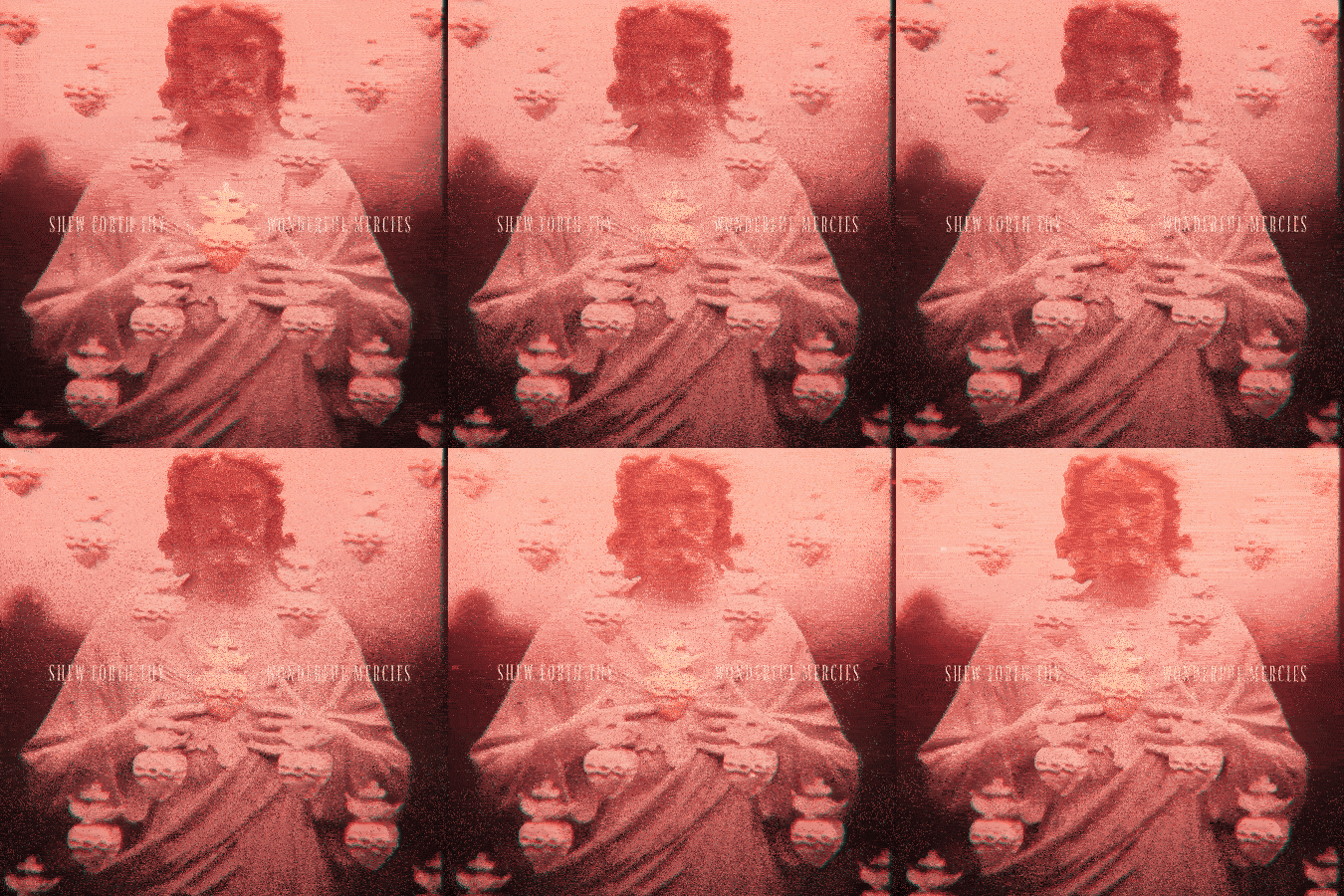
I found this excellent image of a statue of the Sacred Heart and isolated the heart with masks in After Effects, and then used Pixel Repeat to create the repeated images and the animation on them. Pretty hand little tool. I then added in some color correction and animated textures along with some camera shake to conclude this project. The .gif compression really murders this one.
Enjoy.
Shew forth thy wonderful mercies; thou who savest them that trust in thee.
(Psalm 16:7 DR)
View a higher quality version of this gif here: