

Psalm 16:8
an apple a day
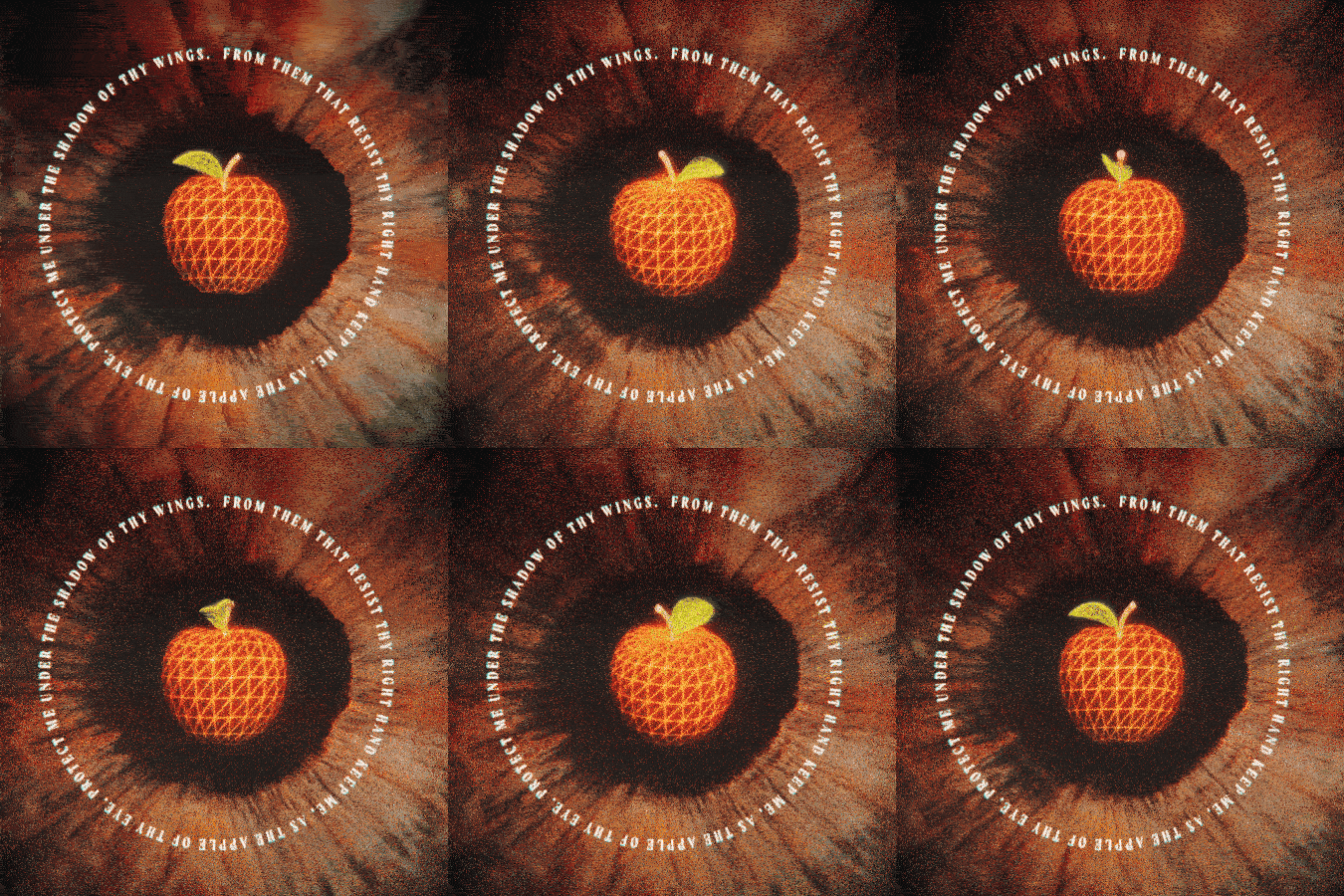
From them that resist thy right hand keep me, as the apple of thy eye. Protect me under the shadow of thy wings. (Psalm 16:8 DR)
The Psalmist has thus far in this Psalm largely dwelt on the interior state of his soul in relation to God. He initiated the Psalm with a request that God would hear his justice and let his judgment come forth from God’s countenance, that his heart would be proved and found innocent. In this testing he has chosen to follow hard ways so as to avoid sin and iniquity, walking in the paths of God, confidently expecting and hoping in God’s salvation.
Naturally, the reason to hope that God will save them that trust in Him is that—in addition to his own internal concupiscence—there is also a world outside that constantly threatens to swallow him up. Elsewhere the Psalmist gives voice to this external danger:
If it had not been that the Lord was with us, let Israel now say: If it had not been that the Lord was with us, when men rose up against us, perhaps they had swallowed us up alive. When their fury was enkindled against us, perhaps the waters had swallowed us up. Our soul hath passed through a torrent: perhaps our soul had passed through a water insupportable. (Psalm 123:1-5 DR)
Those who threaten from without thus threaten him on the deepest level, for they are not only opposed to him personally, but by extension in opposition to God and His will. Since this Psalm is ultimately about Christ and by extension His Body the Church, the Psalmist’s foes who resist him set themselves “against the Lord and against His Christ.” (Psalm 2:2)
These enemies are those who resist God’s right hand, in the Vulgate dexterae tuae. The right hand is a figure of power and of will, but also of favor and authority. To be at the right hand is to share in or hold that authority, such as the Psalmist describes of Christ:
The Lord said to my Lord: Sit thou at my right hand: Until I make thy enemies thy footstool. The Lord will send forth the sceptre of thy power out of Sion: rule thou in the midst of thy enemies. With thee is the principality in the day of thy strength: in the brightness of the saints: from the womb before the day star I begot thee. (Psalm 109:1-3 DR)
St. Paul will quote from this Psalm to prove the supremacy of our Lord Jesus Christ, that being at the right hand of the Father He is the “brightness of His glory, and the figure of His substance” (Hebrews 1:3 DR). For the Psalmist then, the foes who resist the right hand of God not only resist the will of God, but also of His anointed one, which applies literally to David as the anointed king over Israel, but prophetically looks forward to Jesus as the Christ. The “favor” of God upon the Psalmist in providing salvation to those who hope in Him is thus rejected by those who oppose God and His anointed. Yet even in rejecting the will of God, the enemies spoken of here cannot oppose God’s designs, but only in so far as He allows them to sow their own condemnation:
Protect me, as you would “The apple of your eye,” with the greatest care, from those “that resist thy right hand:” in injuring those whom you protect, or who refuse to walk where you lead. This does not contradict the passage in the book of Esther, “There is no one who can resist thy will.” For the will spoken of there, is the will of his good pleasure which is always carried out; but here is meant the will of his expression, which is not always carried out, for God permits the wicked to do many things opposed to his expressed will; that is, against his law, and afterwards punishes them according to their merits. (St. Robert Bellarmine, A Commentary on the Book of the Psalms, 16, 8)
And since such enemies press in around him to oppose and destroy him, the Psalmist now appeals to God for protection through two seemingly unconnected images.
The first is that God would keep him “as the apple of thy eye.” In the Vulgate this is “custodi me ut pupillam oculi,” literally, “keep me as the pupil of thy eye.” This expression—whether using apple or pupil—seems on the surface a rather strange expression. In English it has become idiomatic, so much so that translations often translate it idiomatically as apple of thy eye rather than pupil of thy eye. This idiomatic usage seems to stem from Aelfred the Great’s Old English translation of Boethius’ Consolation of Philosophy, and the Old English word aeppel is used for pupil to create this expression, and eagan aeppel (eye apple) came to be used for pupil of his eye. The relevant passage in Boethius is thus:
Nan wundor; hwaet þu wast þa men þe habbad unhale eagen ne magon full eade locian ongean þa sunnan þonne hio beortost scind, ne furdum on fyr ne on nanwuht beortes hi lyst locian, gif se aeppel lef bid.
That is no wonder. Thou knoweth that the men who have unsound eyes cannot very easily look at the sun when it shines brightest, nor indeed do they choose to look on fire or anything bright, though the apple [of the eye] be left.
Presumably the pupil of the eye was in former times sometimes conceived of as a solid object on or in the eye, which—however it was conceived of—in any event required protection. This eye apple was small and delicate, and damage to it naturally meant damage to sight.
In Latin, the term pupillam has the sense of a ward or a minor; that is, someone whom one has charge to protect. This sense was figuratively transferred to the pupil of the eye, and St. Gregory the Great in his Cura Pastoralis connects the etymology of pupilla to pupa (meaning “a doll”), noting that pupilla as a diminutive of pupa, therefore “refers to the tiny figure of ourselves which we see reflected in another’s eyes as we gaze into them.” When Aelfred the Great translates Cura Pastoralis into Old English, he uses apple for pupil. He may have been unique in this, as this use wasn’t replicated until the end of the 13th century, and eventually Latin-English vocabularies used apple of the eye as a gloss for pupilla.
This passage from Psalm 16 was critical to the development of this idiom, for while the text itself speaks of keeping me as the apple of thy eye, this passage was often cenotized for antiphons and versicles, with the custodi me (keep me) of this passage being replaced with custodi nos (keep us), such as at Compline:
℣. Custódi nos, Dómine, ut pupíllam óculi.
℟. Sub umbra alárum tuárum prótege nos.℣. Keep us, Lord, as the apple of Thine eye.
℟. Protect us under the shadow of Thy wings.
An early English Psalter from the late 9th century is unique in using apple in terms of pupil in Psalm 16:8:
Behoth me swa swa man byrhd þam aeplum on his eagum mid his braewum.
It is also somewhat unique in that—like Aelfred—it locates the apple “in” the eye, rather than merely being “of” the eye, which may show some influence from St. Jerome’s Hebrew translation which has custodi me quasi pupillam intus oculi, with intus being used for in.
There is also speculation that this association of apple with pupil also comes from Aelfred and his translation of St. Augustine’s Soliloquies. St. Augustine asks:
Nosti etiam pilam quam sphaeram nominant?
Do you also know the ball that they call a sphere?
Pilam has the normal meaning of ball in this passage, and Aelfred translates it as apple. It is not certain why this semantic shift took place, but such occurrences do happen. In a fun twist, the term apple was formerly used as slang for the baseball in the sport of that same name. And while the more modern usage is probably a remnant from this earlier shift, the idiomatic nature of language creates these sometimes inexplicable connections. It is speculated that once this association of pilam with apple had been made and became more widespread, there was ample opportunity for the term pupillam to be mistaken for pilam in the copying of manuscripts, especially since abbreviations such as pp. were sometimes used to save space, such as is found in a Breviary where this versicle is written as “custodi nos Dne ut pp.” A scribe with less than stellar familiarity with Latin might gloss pupillam with pilam, and thus connection with apple might suggest itself when translating.
But the importance of this “pupil”—whether an apple or not—was not lost on many ancient commentators. Cassiodorus naturally connects it with sight, and that sight being a figure for the judgment with which Christ will judge the world, separating the just from the wicked. To be kept or guarded as the “pupil” or “apple” of God’s eye thus prophetically looks forward to the last day when He will judge with perfect clarity.
Theodoret takes the image and runs with it, constructing a rather elaborate figure for the entirety of the eye and its surrounding environs:
He gave the name “adversaries at the right hand of God” to those opposing him, and rightly so: he had been anointed by God and on his initiative received the royal calling. So he says, “Those involved in battle against me are ranging themselves against your decision;” his prayer is to enjoy such protection as does the apple of the eye, which has eyelids as a kind of rampart and eyelashes for a palisade; it also has eyebrows as mounds, conducting the stream of sweat to the temples and warding off from the faculty of sight any harm from that source. (Theodoret of Cyrus, Commentary on the Psalms, 16, 3.)
Given the striking nature of the apple of thy eye, it can come off as somewhat disjointed for the Psalmist to suddenly shift figures in the middle of the passage. To be sure, the parallelism allows for such a shift, but there doesn’t seem to be any obvious connection between them, for in the first figure the object of protection is the thrust of the figure, whereas in the second figure it is the source of protection itself. Cassiodorus explains the rhetorical significance:
There follows: “Protect me under the shadow of thy wings.” Another figure is introduced here, in Greek parabole and in Latin comparatio, when things dissimilar in kind are joined in some relationship; for the Father's protection is compared with wings. Mercy and love are—as it were—the Father’s wings by which He fittingly demands to be protected. The comparison derives from birds, which guard their dear brood by spreading out their wings. (Cassiodorus, Explanation of the Psalms, 16, 8.)
One is naturally reminded of our Lord’s application of this latter figure to Himself when He wept over Jerusalem, and Cassiodorus’ figure of the the wings being mercy and love is thus brought to fruition in our Lord Himself, for it was mercy and love which was the reason for His Incarnation, and there are perhaps allusions to the Psalmist’s striking words in Psalm 84:
Surely his salvation is near to them that fear him: that glory may dwell in our land. Mercy and truth have met each other: justice and peace have kissed. Truth is sprung out of the earth: and justice hath looked down from heaven. (Psalm 84:10-12 DR)
If the wicked are those who resist the right hand of God, the righteous are those who accept from His hand what the Lord wills. Our Lord Jesus Christ—Who is Himself at the right hand of God—accepted the will of His Father in His Passion, saying “Not My will, but Thine be done.” The implication then is that even though on the natural and human level this living in God’s will may often put one in the way of danger and even of loss and harm, it is also the place of protection. For the buffets of this world and of the men therein can only afflict the body, but they have no access to the soul, unless they are allowed to have it.
Those who walk within the will of God and seek after His ways find protection under the shadow of His wings and need not fear what man or even the devil might do against them, for the ravages of sin have been defeated by our Lord Who Himself was without sin and will perfect in charity those who cleave to Him, who find shelter under those wings of mercy and love. Those who are united to Christ in His mystical Body the Holy Catholic Church thus become as the apple of God’s eye, Who will ever keep them in His ways:
And lest we should be led by despair into sheer inaction, He promises that the Divine power shall make those things possible which are to man impossible from his own lack of power: “for narrow and strait is the way which leads unto life,” and no one could set foot on it, no one could advance one step, unless Christ by making Himself the Way unbarred the difficulties of approach: and thus the Ordainer of the journey becomes the Means whereby we are able to accomplish it, because not only does He impose the labor, but also brings us to the haven of rest. In Him therefore we find our Model of patience, in Whom we have our Hope of life eternal; “for if we suffer with Him, we shall also reign with Him,” since, as the Apostle says, “he that says he abides in Christ ought himself also to walk as He walked.” Otherwise we make a vain presence and show, if we follow not His steps, Whose name we glory in, and assuredly they would not be irksome to us, but would free us from all dangers, if we loved nothing but what He commanded us to love. (Pope Leo the Great, Sermon 90, II.)
Note: Information about the philology of apply of the eye largely derived from: Marbury B. Ogle, The Apple of the Eye, Transactions and Proceedings of the American Philological Association, Vol. 73, 1942.
In this animation I found an image of an eye close-up and brought it into After Effects, using a series of masks to create the setup for Loopflow to make it move. I then found a 3D model of an apple and used Trapcode MIR to create the mesh and applied the color appropriately, animating the rotation of the apple so as to loop.
I then added in the text and drew an ellipse around the center of the eye, using the path to shape the text in the same ellipse shape. I finally added in some color correction and other effects to finalize this project.
Enjoy.
From them that resist thy right hand keep me, as the apple of thy eye. Protect me under the shadow of thy wings.
(Psalm 16:8 DR)
View a higher quality version of this gif here: