

Psalm 21:13
grabbing the bull by the horns
Many calves have surrounded me: fat bulls have besieged me. (Psalm 21:13 DR)
A Spacious Bed
Early in the book of Deuteronomy is the account of the defeat of the kingdom of Basan, ruled by a king named Og. The land of Basan was known for its fertile plains and its cattle, such that to speak of the bulls of Basan was to invoke the idea of strength and virility and health and prosperity. Thus, when the Israelites approached unto Basan, Og and his army came out to meet them, which thoroughly intimidated the Israelites. One reason for this is that Og himself seemed to be no common man, described in Deuteronomy 3:11 as the last surviving member of a race of giants, in the book of Joshua named the Raphaims:
For only Og king of Basan remained of the race of the giants. His bed of iron is shewn, which is in Rabbath of the children of Ammon, being nine cubits long, and four broad after the measure of the cubit of a man’s hand. (Deuteronomy 3:11 DR)
The length of the cubit had some variation, but it is often averaged to around 1.5 feet, which would put Og’s bed at around 13.5 feet long and 6 feet wide, which is impressive both in size and in weight, as it was made out of iron. Truly a king-sized bed!
Such a physically imposing king leading a vast well-trained army thus filled the Israelites with trepidation. For even though the kingdom of Basan had sixty cities with high walls and gates and bars, they were so confident in their military might that they went out to meet the Israelites. Rather than waiting to be besieged, they sought to encircle the Israelites and destroy them before they had a chance to besiege the cities of Basan.
God ultimately tells Moses and the people of Israel to not fear, for even though they faced an imposing foe, the enemy had already been delivered into their hands by the power of God.
Past is Prologue
This victory over Basan and king Og is one of many battles and victories the Israelites had in the course of coming into the Promised Land, but it stuck out particularly because of Og himself, a remnant of the might and strength of the world before the promise made to Abraham. Og was at the height—both literally and figuratively—of power as the world considers power, and his confidence in this power led him and his army to meet the Israelites in battle. From all outward appearances he should have been victorious, a literal giant with a well trained and experienced army and fortified cities pitted against nomadic wanderers living in tents. Yet his downfall was the result of God’s intervention on behalf of His people, not for anything they had done—and often in spite of the things they had done—but rather in fulfillment of the covenant and promise He had made to Abraham.
This victory thus becomes not just another victory but is commemorated as a sort of transition from the old world and its conceptions of power to that in which God’s people find their help and strength in the Lord. The giants of old were the men of renown who did great deeds as the world understands it, and the defeat of Og is the last gasp of that order which now passes away to make way for God’s covenant to be fulfilled. The Psalmist thus fittingly commemorates this victory in Psalms 134 and 135:
He smote many nations, and slew mighty kings: Sehon king of the Amorrhites, and Og king of Basan, and all the kingdoms of Chanaan. And gave their land for an inheritance, for an inheritance to his people Israel. (Psalm 134:10-12 DR)
With a mighty hand and a stretched out arm: for his mercy endureth for ever… Who smote great kings: for his mercy endureth for ever. And slew strong kings: for his mercy endureth for ever. Sehon king of the Amorrhites: for his mercy endureth for ever. And Og king of Basan: for his mercy endureth for ever. And he gave their land for an inheritance: for his mercy endureth for ever. For an inheritance to his servant Israel: for his mercy endureth for ever. For he was mindful of us in our affliction: for his mercy endureth for ever. And he redeemed us from our enemies: for his mercy endureth for ever. (Psalm 135:13; 17-24 DR)
In both Psalms the Psalmist links the smiting of these nations and kings—including Og, king of Basan—to the action of God, even though the Israelites were the ones who conducted the battle. The idea is thus that the strength by which they defeated these strong and mighty kings was not of their own doing, but was only because of God intervening on their behalf. When Israel was departing from Egypt they were encircled and surrounded by enemies on all sides, but through the Lord fighting for them they were able to overcome them, even the bulls of Basan, the giant king and his military might.
Enraging the Bull
This context sets the stage for the Psalmist’s words in this passage, for now the tribulation that was very near in the preceding passage is given a form and a shape: calves which have surrounded him, and fat bulls which have besieged him. The Old Latin and Vulgate follow the Septuagint in the use of calves—vituli in Latin, μόσχοι in Greek—and of fat bulls—tauri pingues in Latin, ταῦροι πίονες in Greek. St. Jerome’s Hebrew translation also follows this.
However, in Aquila’s version of the Septuagint the bulls of Basan make an appearance, as Eusebius of Caesarea notes:
Likewise, in the present Psalm, in place of the verse, Many calves have surrounded me, Symmachus has it thus: Fat, well-fed young bulls have encircled me, he says, and surrounded me; according to Aquila, however: The powerful ones of Bashan have made a public spectacle of me. (Eusebius of Caesarea, Commentary on the Psalms, 21, 12-14)
The phrase here:—Δυνάσται Βασὰν διεδειγματίσαντό με—(dunastai basan di-edegmati-santo me)—potentes Βasan in spectaculum traduxerunt me in Latin)—corresponds more closely to the (much) later Masoretic text that many modern translations employ, such as the NRSV:
Many bulls encircle me,
strong bulls of Bashan surround me. (Psalm 22:12 NRSVCE)
However, the use of the term διεδειγματίσαντό (di-edegmati-santo) or traduxerunt signifies not merely being surrounded or encircled, but the act of being led forth in a public spectacle, such as the armies of Rome leading the defeated enemies through the capitol city to show forth the extent of their victory. The root of this verb is employed by St. Paul in Colossians 2 to signify Christ’s victory over the princes and principalities of this world:
And despoiling the principalities and powers, he hath exposed them confidently in open shew, triumphing over them in himself. (Colossians 2:15 DR)
The Vulgate has potestates traduxit for exposed them… in open shew, bringing in this very same militaristic imagery. Eusebius of Caesarea draws a connection between this reading of this passage in the Psalms and Christ’s being stripped of His garments and mocked and led to the judgment seat of Pilate:
By these, the military hand of Pilate is foreshadowed—called ‘Bashan’—which placed the woven crown of thorns upon his head in place of a diadem. (Eusebius of Caesarea, Commentary on the Psalms, 21, 12-14)
There is a fitting parallel here, for while Christ in this Psalm is the One Who is made a pubic spectacle of—principally in the cross upon which He died—this ultimately becomes the very means by which He triumphs over His enemies and makes a public show of them, as St. Paul spoke of. This unexpected reversal—at least from the perspective of the world and worldly wisdom—brings everything full circle, as Christ becomes in the New Covenant the fulfillment of the promises made in the Old. For just as the giant Og and the fat bulls of Basan surrounded the Israelites to destroy them, so Christ in His own Person recapitulates the victory of God’s people over their enemies by the same power of God, defeating the fat bulls of sin and death, making a public show of them in His death and resurrection.
Turning the Turned Tables
Theodoret of Cyrus often refers to the translation of Aquila in his commentaries, but in this instance passes it over. Nevertheless, he draws the same conclusion as Eusebius, pulling in references to other passages in the Old Testament, which lead to a supremely tragic irony:
Now, he calls bulls the priests and scribes, entrusted with ruling the people and given to great audacity; young bulls those under them, calling them fat because reveling in the good things supplied by him. This was the way the mighty Moses also prophesied: “Jacob ate his fill, the beloved kicked up his heels, he grew fat, bloated, and obese, and abandoned the Lord who made him.” Blessed Hosea actually likens him to a frisky heifer: “Like a rebellious heifer Ephraim rebelled.” Now, he gave that name to the people: “This was the way with Ephraim, a heifer trained to love contention,” that is, quarrelsome and contentious. He gives the name contention not to conquest, note, but to contentiousness. And to show the humiliation that came afterwards, he added, “But I shall tread on the beauty of her neck”: I shall lower her haughty neck and impose the yoke of slavery. So the Psalm describes in advance the attacks of the chief priests, the scribes, and the Pharisees, who in imitation of the audacity of bulls and the frenzy of lions hemmed in Christ the Lord. (Theodoret of Cyrus, Commentary on the Psalms, 21, 8)
The turnaround here is that the very people whom the Lord rescued from the fat bulls of Basan when they faced off against Og and his army now become those self-same fat bulls in their pride and obstinacy. Throughout the history of God’s people they are often likened by the prophets to being a stiff-necked people, and when the same Lord Who brought them into the Promised Land now comes to deliver them from sin and death and lead them to the heavenly Promised Land, they reject Him and become like the very enemies who opposed God and His people as they were leaving the bondage of Egypt. Those who were encircled are now the ones encircling the Son of God.
Western writers like St. Augustine come to similar readings:
Many calves came about Me. The multitude of the wanton populace came about Me. Fat bulls closed Me in. And their leaders, glad at My oppression, closed Me in. (St. Augustine, Expositions on the Psalms, 21, Exposition 1, 13)
And Cassiodorus draws a moral meaning from the literal identification in the Passion of Christ:
Many calves are clearly the Jewish people, who do not experience God’s yoke, and sport with heedless wantonness. They are also shameless and foolish, for they do not guide their steps with any sense of control, but with wandering and fluid course skip and bound towards wicked designs. By fat bulls He designates the Jewish leaders, who like bulls raised their heads high, and puffed out their wickedness and pride, and with savage horns spilt the blood of the guiltless One. The addition of the adjective fat is apt; for that beast becomes exceedingly restless when it bulges with surplus fat, and after being tame it becomes fierce once it is incited with the arrogance of excessive flesh. (Cassiodorus, Explanation of the Psalms, 21, 13)
The Bull that Rages Within
It would, of course, be hasty to apply such designations only to a specific people at a specific time, for, as Cassiodorus elucidates, the very vices which characterize those who sought our Lord’s death are the very same vices with which we all must battle. There is a fat bull puffed up in pride within each of us, out of control, wild, chasing after its passions and following its appetites, raging at those who would oppose its will or get in the way of sating its desires.
Yet as apt as the bull metaphor is, it is also seemingly combined in an odd way with the term besieged—obsederunt in the Vulgate—which has the sense of blockading a place, something that bulls do not do, given their lack of rationality. However, the term fat as a designation for pride resolves this oddity, for in our pride we can turn our intellects to evil and devise evil that we might do it. We can of course fall into sin through moments of passion or the seemingly overwhelming influence of our appetites, but we can also learn to love evil for its own sake, to plot and plan evil acts.
In the deliberation of evil we can blockade ourselves from the influence of grace, closing down all avenues of escape from what we have determined to do. Pride naturally provides the justification and rationalization necessary to commit what we have already decided we want to do, even if we know it is evil. After all, those who sought the life of Jesus justified it in the name of patriotism and piety and good doctrine, yet their pride blinded them from seeing the true import of their acts:
But we speak the wisdom of God in a mystery, a wisdom which is hidden, which God ordained before the world, unto our glory: Which none of the princes of this world knew; for if they had known it, they would never have crucified the Lord of glory. (1 Corinthians 2:7-8 DR)
Calves and Fat Bulls
Og the king of Basan was one of the princes of this world who stood against the Lord and His people, opposing them in ignorance and in the confidence of his pride and of his own natural strength. Like the wild calf he followed the lusts of his concupiscence and desired the spoils of victory from the Israelites, leaving his fortified cities behind to meet them on the field of battle. Like the fat bulls of his kingdom he raised his head in pride against God and rushed into the fray of war and the clash of swords and spears, trusting in his own power and might and glory and renown.
He met his end at God’s hand and became but a curiosity of the old order of things for his large iron bed, and also became the archetype of God’s victory on behalf of his people opposing the might of this world. In regrettable irony the people of God too often became like unto Og, king of Basan, rushing about after their lusts and setting their faces against heaven and stiffening their necks, despite God’s repeated attempts to draw them back to virtue and right worship. And like Og, they too became an archetype of those whom God chastises by His power for their obstinacy and pride:
Now all these things happened to them in figure: and they are written for our correction, upon whom the ends of the world are come. Wherefore he that thinketh himself to stand, let him take heed lest he fall. (1 Corinthians 10:11-12 DR)
Setting Up the Siege
The Etruscan king Porsenna was intent on taking the city of Rome in the year 508 B.C., and took pains to encircle and blockade it in an attempt to bring this mighty city to its knees:
Porsenna, repulsed in his first attempt, gave up the plan of storming the City, and determined to lay siege to it. Placing a garrison on Janiculum, he pitched his camp in the plain by the banks of the Tiber. He collected ships from every quarter, both for guarding the river, to prevent any corn from being brought into the City, and also to send his troops across for plundering, as the opportunity might present itself at one point or another; and in a short time he made all the territory of the Romans so unsafe that not only were they forced to bring all their other property inside the walls, but even their flocks too, nor did anybody dare to drive them outside the gates. (Livy, History of Rome, Book 2, Chapter 11)
Porsenna employed a two-prong strategy, the first being defensive in that he sought to keep the enemy from receiving any aid, the second prong being offensive in that he actively sent sorties to root out opposition and force them into the city so they could not harass his own army.
The appetites and passions of the flesh must be besieged and starved; this is part of the purpose of fasting and penance. By intentionally depriving our natural desires of their satiation—even if those desires are good—we bring them under greater mastery, for we choose to deny them or to fulfill them, rather than simply being led wherever they might lead.
But this is not enough, for vices must be actively rooted out by means of pursuing and cultivating virtues. Spiritual practices like prayer, going to Mass, devotions, holy hours, spiritual reading, etc., all become like unto those sorties into enemy territory, for not only do we deny the flesh, but we force its desires and appetites back by pursuing and engaging in higher desires and acts.
Greener Pastures
In this manner both the wild calf and the fat bull are brought into submission, and on the spiritual level, instead of being encircled, the encircled become the encirclers. The Promised land was to be both cleansed of idolatry and to become the home of the worship of God alone. The soul in some manner mirrors this within itself, for it must not only be cleansed of sin, but filled with the Holy Ghost and virtue.
The Promised Land for the Israelites was hard won through many battles, but only imperfectly cleansed of idolatry and only imperfectly made the home of the worship of the One true God. These compromises eventually led to it being wrested from the very people to whom it was given as a gracious gift, since through their obstinacy and pride and the chasing after their own desires they forfeited it and were led into captivity.
Our Lord came to lead the new Exodus out of this captivity to sin into the true Promised Land of heaven, and while we will one day dwell there, in another reversal He here and now comes to make His home in the soul, to lead it to its heavenly home, if that soul will remain united to Him in charity and truth. The calf and the bull within each of us can pull us down to destruction, and we must, as St. Paul exhorts, take heed lest we fall.
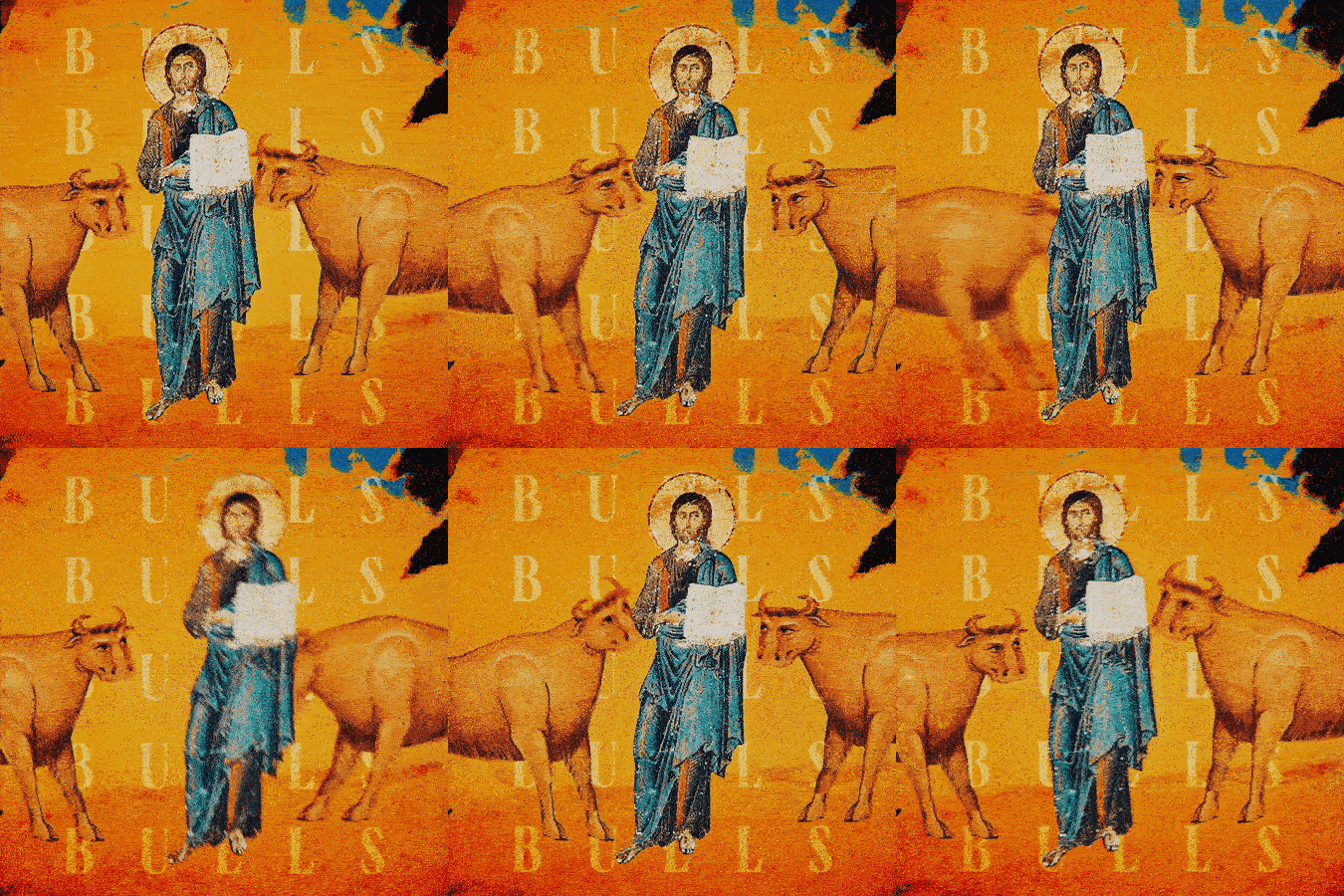
I isolated the figures from various medieval miniatures and precomped them in After Effects. For the bulls I rigged them up using the Puppet Tool and then animated the head butting and movement. In the main composition I then timed the movement of the Christ figure being butted back and forth, adding in some camera shake and Motion Blur to give the impact more visual weight.
I then placed the text behind the figures and added in some textures and color correction and noise to finish this out.
Enjoy.
Many calves have surrounded me: fat bulls have besieged me. (Psalm 21:13 DR)
View a higher quality version of this gif here: