

Psalm 2:12
how to never get what you want
Embrace discipline, lest at any time the Lord be angry, and you perish from the just way. (Psalm 2:12 DR)
There is a terrifying scene in the live production of The Screwtape Letters wherein Screwtape is speaking to his nephew Wormwood about how souls are often drawn to hell by their base desires. The irony, however, is that the problem is not exclusively in them desiring something too greatly, but rather in not desiring great things enough. They become satisfied with lesser things, and even these only half-heartedly, so that not only do they not obtain what they actually desire, but they lose their soul in the process:
All the healthy and outgoing activities which we want him to avoid can be inhibited and nothing given in return, so that at last he may say... “I now see that I spent most my life in doing neither what I ought nor what I liked.” (C. S. Lewis, Screwtape Letters)
The Psalmist in this penultimate verse encourages rulers and kings to seek after the good, to not chase after their own base desires. For there is a cost to doing so, in that it brings about God’s anger. The wicked often think that they escape punishment (cf. Psalm 72) because there is often no outward frustration of their plans nor manifestation of God’s wrath. But as St. Paul says, God’s wrath is often found in the darkening of the intellect and the giving over of one to one’s sinful desires (cf. Romans 1). Thus St. Bellarmine:
The most grievous punishment inflicted on princes is when God, on account of their sins, gives them up to the “reprobate sense,” Rom. 1, permits them to be deceived by wicked counselors, and do much evil, for which they are lost to this world and the next; such were Pharaoh, Roboam, Achab, and others, in whom the most grievous sins became the punishment of other sins, such being not a small slip from the straight road, but an entire loss and extermination of the path of justice. (St. Robert Bellarmine, A Commentary on the Book of the Psalms, 2, 12.)
Their power and might exhibits to the world a sense of freedom, but in reality they are becoming slaves to their sins and their desires. Rather than a being who can contemplate God in his intellect and ascend unto Him in spirit, as it were, they become content with being driven by the urges of their lower nature, subject to chemical reactions and animal instincts which put them on par with the beasts. Their reward becomes merely to have the pleasures of the beasts, but to lose their own souls.
Before writing this I made what I think was a pretty great lunch. My dogs also thought it was great, because I gave them some of it. It strikes me tat while I may be able to intellectually appreciate the food more than they can and perhaps have a more developed palate, at the end of the day the desire itself of hunger is the same in them and in me. If were to orient my entire existence around the satiation of this desire, I would exist only on the level of my dogs.
The same, of course, is true for all our lower desires, which is why the Psalmist exhorts us to embrace discipline. Our lower nature is meant to be subject to our higher nature, rather than the inverse. As we depart from righteousness and perpetually and intentionally offend God, we must beware lest our intellects darken and we be given over to these desires. The loss of the ability to pursue righteousness is in itself a punishment, as St. Augustine relates:
“And you perish from the righteous way.” This is a great punishment, and dreaded by those who have had any perception of the sweetness of righteousness; for he who perishes from the way of righteousness, in much misery will wander through the ways of unrighteousness. (St. Augustine, Expositions on the Psalms, 2, 10.)
To continue the previous analogy, if I as a human were through my degradation in desire unable to do anything that rose above the satiation of my desires—such as reasoning, thinking, contemplating, etc., I would actually be worse off than a beast. My dogs by their nature do not think, reason or contemplate; they have instincts and are created to fulfill those desires. But I am created with reason, and if I were to lose that or to have my desires have complete mastery over it, the loss of that endowment would be worse than to not have ever had it.
This warning of the Psalmist is not a threat per se but rather the reality of sin’s effect on our souls and intellects. We all know of someone who is enslaved to some desire; in extreme forms like addiction it is more manifest, but it comes in many forms. Discipline in virtue helps us to control our lower desires and steer them towards the good. Our desires aren’t evil but are like a current that needs to be channeled in a specific direction, or else we end up getting carried away by them.
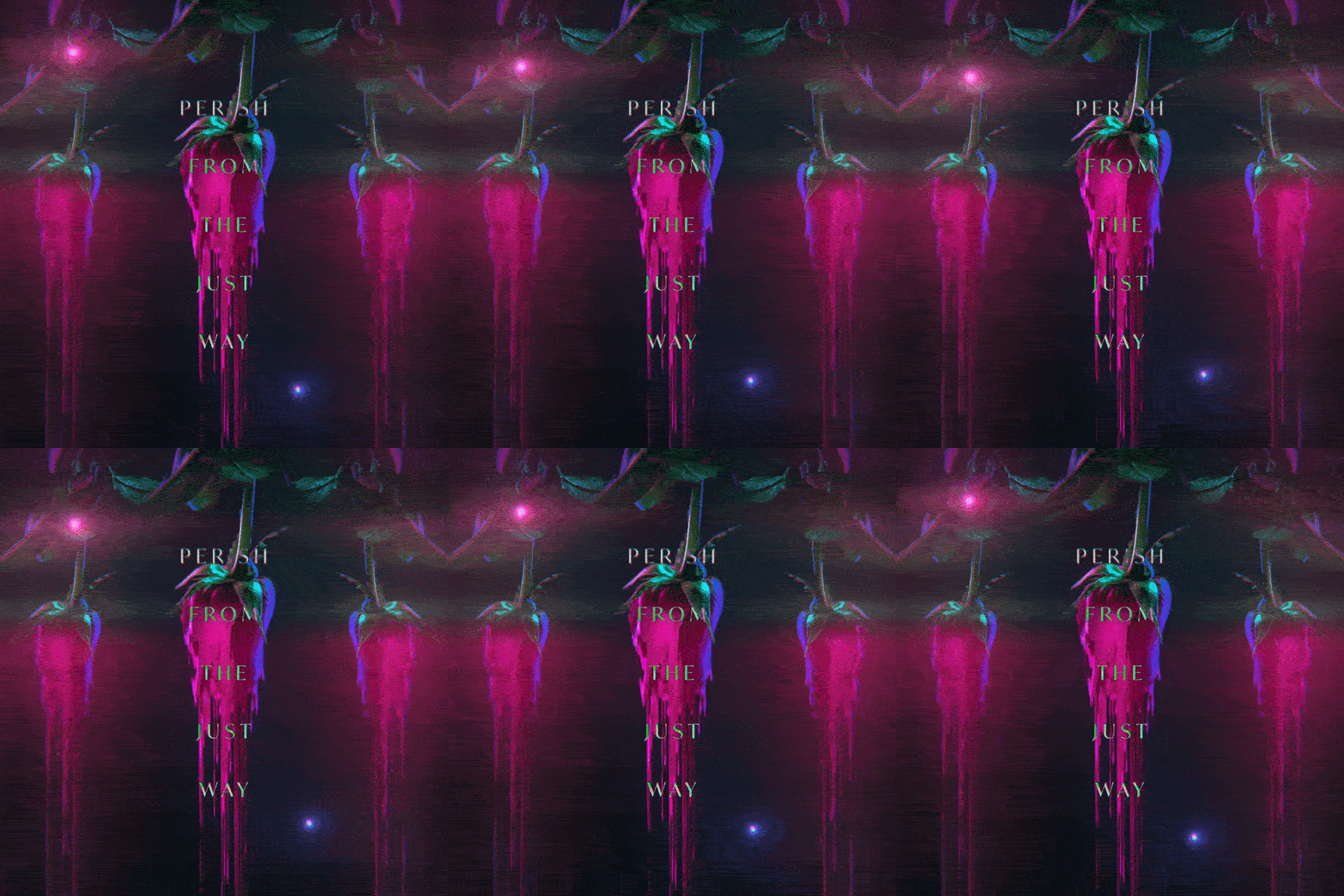
I liked the term “perish” from this passage, not because of the term itself, but mostly because it is capable of evoking a lot of poignant imagery. I had in mind the idea of a wilted flower, and then I found this nicely stylized photo of a rose.
I brought it into After Effects and applied Stretch to it to give it the dripping effect. I had to do some creative masking to get it to work right, but I think the effect turned out well. I precomped it and then duplicated it a couple times for some depth and to fill out the composition. I also added in a some floating orbs because, well, you can rarely go wrong with floating orbs.
Enjoy.
Embrace discipline, lest at any time the Lord be angry, and you perish from the just way.
(Psalm 2:12 DR)
View a higher quality version of this gif here: