

Psalm 21:32
the new creation
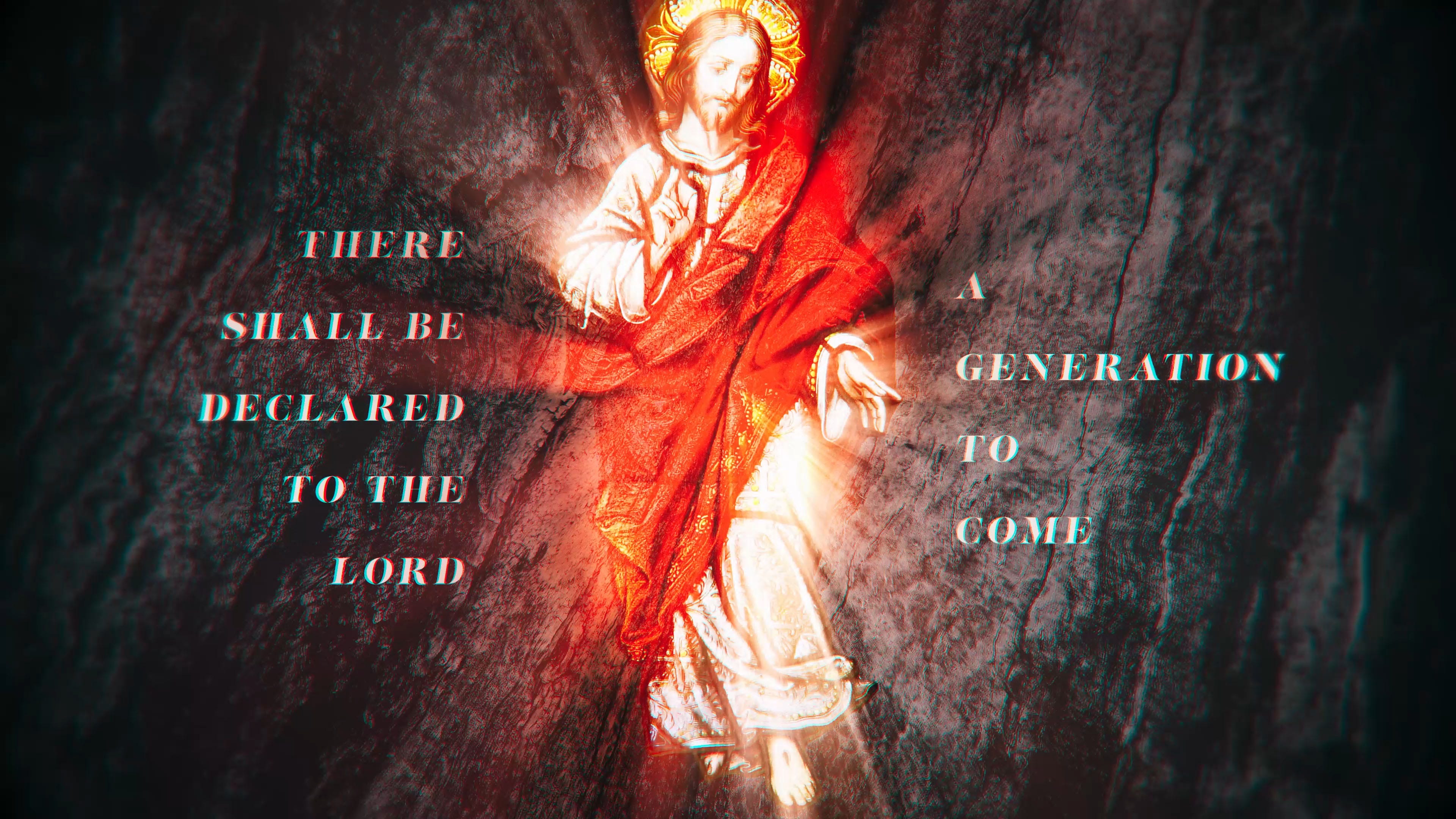
There shall be declared to the Lord a generation to come: and the heavens shall shew forth his justice to a people that shall be born, which the Lord hath made. (Psalm 21:32 DR)
Finish It Already!
Better is the end of a speech than the beginning, so the book of Ecclesiastes proclaims, and such is true of Psalm 21, which reaches its culmination in this passage. The incipit of unto the end, for the morning protection now finds its end in Christ as revealed throughout this Psalm, manifested in power in His Passion, death and Resurrection. The cry of dereliction which opened this Psalm seemed to threaten that morning, but in the dawn of the Resurrection of our Lord Jesus Christ all His suffering becomes itself the means of that protection, and the Resurrection vouchsafes its prophetic fulfillment.
The Psalmist now proclaims the declaration or announcement (annuntiabitur) of Christ’s victory. This victory is begun on the cross and manifested in the Resurrection, but is completed or consummated now in the drawing of the nations into His mystical Body. The Psalmist speaks of this as the generation to come, and then expands upon it in the parallelism with a people that shall be born. Both of these expressions combine to demonstrate that the Psalmist is not looking forward to a natural generation or people, but rather one that would be—as St. John says—born, not of blood, nor of the will of the flesh, nor of the will of man, but of God. At the time of the Psalmist the nations of the Gentiles were outside of the covenant, but now in Christ the have been brought into union with Him:
That you were at that time without Christ, being aliens from the conversation of Israel, and strangers to the testament, having no hope of the promise, and without God in this world. But now in Christ Jesus, you, who some time were afar off, are made nigh by the blood of Christ. (Ephesians 2:12-13 DR)
Breaking Down Walls
St. Paul will go on to speak of how Christ has broken down this wall of division between the two and made them one in Himself so that all in Him would have access to the Father through the Spirit:
Now therefore you are no more strangers and foreigners; but you are fellow citizens with the saints, and the domestics of God, built upon the foundation of the apostles and prophets, Jesus Christ himself being the chief corner stone: In whom all the building, being framed together, groweth up into an holy temple in the Lord. In whom you also are built together into an habitation of God in the Spirit. (Ephesians 2:19-22 DR)
This building of Christ’s Church is, as St. John noted, not something owing to human effort or decisions, but is brought about by God’s initiative and will. On the natural level the enmities between God’s people and the Gentile nations would be insurmountable, and thus the Psalmist’s words look beyond himself and to Christ:
And the peroration of the whole prophecy crowning all—“The generation that cometh shall be announced to the Lord, and they shall announce his righteousness to a people that shall be born, whom the Lord has made”—specifically foretells the Church of the Gentiles, and the generation established on the earth, through our Saviour Jesus Christ. For what could this people be which, it is here said, will be born for God after these things, which did not exist of old, and did not appear among men, but will be hereafter? What was the generation, which was not then, but which it is said will come, but the Church established by our Saviour in all the world, and the new people from the Gentiles, of which the Holy Spirit wonderfully spake by Isaiah, saying, “Who hath heard such things, and who hath seen them thus? The earth was in travail for one day, and a nation was born at once.” (Eusebius of Caesarea, Demonstratio Evangelica, Book 10, Chapter 8)
This new people comes to the Father not through natural descent or its own desire but by grace, specifically the waters of baptism in which the Spirit Who gives access to the Father pours the charity of God into the heart:
A generation to come means that which is to be begotten through the Lord’s generosity of water and the holy Spirit. To show that this generation is just, He says that it will come to the Lord; for a generation of evil men is seen to come on its own behalf rather than to the Lord. (Cassiodorus, Explanation of the Psalms, 21, 32 ACW)
Baptism and Justice
The second clause of this Psalm underscores this washing of regeneration in baptism, for the people to be born are shown the justice of God, not merely as external to themselves in its revelation to them, but in fact because they are themselves made just through the outpouring of charity into their souls through the Holy Ghost. They are declared just because they have been made just, having sanctification infused into their souls:
The justice of faith is called the justice of God, which makes men truly just, and which God gratuitously gives to those who believe in Christ. For the gospel strongly inculcates that we are all sinners, that we cannot be justified of ourselves, but that through faith in Christ we are to expect justice from God alone. (St. Robert Bellarmine, A Commentary on the Book of the Psalms, 21, 31)
The use of generation and people signifies not the descent of this new people from man but rather their relationship to God. He is the one Who creates them into a people, who makes this generation to come to partake of His justice. Through the preaching of the apostles—those who will declare and who are the heavens who shew forth God’s justice—through this preaching the new people will receive the Spirit of adoption:
For just as things which are procreated derive their beginning of existence from a seed, in exactly the same way he declares that the people to be born and the generation to come—namely, a new and recent one—shall receive their beginning from nothing else except from his own “rational seed,” which he himself, being present, was sowing upon the earth through the apostles: specifically, the spirit of adoption. (Eusebius of Caesarea, Commentary on the Psalms, 21, 32)
Numbers and Mysteries
As this Psalm closes, there is a spiritual aspect to its very numbering, that of the 21st Psalm. Cassiodorus notes that in the book of Daniel the prophet prays about the future of the seed of Israel, and is answered on the 21st day, after the angel had been delayed in a battle with a devil. This mystical signification points to the Psalm’s entire structure and purpose:
So this psalm too is seen to have been appropriately endowed with this number, for having destroyed the devil’s malevolence it unlocked the gifts of the healing passion, by the benefit of which the human race was freed from eternal death, and attained the gifts of enduring salvation. (Cassiodorus, Explanation of the Psalms, 21, Conclusion, ACW)
By Christ’s Passion, death and Resurrection the race of mankind is freed from sin and eternal death. In His own sufferings our Lord fulfills the sufferings of the Psalmist which prophetically anticipated the mysteries shown forth in the cross and in the empty tomb. It is because our Lord emptied Himself and took upon Himself our sufferings that the nations would come into the Church, and this should transform our own sufferings. For when they are united with Christ’s sufferings they participate in His redemptive efficacy, and the Church—which is His mystical Body—partakes of His suffering and shares in His glory.
So justice is to be preached to the people who are to believe in God, who abandon the death brought by sins and advance to life, who by God’s kindness are born of faith in such a way as to deserve to live for ever. So the statement that the Lord has made the Christian people is especially apt. He created them when He brought them forth from their mothers’ wombs, but then He freed them from sins when He made them Christians by the water of regeneration. So we must store in our hearts the fact that this and other psalms which speak of the Lord’s passion find their outcome above all in the hope of Christians. In this way we may recognise that by this wonderful ordering of events, salvation has been bestowed by such a mystery on those that believe. (Cassiodorus, Explanation of the Psalms, 21, 32 ACW)
I found this wonderful stained glass image of the Ascension and isolated and cleaned it up in Photoshop and then precomped it in After Effects. I applied Trapcode Shine to create the volumetric rays and applied various glows using Deep Glow. I slightly animated the floating of the image and then in the background used loopFlow to create the moving texture.
I finally composited the text and applied some color correction.
Enjoy.
There shall be declared to the Lord a generation to come: and the heavens shall shew forth his justice to a people that shall be born, which the Lord hath made. (Psalm 21:32 DR)
View a higher quality version of this gif here: