

Psalm 21:4
shifting perspectives
But thou dwellest in the holy place, the praise of Israel. (Psalm 21:4 DR)
A Fez-y Introduction
There was this video game I played once called Fez which, while not the most enjoyable game as far as the gameplay was concerned, did have a fascinating mechanic that drove the entirety of the gameplay. You could shift the perspective of the entire world by rotating it 90 degrees, and each rotation, while leaving the world mostly the same, would reveal different things in each rotational dimension.
For example, a platform or ladder or item that might not exist in one rotational frame might exist in another, and the gameplay was concerned with shifting perspectives (sometimes in the midst of jumping or other actions) to solve puzzles and advance in the story, such as it was. It was certainly a gameplay mechanic that forced you to think within these different rotational dimensions instead of simply linearly on a 2D plane, and each shift in perspective often made what seemed impossible suddenly have wider possibilities.
(Some sample gameplay can be seen in the embed below.)
Reframing Your Mind
Often times in this vale of tears a shift in perspective can make all the difference. Granted, we cannot rotate the entire world around us—even though we often live like the world does revolve around us—but reframing the way we think about something or perceive it can completely shift how we perceive or think about it. We have perhaps all had situations or experiences where we have an opinion or assumption about someone’s motives in respect to something they have done which frames how we think about or relate to them in one way. But it can often happen that we then get the rest of the story or other information that then places all their actions in a completely different light. Even animosities or hard feelings that arise from these mistaken assumptions can be almost instantly transformed by this shift in perspective when the truth becomes known.
At least, that is, if we are willing to truly embrace the truth.
An odd conjunction?
The Psalmist seemingly shifts his perspective suddenly from the previous passage in which he states that he cries to God by day and night but will not be heard. Now he turns to declare that God dwells in the holy place, and this can seem a jarring shift. The Latin has tu autem to open this passage, which the Douay-Rheims renders as but Thou. It could also be Nevertheless, Thou, or On the other hand, Thou, as autem as a conjunction can be used in a wide variety of situations, sometimes joining a new thought to a preceding one and sometimes joining antithetical thoughts. It does not have the restrictive sense of sed—but—which joins contrary thoughts grammatically.
The way in which autem is understood here thus arises from the sense given to the folly not being reputed to the Psalmist in the previous passage. Since this is a thoroughly Christological Psalm, the seeming dereliction the Psalmist experiences is the will of God to not hear the cry of Christ from the cross, that the mystery of salvation might be accomplished:
And therein lies the key to this passage, for the Psalmist’s seemingly unheard cry will not be reputed as folly since in the suffering of Christ the great good of salvation will be merited by the outpouring of His blood. In His vision of God He sees the good set before Him, the very will of the Father with which His own will is aligned, and this gives Him the perspective to cut through the darkness of the night to judge rightly.
Holiness and Unanswered Prayer
The Psalmist now links the unanswered prayer of Christ from the cross with God dwelling in the holy place. St. Robert Bellarmine derives four reasons from this present passage that connect from the previous, such that his prayer will not be folly:
He proves that it was not folly in him to cry out at night, even though he was not heard by day, and that for four reasons. First, because God is holy and merciful. Secondly, because he is wont kindly to hear those that call upon him. Thirdly, because he is in the greatest straits. Fourthly, because, from his nativity, he has confided in God, and in him alone. The present verse contains the first reason. You, O Lord, will certainly hear me, for you “dwell in the holy place;” you are all sanctity and piety; malice or cruelty cannot come near you, and, therefore, you are “the praise” of thy people “Israel;” both because the people of Israel praise thee, and they are praised on your account. For the greatest praise thy people can have is their having a God so holy in every respect. (St. Robert Bellarmine, A Commentary on the Book of the Psalms, 21, 3)
The holiness of God is Himself in His own perfect and eternal being, but is manifested in His saints as He makes His dwelling within them. This indwelling by the outpouring of charity into the soul through baptism by the Holy Ghost shifts the perspective of the Christian from that of natural things to supernatural things. It is the renewing of the the mind of which St. Paul speaks by which the will is aligned with God’s will, desiring what He desires, even if that Will leads into suffering and trials and tribulations. The Psalmist’s cry that finds itself on Christ’s lips on the cross that God seems not to hear is reconciled in that His ways are not our ways, and thus often what seems good and obvious to us might be the worst thing we could possibly receive. The very things we pray for which we think we need so badly might be to our spiritual detriment, and the things we shrink from and wish to avoid might be the very purifying trials that God wishes so as to prove and test us:
But Thou dwellest in the holy place, O Thou praise of Israel. Thou dwellest in them, whom Thou hast sanctified, and whom Thou makest to understand, that some to their profit Thou hearest not, and some to their condemnation Thou hearest…
The fire is brought to the furnace; and the refiner’s furnace is a thing of high mysterious meaning. There is gold there, there is chaff, there is fire working in a confined space. This fire is not diverse, yet its effects are diverse: it turns chaff into ashes, from gold it takes away its impurities. Now they in whom God dwelleth, are assuredly made better in tribulation, proved as gold. And if perchance the adversary, the devil, ask (to prove any), and it be granted him, whether by some bodily pain, or some loss, or bereavement, let him keep his heart fixed on Him, Who withdraweth not Himself, and if He seem to withdraw His ear from his lamentations, yet He sheweth mercy to his supplications. He who made us knoweth what to do, He knoweth how to re-make us. He is a good builder Who built the house; and if any thing therein hath fallen to decay, He knoweth how to repair it. (St. Augustine, Expositions on the Psalms, 21, Exposition 2, 5)
Not Getting what You Want Can Be A Good Thing
In the previous passage it was seen how in various instances some—like the devil—received what they asked of God, but to their shame and condemnation, while others—like St. Paul—who did not receive what they requested did so to their glory and sanctification. The dwelling of God within the soul so as to make it a holy place requires this refining fire, that the heart be made pure and the will be made subject to God.
In this manner the Psalmist is not contrasting competing or contrary thoughts through the conjunction autem but is bringing the previous thought to completion. In our Lord the dwelling in the Holy Place was not in a qualified sense as with the saints but was in the union of the divine and human natures in the hypostatic union as realized in the Incarnation of our Lord Jesus Christ. His cry of dereliction from the cross drawn from this Psalm thus becomes the exemplar of the heart and will completely united with the will of the Father:
“But you dwell in the holy place, O praise of Israel.” And indeed you dwell in all the holy ones, and always turning to them, you hear them. Therefore, in this matter, you have customarily been the praise of Israel, that is, of every holy one. But if God dwells in all the holy ones, He will certainly dwell much more in His Only-Begotten Son, whom He will, of course, hear more readily. (Eusebius of Caesarea, Commentary on the Psalms, 21, 4)
Of course, one might ask, it is all well and good to say that the Only-Begotten will be heard more readily, but how does this square with His seeming dereliction on the cross? In the garden of His agony He explicitly prayed that the cup might pass from Him, yet this prayer was not answered, at least not as He prayed it, for the cup did not pass from Him.
Reconciling Contraries
The conjunction of the not being heard to God dwelling in the holy place brings this conundrum into resolution by shifting the perspective. Just as our Lord in the garden prayed, Not My will, but Thine be done, so the soul in which the Lord dwells ultimately frames the hearing of its prayers on its alignment with the will of God. In this manner our Lord’s prayer in the garden and from the cross was heard by God the Father, for in submitting His will to the Father our Lord united His human will to His divine will and accomplished salvation:
Who in the days of his flesh, with a strong cry and tears, offering up prayers and supplications to him that was able to save him from death, was heard for his reverence. And whereas indeed he was the Son of God, he learned obedience by the things which he suffered: And being consummated, he became, to all that obey him, the cause of eternal salvation. (Hebrews 5:7-9 DR)
This passage has always been fascinating to me, since it says He was heard for His reverence, even though this hearing ultimately entailed His Passion and Death. Yet because the will of our Lord was perfectly united to the Father He was heard because ultimately His prayer was for that will to be accomplished. And as St. Paul further elaborates, He becomes—to all who obey Him—the cause of eternal salvation. That is, to share in that salvation is to learn obedience through suffering as He did, and so to have God dwell within as His holy place, in which we too will be heard for our reverence. This hearing may be—as it was for St. Paul—the divine “No” to our requests, but this “No” is always for our sanctification.
The Final Shifting
In eternity we will have that final perfection of vision in which the shift of perspective will bring all these things into their proper alignment, that we will be able to see the grand design of God’s will woven through our lives, how all the sufferings and struggles and trials were not God’s indifference to us but rather a deep and perfecting solicitude for our salvation, each thread of pain and suffering in whatever form a part of the tapestry of God’s working of salvation in us, our sanctification and the making of our souls into a dwelling place for He Who dwells in the holy place.
If we could now see how all these things work together with perfect clarity we would face trials and temptation and suffering without fear, but we would also have no need of faith, for our faith would then be sight. In this vale of tears we trust that God’s will is for our good and for our salvation, accepting the griefs and sufferings that He allows so as to purify our wills and sanctify our souls.
The fallen angels in their testing perhaps saw all that submitting to God’s will would entail and rejected it out of pride, and we would likely do the same if we saw every thread of our lives woven together in its entirety. The probationary nature of this life gives us the experience of going through suffering and coming out the other side, even if the suffering itself is not abated, but at least in our mindset discovering that sufficiency of God’s grace as St. Paul did. The minister of Satan who tormented him was never taken away, but this was ultimately to St. Paul’s good and salvation, as this purifying and testing and proving of his soul made it into a dwelling place of the Lord.
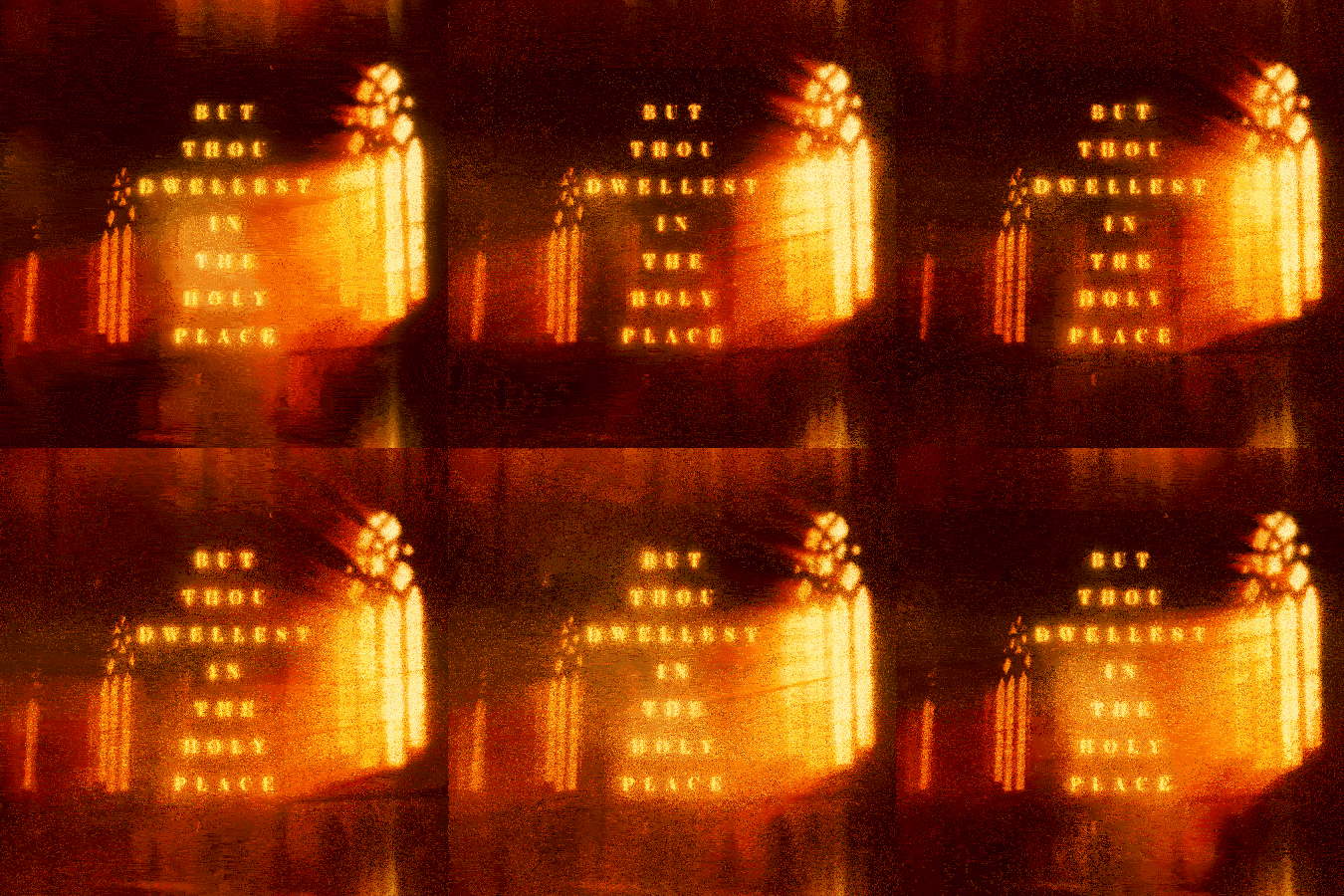
This was a pretty simple .gif. I found a nice image of some stained glass windows and brought the image into After Effects, precomped it and applied Trapcode Shine to create the volumetric light rays. I applied a looping wiggle expression to the Source Point’s position in the effect, which creates the undulating ray effects. I then added in a bunch of glows and applied some final color correction.
Unfortunately the .gif compression really murders this one, but wat can you do?
Enjoy.
But thou dwellest in the holy place, the praise of Israel. (Psalm 21:4 DR)
View a higher quality version of this gif here: