

Psalm 21:7
a bad case of the worms
But I am a worm, and no man: the reproach of men, and the outcast of the people. (Psalm 21:7 DR)
The Obligatory Skyrim Reference
In one of the side-quests of the game Skyrim—specifically that of the Bard’s College in Solitude—your character is tasked with finding a long-lost portion of the Poetic Edda, King Olaf’s Verse, which was purportedly written by an ancient bard named Svaknir as a scathing critique of a notorious king named King Olaf One-Eye. Granted, other potential bards at this college need only have some skill in singing or performance to be admitted; they naturally need your character to delve into a long-sealed tomb filled with terrifying enemies to retrieve something that may or may not exist as the entrance requirement. [Insert DEI joke here].
Through the course of the quest you of course find this ancient missing verse—after dispatching the reanimated corpse of the one-eyed king—and bring it back to the College, only to discover that portions of it are missing and have to be, ahem, reconstructed so that an ancient celebration of burning King Olaf’s effigy can be resumed, which had been paused for current political reasons. You are then given the option of creatively filling in these portions, and one involves King Olaf’s legendary capture of the dragon—known to the Nords in Skyrim as wyrms—named Numinex in the Great Hall of the palace in Whiterun.
One particularly fun option—that Svaknir himself would no doubt have endorsed—is that King Olaf One-Eye was himself the wyrm Numinex in human form, and used that power as his means to both secure his kingdom and h
is legend. The Nord afterlife in Sovngarde is generous to the brave, however, and both Olaf and Svaknir get to enjoy each other’s company, with Olaf coming to respect the latter as an honest enemy. I suppose there is something to be said for mead halls.
Worming One’s Way into Etymology, and Then into Hell
The English term worm and the Latin term vermis both are derived from an even earlier term *wr̥mis, which was used for both worms and snakes and often encompassed any sort of creature that was similar in structure to these creatures. The Germanic descendent of *wr̥mis became *wurmiz and eventually the Old English wyrm, which ranged from worms to dragons. Similarly the Italic descendent became *wormis, and eventually vermis as in Latin.
The latinization of English later used the Latin vermis to form words that we still use to this day like vermin, although in modern English the term vermin tends to be more directed towards pests like mice and rats that are associated with disease and uncleanliness.
This is no accident, as the Latin word vermis also tended to have this sort of connotation, being linked to things like rot and corruption and decomposition. In the ancient world it was often thought that worms were the cause of something’s corruption or disease, and the idea of them ceaselessly gnawing away at organic matter became a synonymic connotation of the word worm. This can be seen in our Lord’s description of hell:
And if thy hand scandalize thee, cut it off: it is better for thee to enter into life, maimed, than having two hands to go into hell, into unquenchable fire: Where their worm dieth not, and the fire is not extinguished. And if thy foot scandalize thee, cut it off. It is better for thee to enter lame into life everlasting, than having two feet, to be cast into the hell of unquenchable fire: Where their worm dieth not, and the fire is not extinguished. And if thy eye scandalize thee, pluck it out. It is better for thee with one eye to enter into the kingdom of God, than having two eyes to be cast into the hell of fire: Where their worm dieth not, and the fire is not extinguished. (Mark 9:42-47 DR)
Our Lord chooses two descriptions that He repeats three times: the first of unquenchable fire, and the second of worms that do not die. The idea in the latter image is of a consuming that never ends and that, in some manner, perhaps proceeds from oneself. These worms, after all, are their worms, and thus those who suffer this fate are themselves the source of this everlasting gnawing.
How to Get Worms
The ancient world also viewed worms as not being generated as other animals are through procreation, but rather as being somehow naturally generated out of rotten things, an idea which stuck around for centuries until the experiments of Francesco Redi and later of Pasteur. Lucretius provides an example of the principle involved:
Of which facts
Naught we perceive in logs of wood and clods;
And yet even these, when sodden by the rains,
Give birth to wormy grubs, because the bodies
Of matter, from their old arrangements stirred
By the new factor, then combine anew
In such a way as genders living things. (Lucretius, De Rerum Natura, 2.928)
Lucretius’ principle is that all sensate things have their origin in insensate things, and this natural change is the order of the world:
Now, too: whate’er we see possessing sense
Must yet confessedly be stablished all
From elements insensate. And those signs,
So clear to all and witnessed out of hand,
Do not refute this dictum nor oppose;
But rather themselves do lead us by the hand,
Compelling belief that living things are born
Of elements insensate, as I say.
Sooth, we may see from out the stinking dung
Live worms spring up, when, after soaking rains,
The drenched earth rots; and all things change the same:
Lo, change the rivers, the fronds, the gladsome pastures
Into the cattle, the cattle their nature change
Into our bodies, and from our body, oft
Grow strong the powers and bodies of wild beasts
And mighty-winged birds. (Lucretius, De Rerum Natura, 2.871)
Worms thus serve for Lucretius as the experiential validation of his principle, as one can see—so he argues—that when the earth and wood get sopped and start to rot, this deterioration in one element leads to the change into another element. Thus the worms spring forth through this change, and this way in which nutrients are absorbed by other living things drinking water or eating other things, etc., and made part of themselves—so as to in some manner make themselves—is how he perceives the natural world to operate.
Inching Back to the Psalms
The Psalmist—having described the hope of the righteous in the past who saw the salvation of God in history—now seemingly leaves no hope for himself. He declares that in contrast to them, he is a worm, and no man.
Becoming the Curse to Break the Curse
Unlike Olaf One Eye who might have been a polymorph of man and wyrm, the Psalmist declares that he is certainly not a man, but rather a worm. The salvation of God applies to the righteous men of the past, but not to him, for he perceives himself to not be a man. Instead, he is the very essence of corruption and gnawing decay, the worm that ceaselessly consumes, as his life is presently ebbing away on account of his sufferings. In this cry of dereliction which anticipates our Lord’s Passion, there is a also a foreshadowing of Him taking the curse of sin upon Himself:
Him, who knew no sin, he hath made sin for us, that we might be made the justice of God in him. (2 Corinthians 5:21 DR)
The worm that consumes and gnaws and corrupts, the vermis or wyrm that springs up in the midst of decay and dissolution is now what he identifies himself as, the essence that he ascribes to himself. As a prefigurement of our Lord on the Cross in His Passion, it describes His bearing of all the sins of the world upon Himself so as to redeem us from its unending corruption:
Why do I say, a servant? He was made sin, a reproach, a curse. For the Apostle has said that He was made sin for us, that the Lord Jesus was made a curse for us. He has said, when all things shall be subdued unto Him, then shall He also Himself be subject. Peter also said in the Acts of the Apostles, In the name of Jesus Christ of Nazareth, rise up and walk. Then he said also, that God had glorified His Servant Jesus, and no one brings any charge against him concerning the time. But in the Apocalypse He is called a Lamb by John, in the Psalm He is called a worm and no man. He was made all these things that He might blunt the sting of our death, that He might take away our slavery, that He might abolish our curses, our sins, our reproaches. (St. Ambrose, Letter 46)
Humility and Abjection
The nature of our Lord’s Passion and Death as taking this curse of sin upon Himself for our sake, is one line of thought that ancient Christian commentators took on this passage. A related yet distinct one is that of humility, in that the worm—in the sense of the earthworm or grub—is a lowly creature, and our Lord took upon Himself our lowliness and vileness in His Incarnation, and as such the Psalmist speaks:
But I am a worm, and no man. But I, speaking now not in the person of Adam, but I in My own person, Jesus Christ, was born without human generation in the flesh, that I might be as man beyond men; that so at least human pride might deign to imitate My humility. (St. Augustine, Expositions on the Psalms, 21, Exposition 1, 7)
I, however, am a worm and not a man, the reproach of men and the outcast of the people. A worm is considered the vilest of all animals, and it derives its existence from the corruption of bodies; if it touches anything, it leads that thing to corruption and destruction… Therefore, when the Savior utters the aforementioned words: But I am a worm, and not a man, he declares the vileness, the infirmity, and the abject condition of his Passion, and the destruction to be inflicted by him upon the opposing powers. For it was to happen that, after he had undergone death and stood in the very place of the dead, he would hand over the opposing powers to corruption like a worm. (Eusebius of Caesarea, Commentary on the Psalms, 21, 6-7)
But I am like a worm, he is saying, seen to be worthless and become a laughingstock. Now, some claimed that by worm is suggested also the birth from a virgin, as it is not by intercourse that it comes into existence; but I believe only lowliness is indicated here by worm… (Theodoret of Cyrus, Commentary on the Psalms, 21, 6)
This lowliness and vileness of our nature that He takes upon Himself in the Incarnation is—compared to the infinite excellence of God’s essence in the purity of His eternal Being—utter abjection, for the difference in dignity between God and man is infinitely greater than that between Man and a worm. We would naturally recoil at being transformed into the limited and (to our perception) vile existence of a worm, yet in the Incarnation our Lord lowered Himself to an infinitely greater degree. This example of profound humility that finds itself on the lips of the Psalmist is worth contemplating and imitating:
The third reason, derived from the straits in which Christ is placed. “But I am a worm, and no man:” I am just now in that position that I am not only “made less than the Angels,” but even made less than man. “Despised and the most abject of men,” nay, even beneath them, when even Barabbas and the robbers were preferred to me, and thus, I am now become so wretched, more “a worm than a man…” (St. Robert Bellarmine, A Commentary on the Book of the Psalms, 21, 6)
Worming Your Way into Being
The final line of thought that ancient commentators pursued in this passage has been mentioned by St. Augustine and Theodoret, which is that the reference to the worm is a reference to our Lord’s Virgin Birth, both in terms of the lowliness of the birth itself but also in terms of the generation of our Lord without the normal means of procreation:
But I am a worm, and no man, the reject of men and the outcast of the people. These words embody the figure of tapeinosis, which in Latin is called humiliatio, employed whenever wondrous greatness is compared with most lowly things. As Paul says: The weak things of the world hath God chosen, that he may confound the strong. The worm seems contemptible through utter lowliness, but incorporates the sacred symbols of a great mystery, being born without intercourse, creeping low, and moving without noise. If you ponder these facts, you will realize that it is not without justification that the Lord Christ is called a worm. (Cassiodorus, Explanation of the Psalms, 21, 7)
St. Augustine (whom Cassiodorus often follows in his explanations of the Psalms) also pursues this line of thought, speculating that it is the virginal nature of the worm that is appropriately applied to the man who is no man:
But I am a worm, and no man. A worm, and no man; for man is a worm also: but He is a worm and no man. How no man? Because God. Why then did He so abase Himself as to say, a worm? Is it because a worm is born of the flesh without coition, as Christ of the Virgin Mary? Both a worm even, and yet no man. Why a worm? Because mortal, because born of the flesh, because born without coition. Why not a man? Because the Word was in the beginning, and the Word was with God, and the Word was God. (St. Augustine, Expositions on the Psalms, 21, Exposition 2, 7)
Worming Out of Weirdness?
His example here is not to at all deny that our Lord was truly human, but rather to emphasize that our Lord was not merely a man like other men, both in His conception but also in His very being itself, for He is God in the flesh. The worm thus stands in for both the lowliness of His birth and the abjection of the Incarnation, but also points beyond itself because He is this worm and no man; that is, he is not simply a man but God and man united in One Person. We do not see this Person of God in His natural glory and splendor, but rather veiled, as it were, in the worm of the Incarnation, His flesh being true flesh but also not mere flesh, as it is truly united in being to the Person of the Word Who has been from the beginning.
Today was born the Child, and His name was called Wonder! For a wonder it is that God as a Babe should show Himself. By the word Worm did the Spirit foreshow Him in parable, because His generation was without marriage. The type that the Holy Ghost figured today its meaning was [explained.] He came up as a root before Him, as a root of parched ground. Anything that covertly was said, openly today was done! (St. Ephraim, Hymns on the Nativity, Hymn 1)
It is, of course, odd to modern ears to hear this type of explanation, for worms do not spontaneously spring forth from decaying animals nor even come about through a change in an elemental fashion as Lucretius describes. However, although these writers and Fathers—while following the natural science of their day—were mistaken in the conception of the worm being virginal in the sense they ascribe to it, neither do they base the doctrines they speak of in connection with it upon it. It becomes—like the phoenix—a natural image of something that supersedes the natural order of man.
This is why St. Augustine sees the image of the worm functioning as both an image of Christ’s lowliness and His greatness over and above natural man. He is not a man in the sense that He is more than a man, He is the God-man; in Him the divine and human nature are united in His own Person. In Him—as God and man—God will suffer the Passion as the worm and die upon the cross, but not as just a man. He will, of course, not suffer in His divine essence—which is impassible—but as united to the human nature in Jesus He is the Subject of the actions of both natures, and thus also the Subject of the sufferings of the human nature.
Digging into the Mystery
This mystery of our Lord’s Incarnation and Passion and Death thus requires images that go beyond man’s own experience. The hiddenness of the worm in the earth, its silence as it moves and its seemingly sudden springing forth into existence around things which pass from life to death, provides a fitting image of the Incarnation and Virgin Birth, even if the particulars are not all what moderns would consider scientifically accurate. The point is not to create a scientific theory of theology, but to prompt the soul to imitate the worm of our Lord, to humble itself and suffer the slings and arrows of its pilgrimage through this vale of tears as our Lord did, entrusting itself not to the hope of this life or its goods and pleasures but rather to Him Who took upon Himself our lowliness and vileness that we might be lifted from our abjection in sin:
So He is a worm as being mortal man, born of the flesh without mingling of human seed, and because His ways appeared silent and lowly. The Creator compares himself to the lowest of His creatures so that you may regard nothing as despicable which is known to have been fashioned by His agency. As Scripture has it: God made all things very good. Thus David too followed his Teacher, and compared himself with the humblest flea; for the real power of religion is that the more an individual humbles himself after the model of the Creator, the more splendidly he is exalted to glory. (Cassiodorus, Explanation of the Psalms, 21, 7)
The Worm Turns
In a final twist, the worm—which the ancients saw as being born from wood—is now mystically born in those who are brought into the Church, the mystical Body of Christ. Evagrius of Pontus sees this wood as those in whom Christ is born as the worm, which does not consume except that which must be consumed so that the soul can attain union with its Maker. St. Paul speaks of how at the judgment the works of men will be judged, and those which are of base materials like hay and stubble and wood will be burned up, but the man will be saved as through fire. This purgation of the soul through fire can begin now so that Christ can be born within us and as a consuming fire remove that which stands between the soul and Christ:
The worm is not born from sexual union, but from wood. The worm eats wood, and perhaps also grass and straw. For our God is a consuming fire. But if the rational natures are also called “wood”—for, he says, “All the trees of Paradise were envious of you” (cf. Ezekiel 31:9)— and in these natures Christ is naturally born as Wisdom and Righteousness, then Christ is also called a “worm” when He is born in such “wood.” (Evagrius of Pontus, Scholia on the Psalms, Psalm 21, Scholium 3)
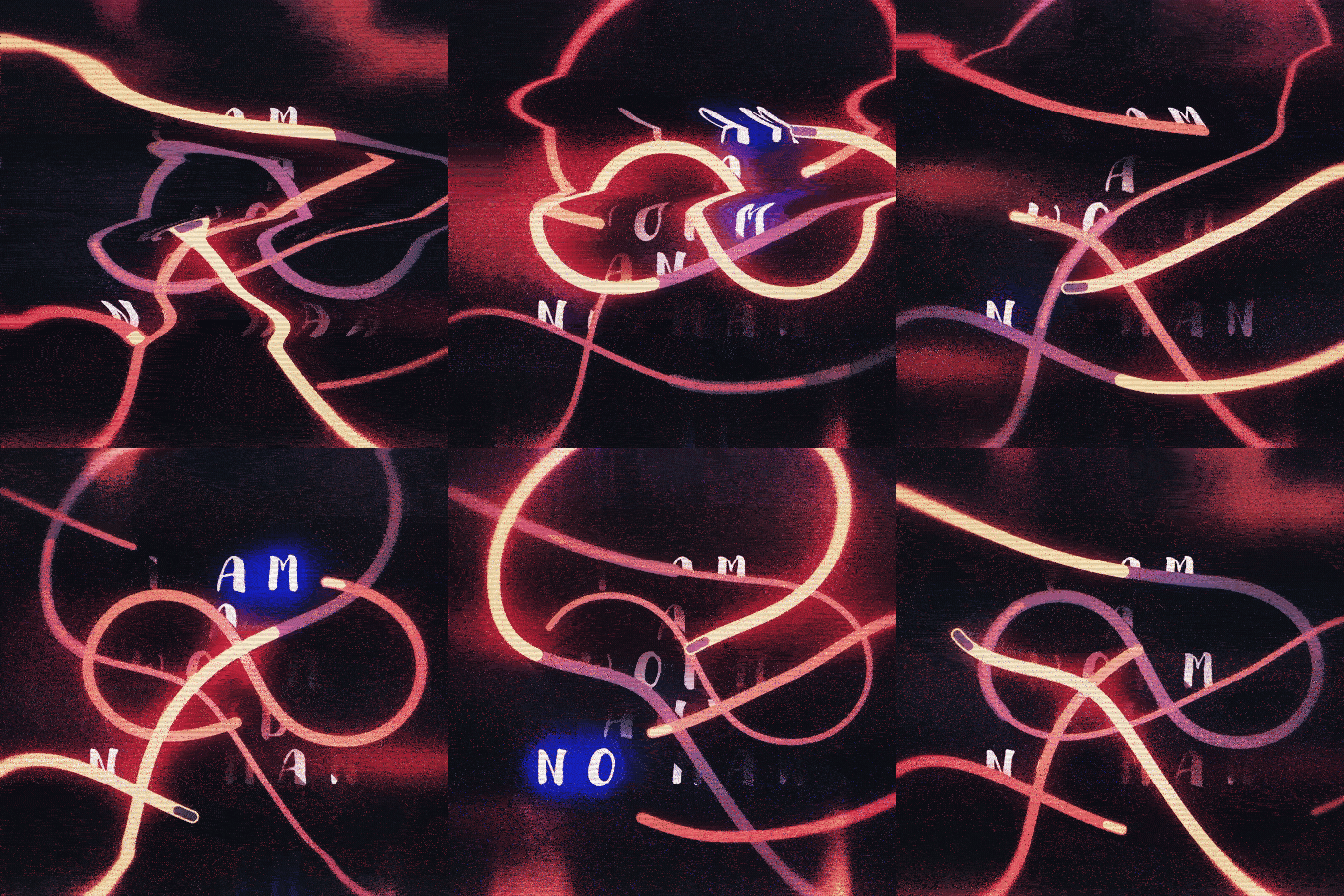
I used a multistroke plugin (whose name escapes me, and I’m too lazy to check) to create the worms in this animation, and used a simple Offset animation of Trim Paths to continually loop the movement of the worms.
I added in the text behind and applied a bunch of glows, noise, camera shake and other glitch effects to achieve the final look.
Enjoy.
But I am a worm, and no man: the reproach of men, and the outcast of the people.
(Psalm 21:7 DR)
View a higher quality version of this gif here: