

Psalm 21:9
getting what you want
He hoped in the Lord, let him deliver him: let him save him, seeing he delighteth in him. (Psalm 21:9 DR)
Do You Want It?
One constitutive element of the rational soul is the ability to will something. The sensible animals have their instincts by which they do things naturally, and their appetites and behavioral patterns by which certain goods are presented to them and acted upon, but my dog no more wills to disobey me and poop on the floor than a flower does to open its petal towards the sun. There is certainly a marked difference between the two actions—especially when you have to clean it up—but neither arises from a rational act of the will.
This is because the will follows intellect, another aspect of the rational soul. The intellect is not simply intelligence simpliciter, for even the beasts have varying levels of this, but is rather that by which we know the essence of things, rather than just the things themselves as concrete things. My dogs “know” what a tree is in the sense that they can tell the difference between a tree and a fence, but this “knowing” is not in terms of concepts or universals. They do not have the idea of “tree” or “tree-ness” that encompasses every instantiation of a tree without being located within this particular tree.
It is the rational soul’s ability to know things and judge between them in terms of essence that gives the will its actuality. To be able to know things and distinguish between them allows one to compare, contrast, delineate, and all the various ways in which we decide between things. Moreover, we can by means of our intellect and will perceive the good as good and evil as evil rather than just as a preference for our appetites. Things such as goodness, love, beauty, etc., are inaccessible to non-rational beings, as these do not exist within concrete objects as their essences do; goodness is not like the bark of a tree, for it is deeper and higher and can only be perceived by the intellect.
Our wills, then, as rational beings, are our means of laying hold, as it were, of what our intellects deem to be good. This can range from amoral choices like what condiments to use on burgers to deeply moral questions between good and evil, love and hate, beauty and ugliness. And since the will follows the intellect, our knowing something allows the will to choose it, and the habitual nature of setting one’s intellect on certain things also tends to solidify the will in choosing that thing. Sometimes our appetites and intellect and will align in harmony, but more often than not there is the struggle between the flesh and the spirit, between what our lower appetites and passions desire and what our intellect knows to be good. The will is then the arbiter of this battle, as it were, choosing which way to go.
Cross References
The Christological nature of this Psalm becomes manifest, in that the very words of the Psalmist here are employed by St. Matthew in his Gospel concerning the words spoken by those who saw our Lord on the cross:
Then were crucified with him two thieves: one on the right hand, and one on the left. And they that passed by, blasphemed him, wagging their heads, And saying: Vah, thou that destroyest the temple of God, and in three days dost rebuild it: save thy own self: if thou be the Son of God, come down from the cross. In like manner also the chief priests, with the scribes and ancients, mocking, said: He saved others; himself he cannot save. If he be the king of Israel, let him now come down from the cross, and we will believe him. He trusted in God; let him now deliver him if he will have him; for he said: I am the Son of God. (Matthew 27:38-43 DR)
So exact is the correspondence here that Cassiodorus sees this passage as more Gospel than Psalm:
He hoped in the Lord, let him deliver him: let him save him, seeing he delighteth in him. This was spoken by the Jews using the figure which in Greek is called ironia and in Latin irrisio, its surface-meaning being at variance with what it seeks to say. These words are in fact an exact gospel-text, for when Christ hung on the cross the Jews said: He hoped in the Lord: let him deliver him, since he will have him. How unchanging is the divine dispensation! We surely seem to be reviewing the gospel here rather than a psalm, since these things were fulfilled so authentically that they seem already enacted rather than still to come; and rightly so, as traitors could have no excuse, nor the faithful be left in doubt. (Cassiodorus, Explanation of the Psalms, 21, 9)
Where There’s a Will
The Vulgate has salvum faciat eum, quoniam vult eum for “let him save him, seeing he delighteth in him.” In St. Matthew’s Gospel the words are slightly different in the Vulgate, but have much the same meaning: liberet nunc, si vult eum—let him now deliver him if he will have him. In the Psalm the conjunction quoniam causally links vult eum to salvum faciat eam; that is, it is because the Lord delights in him that He will (or should) save him. In the Gospel the conjunction si is conditional for vult eum; that is, if the Lord delights in him or desires him, then He will save him.
The Douay-Rheims translates vult eum in the Psalm as delighteth in him because of the causal link to the previous clause, whereas the Gospel has will have him because of the conditional nature of the grammar. Vult is simply the third person present active indicative of volo, which generically means wish, want, desire. The Septuagint has θέλει meaning much the same—will, desire, decide. In various contexts it can take on different shades of meaning, but it gets at what the subject wants or desires, and the accomplishment of that is by means of the will.
Cassiodorus notes that in the case of the Gospel this is being spoken in a form of irony. They say let him now deliver him if he will have him, the implication being that the present situation—Christ on the cross—certainly indicates that this is not the case. This naturally ties in to the blasphemies and calumnies that are heaped upon our Lord, themselves also prophesied in the previous passages of this Psalm.
Common Septuagint Wins
However, while most of the quote from the Gospel is taken from this Psalm, there is an additional clause at the end: for he said: I am the Son of God. This creates an over-arching condition on the prophecy from the Psalm, as the reason God should deliver Him if He will have Him or delights in Him is because our Lord has said: I am the Son of God. This conditional phrase is absent from Psalm 21, but is not absent from the Old Testament, being rather a clear reference to Wisdom chapter 2:
He boasteth that he hath the knowledge of God, and calleth himself the son of God. Let us see then if his words be true, and let us prove what shall happen to him, and we shall know what his end shall be. For if he be the true son of God, he will defend him, and will deliver him from the hands of his enemies. (Wisdom 2:13, 17-18 DR)
The parallels between this passage and the passage from Psalm 21:9 are unmistakable, as the wicked mock the Christ of the Lord and twist the knife by the irony of saying that God will deliver Him if He really is the Son of God. Like Psalm 21, Wisdom 2 is replete with Christological allusions and—in the case—quotations, for St. Matthew combines the words of Psalm 21:9 and Wisdom 2:13 as the rulers of God’s people deride the Son of God as He hangs on the cross. And as the rest of Wisdom 2 makes clear, they do not say this because they have a genuine interest in knowing if He is the Son of God or not. Rather, they are upbraided by His holiness and feel the inconvenient sting of their consciences when He refuses to act as they do or value what they desire:
He is become a censurer of our thoughts. He is grievous unto us, even to behold: for his life is not like other men’s, and his ways are very different. We are esteemed by him as triflers, and he abstaineth from our ways as from filthiness, and he preferreth the latter end of the just, and glorieth that he hath God for his father. (Wisdom 2:14-16 DR)
In Jesus’ conflicts with the religious leaders, His main attack was usually against their hypocrisy. They professed to be good but then did not turn their wills to that good, instead desiring the lesser goods of this world such as the esteem of men, luxuries, money and the like. They had even made the temple itself into a sort of idol, for when He—as the true temple—started to threaten the order of things in respect to the temple, it was then that they determined—as an act of their wills—that He had to die. It was cloaked under the piety of not wanting the Romans to come and destroy it, but underneath was avarice and malice. There is a tragic irony here, for they mock Him with how He hoped in the Lord yet is not saved from the cross, yet the very motivations which lead them to sentence Him to death are themselves prompted by a lack of hope in the Lord. They think it is only through their wisdom and machinations that they can protect the temple, yet those very machinations will forty years later lead to its destruction. Thus, they do not sincerely turn their intellects to our Lord to see if He is the Son of God and will be delivered, since their wills have already decided to reject Him and put Him to death.
The Will and The Way
The final act of lack of faith is that in all three passages—whether in the Psalms or in Wisdom or in St. Matthew’s Gospel—the baseline assumption is that their understanding of things necessarily must prompt God to act in a certain manner. They in essence substitute their will for God’s will, and under the guise of piety blaspheme the will of God, that Christ should suffer for their salvation. Their intellects are fixed upon this world and the way in which it works—or the way they are comfortable with it working—and do not consider that God’s will might lie outside of their own limited intellects and their own mal-aligned wills. They cannot conceive of the Christ suffering, not because their Scriptures didn’t speak of it, but rather because they do not want to conceive that the way of righteousness might lie precisely within that suffering. For if God’s will is that His own Son should suffer for the sins of the world as a ransom, then His words about taking up the cross and following Him might be more than just metaphorical.
The wound of Original Sin weakens our wills, and we are tossed to and fro by the onslaught of concupiscence on a daily basis. Even with that being the case, in our natural selves we are far more comfortable with trying to hammer things out on our own, according to our wisdom and on our own terms. Christ on the cross, however, shows that the path of holiness and the path of hoping in the Lord and being delighted in by the Lord will itself bring crosses of varying kinds. Our Lord’s death on the cross was not an abandonment of Him by the Father, but the deepest union of will between the Father and the Son, for the Son said to the Father, not as I will, but as You will. If this is what it means to be the Son of God, then the same is true for all of His sons:
And you have forgotten the consolation, which speaketh to you, as unto children, saying: My son, neglect not the discipline of the Lord; neither be thou wearied whilst thou art rebuked by him. For whom the Lord loveth, he chastiseth; and he scourgeth every son whom he receiveth. Persevere under discipline. God dealeth with you as with his sons; for what son is there, whom the father doth not correct? (Hebrews 12:5-7 DR)
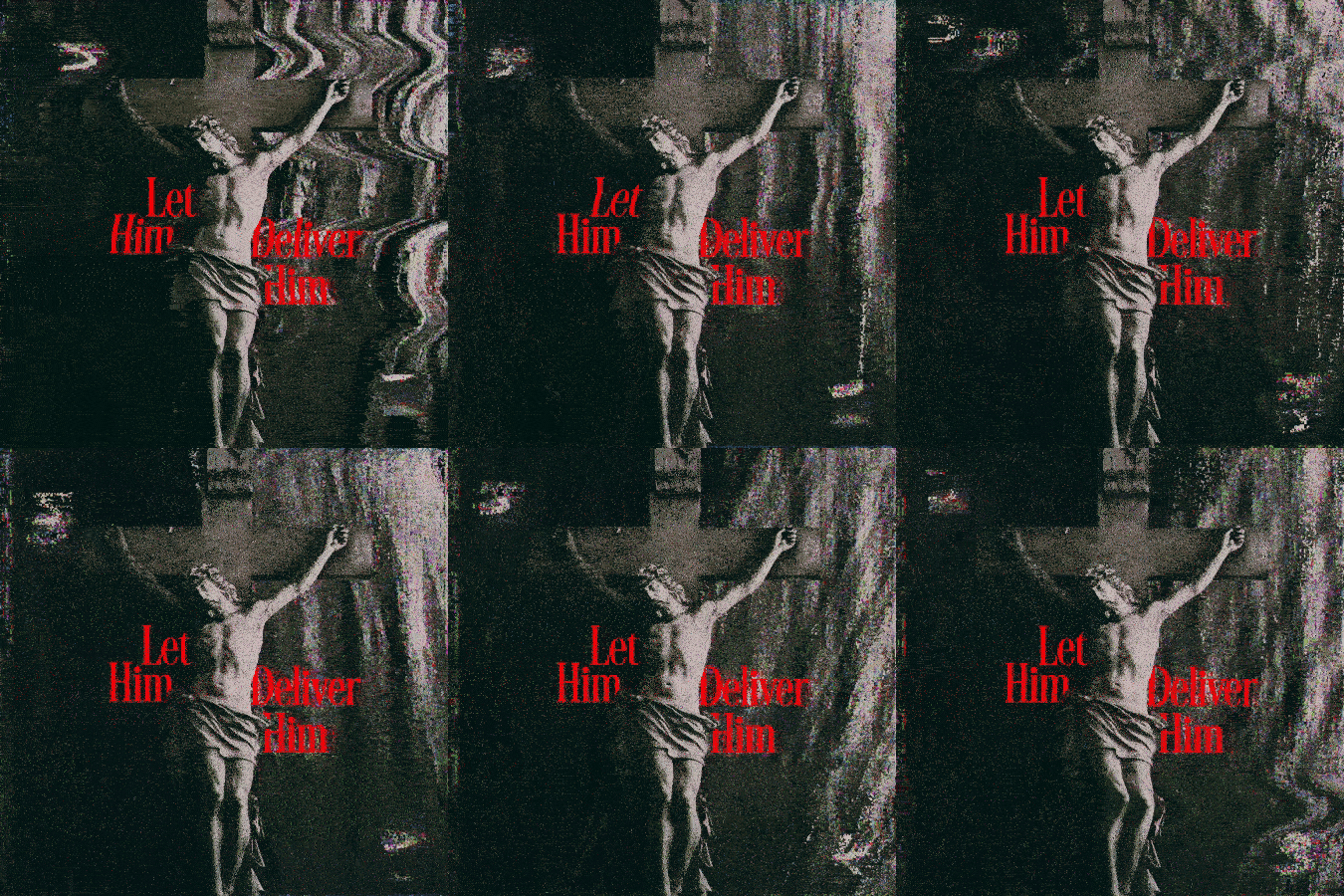
I found this excellent image of an old crucifix in what seemed like some ruins and tediously isolated it from the background, by which I mean I had the robots in Photoshop try and do that and then went in and re-did the whole thing when it miserably failed. Not that I have anything against the robots; I just hope they are more competent at enslaving us than a simple isolation of a foreground image from its background.
At any rate, in photoshop I added in an abstract textured background and applied Stretch to it along with some pixel sorting and Pixel Galactic, and then applied some wiggle hold to the rotation of the pixel sorting.
I then placed some glitch effects on top and composited the text behind the crucifix.
Enjoy.
He hoped in the Lord, let him deliver him: let him save him, seeing he delighteth in him. (Psalm 21:9 DR)
View a higher quality version of this gif here: