

A psalm for David. The Lord ruleth me: and I shall want nothing. (Psalm 22:1 DR)
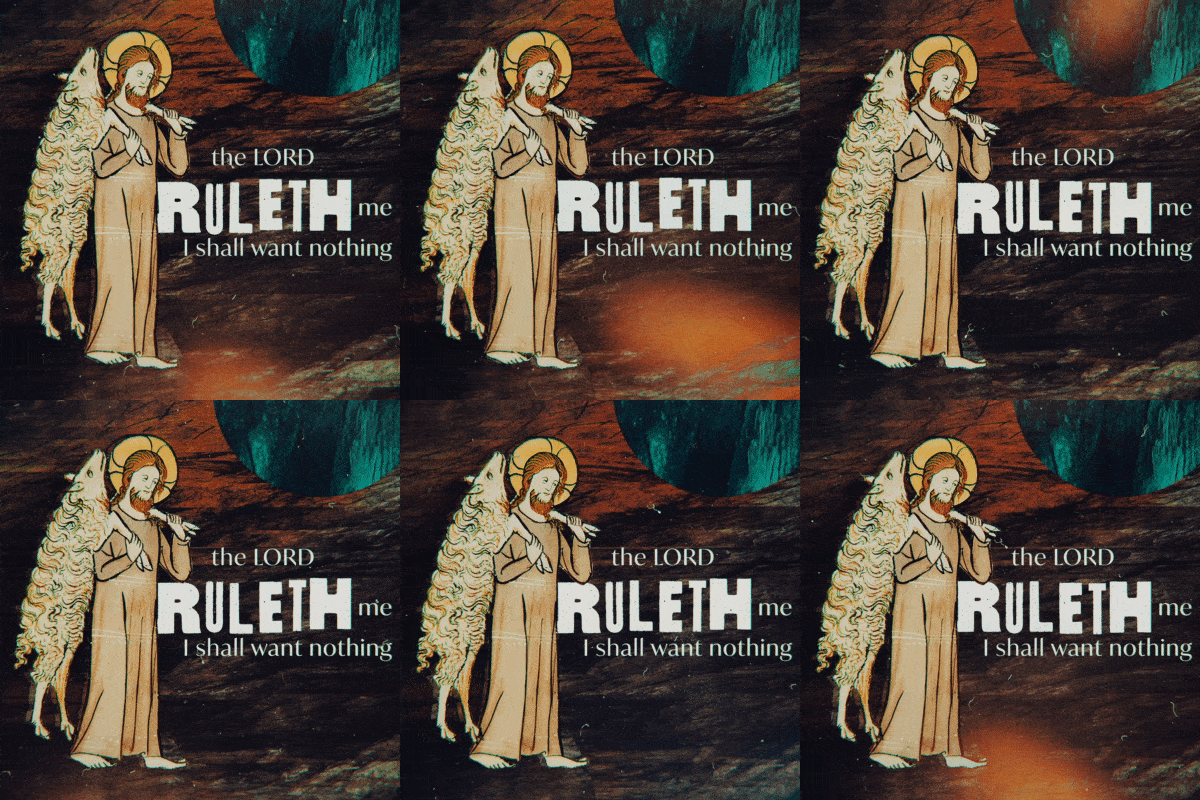
Psalm 22 is probably one of the most well-known of all the Psalms, or at least among English-speaking peoples. However, among many of them it is probably better known as Psalm 23, for the KJV translators opted to follow the Masoretic text rather than the Septuagint, which among other things messed up the long-standing numbering. This created headaches that are obnoxious and persistent since over 1500 years of Christian history had numbered it correctly as Psalm 22.
At any rate, things are as they are, and the KJV formed the warp and woof of much of the English-speaking religious vocabulary, such that its opening line of this Psalm— “The Lord is my shepherd”—is probably near to one of the most well-known biblical phrases in the English-speaking world.
And, to be fair, this is not a poor translation. Numbering issues aside, describing the Lord as a shepherd is a correct way in which to render the Hebrew רֹ֝עִ֗י (rō‘î), which means in English “my shepherd.” This corresponds to the Greek ποιμαίνει in the Septuagint which means “to shepherd” or “to rule.”
The Douay-Rheims, on the other hand, follows the correct numbering of the Psalms as found in the Vulgate, which itself follows the Septuagint. St. Jerome opted for regit to translate ποιμαίνει, as regit means to rule or direct or steer. In this manner the role of “shepherd” is implied by the context, which makes such an identification unmistakable.
Within the rendering of the Septuagint and Vulgate is a somewhat more active role for this Shepherd in relation to the sheep. Instead of being immediately identified by means of a relation to the Psalmist —e.g., the Lord is my shepherd—the Lord is identified firstly by means of His action in respect to the Psalmist—that is, “the Lord ruleth me.” This is perhaps a subtle distinction, but one which sets the tone for the rest of the Psalm.
The relationship between the Psalmist and his Lord can be likened to that between sheep and shepherd, in which the sheep relies entirely on the shepherd for survival and flourishing. Sheep have a tendency to wander off and go astray (cf. Isaiah 53:6), and the Psalmist begins by admitting his entire dependence on the Lord’s rule over him. Elsewhere the Psalmist also concludes the grand Psalm of God’s law by describing his own propensity to lose himself apart from God’s law:
I have gone astray like a sheep that is lost: seek thy servant, because I have not forgotten thy commandments. (Psalm 118:176 DR)
This dependency which is implied by the Lord’s rule is expanded in the second half of this passage, wherein the Psalmist says that because the Lord rules him, he shall want nothing. The supply of all that the Psalmist needs will be expounded over the rest of the Psalm, which makes this statement a container of sorts for what will come next:
The words, “I shall want nothing,” come to be explained by him after. Sheep require, first, rich pasture; secondly, pure water; thirdly, one to bring them back when they stray; fourthly, to be brought through easy passages; fifthly, to be protected from wolves and wild beasts; sixthly, to be supported when tired and weary; seventhly, if cut or maimed by passing through cliffs or rocks, to be cured; and, lastly, at the close of day, at the end of their journey, to have a home wherein they may securely rest. All these matters God gives in abundance to his elect, and they can, therefore, justly say, “I shall want nothing.” (St. Robert Bellarmine, A Commentary on the Book of the Psalms, 22, 1.)
To cast the Lord as Shepherd implicitly by the ways in which He rules His sheep is to also distinguish what makes a good shepherd from that which makes a bad one. The Lord thus isn’t just any shepherd, but the one Who will rule His sheep by doing for them all that the Psalm will describe. The Psalmist’s praise of the Lord is thus concretely realized in all the ways that God acts on His behalf, and thus this Psalm prophetically sets forth Jesus Christ as Good Shepherd and the Church as the sheepfold that He rules and Shepherds:
The Church speaks to Christ: “The Lord feeds me, and I shall lack nothing” The Lord Jesus Christ is my Shepherd, “and I shall lack nothing.” (St. Augustine, Expositions on the Psalms, 22, 1.)
It is a somewhat curious fact that St. Augustine follows the Latin version of the Hebrew text here, which has pascuit for regit, the word “pascuit” meaning to feed or to pasture. There are of course allusions to the Word of God as our food (cf. Deuteronomy 8:3), but preeminently to the Eucharist:
This is the bread which cometh down from heaven; that if any man eat of it, he may not die. I am the living bread which came down from heaven. If any man eat of this bread, he shall live for ever; and the bread that I will give, is my flesh, for the life of the world. Then Jesus said to them: Amen, amen I say unto you: Except you eat the flesh of the Son of man, and drink his blood, you shall not have life in you. (John 6:51-52, 54 DR)
The wanting of nothing of the Psalmist is thus directly fulfilled by our Lord in the Eucharist, for the Bread that gives eternal life is that Which will never cease to satisfy, and thus those who eat of it “shall want nothing.” Our Lord explains further:
He that eateth my flesh, and drinketh my blood, hath everlasting life: and I will raise him up in the last day. For my flesh is meat indeed: and my blood is drink indeed. He that eateth my flesh, and drinketh my blood, abideth in me, and I in him. As the living Father hath sent me, and I live by the Father; so he that eateth me, the same also shall live by me. (John 6:55-58 DR)
It should also be noted that it is precisely because “the Lord ruleth me” that the Psalmist can have confidence in never wanting for anything. It is not his own effort or goodness which brings him to this fulfillment of desire, but rather the gracious act of God, which again parallels perfectly our Lord’s discourse:
It is the spirit that quickeneth: the flesh profiteth nothing. The words that I have spoken to you, are spirit and life… And he said: Therefore did I say to you, that no man can come to me, unless it be given him by my Father. (John 6:64, 66 DR)
Only by being ruled and shepherded in such a manner can the Psalmist know that he will want nothing, for “faith is the substance of things to be hoped for” (Hebrews 11:1 DR). Faith that cooperates with God’s grace brings one into the relation of being ruled by the Lord, wherein a true conversion of heart is wrought and the wandering heart is set back on the right path. The sheep now trust completely in the Shepherd rather than in themselves, looking to Him to rule and to guide them:
When you say, “The Lord is my Shepherd,” no proper grounds are left for you to trust in yourself.” (St. Augustine, Sermon 366.2., ACCS.)
This is no saccharine sentiment robed in romanticized pastoral imagery, but rather the entirety of the spiritual life in summary. Our desires are set in our hearts for the Lord and can only be fulfilled by Him; only by allowing Him to shepherd and rule us can we ever confidently know that we will never want for anything, even in the face of what seems like poverty or persecution in this world. The Psalmist elsewhere declares his trust in the Lord despite what surrounds him:
For better is one day in thy courts above thousands. I have chosen to be an abject in the house of my God, rather than to dwell in the tabernacles of sinners. For God loveth mercy and truth: the Lord will give grace and glory. He will not deprive of good things them that walk in innocence: O Lord of hosts, blessed is the man that trusteth in thee. (Psalm 83:11-13 DR)
The superscription of this Psalm is “A Psalm for David,” which forms an interesting juxtaposition. David, after all, was king of his people, yet the one who was to rule and shepherd God’s people—by God’s very anointing and ordaining—himself must be ruled and shepherded. Our Lord Himself—as the Son of David—would become the Agnus Dei, the Lamb of God Who would take away the sins of the world. St. Paul reminds the Philippians that our Lord:
Who being in the form of God, thought it not robbery to be equal with God: But emptied himself, taking the form of a servant, being made in the likeness of men, and in habit found as a man. He humbled himself, becoming obedient unto death, even to the death of the cross. (Philippians 2:6-8 DR)
He thus modeled for us in His own Incarnation the humility that is to characterize those who have God as their Shepherd and are ruled by Him. And just as our Lord submitted His human will to the Father’s, so we as sheep must follow after our Good Shepherd Who will lead us to our heavenly homeland. St. Peter invokes the imagery of this Psalm to conclude:
For you were as sheep going astray; but you are now converted to the shepherd and bishop of your souls. (1 Peter 2:25 DR)
For this animation I found this fascinating miniature from the Speculum Humanae Salvationis from Darmstadt, which is translated as The Mirror of Human Salvation. This genre was interesting in its exploration of typology between the Old and New Testament, and in this particular manuscript the finding of a lost sheep by the Good Shepherd is typologized by the ascending of Elijah into heaven in the fiery chariot.
At any rate, I found the actual image of the shepherd carrying the sheep thought-provoking, as I thought it captured well how the spiritual life is often a manner of Jesus carrying the wounded sheep across the finish line, as it were.
I isolated the image in Photoshop and then tedious separated the sheep from the figure, and then isolated the various body part so I could create a walk cycle. I made generous use of Generative Fill for this.
In After Effects I precomped all the layers and created a looping walk cycle as best as I could with the limited pixel information.
I added in a background texture and used loopFlow to animate it and give the walk cycle some presence in the scene and a sense of moving somewhere. I also added in some spheres as mattes for textures for some more visual balance and interest.
Enjoy.
A psalm for David. The Lord ruleth me: and I shall want nothing.
(Psalm 22:1 DR)
View a higher quality version of this gif here:


