

He hath set me in a place of pasture. He hath brought me up, on the water of refreshment: (Psalm 22:2 DR)
The theme of shepherding is replete throughout the Scriptures, and the relationship between the Lord and His people is often couched in these very terms. The soul which has the Lord for its ruler and shepherd shall want for nothing, as the Psalmist began this Psalm. This is—as was seen in the first verse—the characteristic of the “good” shepherd, and our Lord is of course the exemplar of the Good Shepherd Who will lay down His life for the Sheep (cf. John 10:11).
The prophets on many occasions castigate the people for straying like sheep or their leaders for being poor shepherds. Jeremiah prophesies of the coming Messianic kingdom which will set this right and provide good shepherds who will feed the Lord’s sheep:
And I will gather together the remnant of my flock, out of all the lands into which I have cast them out: and I will make them return to their own fields, and they shall increase and be multiplied. And I will set up pastors over them, and they shall feed them: they shall fear no more, and they shall not be dismayed: and none shall be wanting of their number, saith the Lord. Behold the days come, saith the Lord, and I will raise up to David a just branch: and a king shall reign, and shall be wise, and shall execute judgement and justice in the earth. In those days shall Juda be saved, and Israel shall dwell confidently: and this is the name that they shall call him: the Lord our just one. (Jeremiah 23:3-6 DR)
This metaphor of shepherd and sheep provides numerous prophetic foreshadowings. The pastors who will feed the Lord’s sheep are the Apostles and their successors; after all, St. Peter—who is the Prince of the Apostles—was given this truly pastoral role:
[Jesus] said to him the third time: Simon, son of John, lovest thou me? Peter was grieved, because he had said to him the third time: Lovest thou me? And he said to him: Lord, thou knowest all things: thou knowest that I love thee. He said to him: Feed my sheep. (John 21:17 DR)
This threefold confession and our Lord’s threefold admonition to feed My sheep not only parallels and undoes St. Peter’s three-fold denial; it also sets the admonition in the superlative, as ancient idioms were wont to do, much like the Sanctus, sanctus, sanctus of the Mass indicates the superlative holiness of God. St. Peter as holding the keys of the kingdom—as our Lord’s vicar—therefore has this responsibility to feed the sheep of the Lord, which is carried out through his teaching and that of the Apostles and their successors.
However, it is not his teaching of his own devising but is the teaching of our Lord which he safeguards. This deposit of faith is what he and the apostles guard and pass on, and thus:
He that heareth you, heareth me; and he that despiseth you, despiseth me; and he that despiseth me, despiseth him that sent me. (Luke 10:16 DR)
Jeremiah’s prophecy also spoke of the sheep dwelling confidently in their own fields, which brings this prophecy of Jeremiah into contact with this Psalm, for the Psalmist speaks of the Lord placing him in a place of pasture. The primary purpose of pasture for sheep is to provide them nourishing food in abundance, which has the effect of leading them where the shepherd wants to and the latent effect of keeping them from wandering off looking for greener pastures:
“In a place of pasture there has He placed me.” In a place of fresh pasture, leading me to faith, there has He placed me to be nourished. (St. Augustine, Expositions on the Psalms, 22, 2.)
St. Augustine elsewhere ties these pastures directly to the words of God and the nourishment they provide:
The pastures, then, which this Good Shepherd has prepared for you, in which he has settled you for you to take your fill, are not various kinds of grasses and green things, among which some are sweet to the taste, some extremely bitter, which as the seasons succeed one another are sometimes there and sometimes not. Your pastures are the words of God and his commandments, and they have all been sown as sweet grasses. (St. Augustine, Sermon 366.3, ACCS.)
It is crucial to understand, however, that the sheep feeding in this pasture is not an act that arises out of itself; as the Psalm says: “He hath set me in a place of pasture.” The sustenance that we are provided is thus not of our own doing nor something we can contrive or modify. The pleasant and bountiful pastures are a gift to be received with gratitude, and these, as St. Augustine notes, leads us to faith.
This place of pasture is not, however, some abstraction, but rather is realized in the Catholic Church which our Lord founded, the sheepfold for the sheep, as it were. The abundance of the pastures are found within her, for she possesses the fullness of truth as the Truth Himself is the One Who founded her:
“He hath set me in a place of pasture;” not in a barren or desert spot, but in prairie land, where an abundance of the choicest and most wholesome grass is to be had; where the sheep have food in abundance; the food, in a spiritual sense, being the knowledge of God, his sacraments, especially the Eucharist, Truth himself, for these are what support, nourish, and increase the spiritual life within us. (St. Robert Bellarmine, A Commentary on the Book of the Psalms, 22, 1.)
The sacramental reality of the Church is thus the means by which God’s grace is shed abroad into the world and through which her members grow in virtue and holiness.
The Psalmist continues to describe these pastures as being watered by the waters of refreshment, for abundant fields require a plentiful and ever-renewed water source. St. Bellarmine draws a parallel to our Lord’s words about Himself as the “living water:”
The spiritual water that extinguishes the thirst of us sheep, is the grace of God, of which Christ himself speaks in the Gospel, Jn. 4, “Whosoever shall drink of the water I will give him, shall not thirst forever.” Nothing is so effectual in curbing our carnal desires, as a taste of the love of God; to the soul who once tastes of it, everything else seems insipid. (St. Robert Bellarmine, A Commentary on the Book of the Psalms, 22, 2.)
This water was understood by the Church Fathers as a prophetic utterance of the sacrament of Baptism which effectuated the translation from death to life:
He hints at the waters of rebirth, in which the baptized person longs for grace and sheds the old age of sin and is made young instead of being old. (Theodoret of Cyr, Commentary on the Psalms, 23.2., ACCS.)
St. Augustine draws out this analogy of the pastures and the waters a bit more concretely, for while the pastures as the word of God lead to faith, that faith will be ineffectual unless watered by Baptism. And on another level, Baptism is the gateway to all the other sacraments, including the Eucharist. These pastures are thus not only the words of God but also in the Eucharist the very Word of God, our Lord Jesus Christ as truly present in the sacrament. These waters of refreshment in Baptism thus take the soul prepared in faith by hearing the word of God (cf. Romans 10:17) and incorporate her fully into the one sheepfold, the Holy Catholic Church, where that self-same soul can then be truly and fully nourished:
These pastures, though, are not far from the water of refreshment; the one place for both of these is the Catholic Church of God, where the commandments of life are your pastures, and where is to be found the fountain of water leaping up to eternal life [John 4:14], with whose streams you will be refreshed when you are baptized in order to be restored in Christ. (St. Augustine, Sermon 366.3, The Works of St. Augustine, Vol. 10.)
The term the Psalmist uses for refreshment is refectionis, which has the sense of repairing or restoring something, in this case the soul. St. Paul in his Epistle to the Romans couches the Psalmist’s prophecy here in explicitly theological terms, as the one who is baptized is baptized and buried with Christ so as to be raised to new life:
Know you not that all we, who are baptized in Christ Jesus, are baptized in his death? For we are buried together with him by baptism into death; that as Christ is risen from the dead by the glory of the Father, so we also may walk in newness of life. (Romans 6:3-4 DR)
Baptism thus forms on one hand the culmination of faith to eternal life, but also enables the soul to partake of the commandments of life:
Unless your pastures, then, are irrigated by this water, it will be impossible for you to be reared, because the commandment of God can neither germinate without the baptism of Christ, nor be eaten so as to satisfy the soul. (St. Augustine, Sermon 366.3, The Works of St. Augustine, Vol. 10.)
In the Church, then, is the fullness of the words of God through the teaching office of the Apostles, who were commissioned by our Lord to proclaim his teachings throughout the world. However—and this is the Providence of God in the inspiration of Scripture—this commission to preach and teach is inextricably linked with the command to baptize:
Going therefore, teach ye all nations; baptizing them in the name of the Father, and of the Son, and of the Holy Ghost. Teaching them to observe all things whatsoever I have commanded you: and behold I am with you all days, even to the consummation of the world. (Matthew 28:19-20 DR)
This the Psalmist all foresees and prophesies, and our Lord as the Good Shepherd fulfills them in His very Person and in His mystical Body the Church. The Psalmist has thus far framed everything in terms of what the shepherd has done for the sheep, but all this comes forth from the shepherd’s love and care for the sheep, which in our Lord the Good Shepherd extends to His suffering and death. It is thus fitting that at every Mass is commemorated and re-presented this self-same perfect Sacrifice which effects our salvation and which we—as members of His Body—participate in unto the salvation of our souls:
The Lord leads me. That is the word of the one who the Church, settled in a place of pasture and drawn from the water of reflection, has received, the one who is made complete from the suffering of our Lord. When the stream flows, it pours forth from deep veins, there freshness, there pleasantness, there renewal. These things will happen to me because he has transformed my soul through His suffering. (Arnobius the Younger, Commentary on the Psalms, 22., ACCS.)
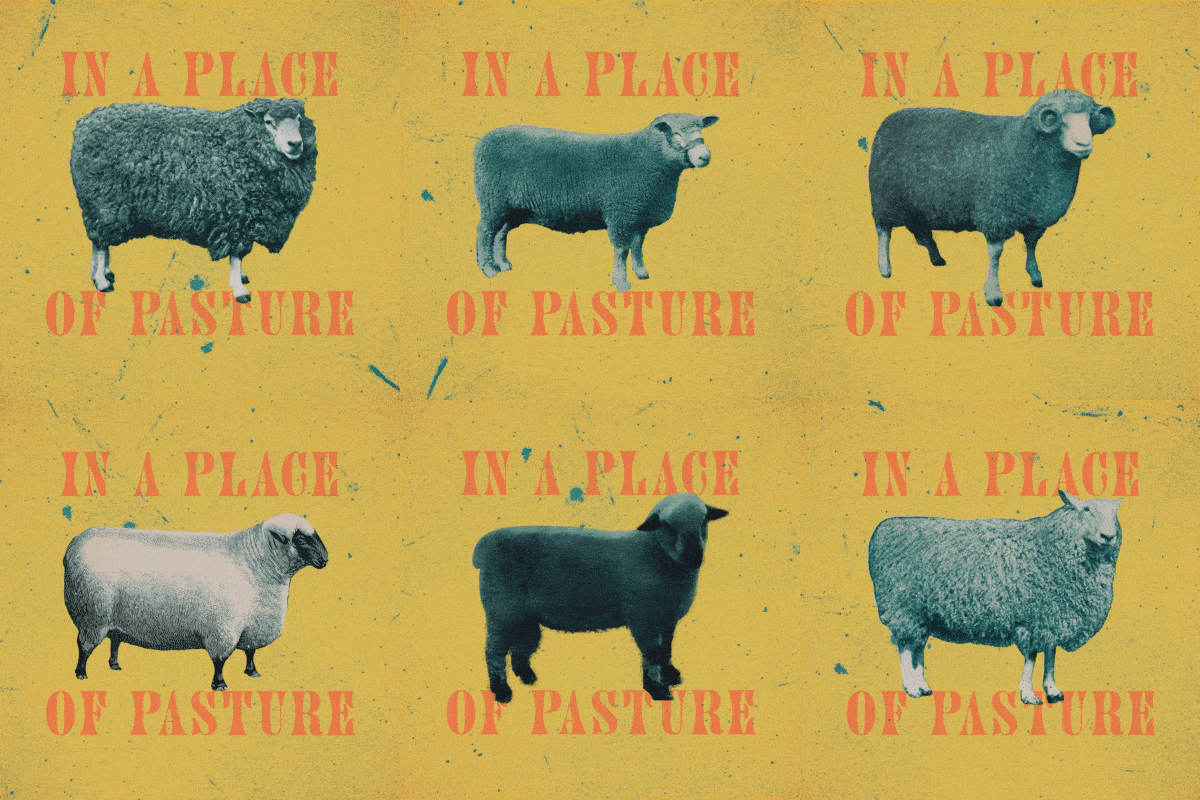
I wanted to focus on sheep for this one, so I found a bunch of old vintage images of various breeds of sheep and cut them all out in Photoshop. I then sequenced them in After Effects and that was basically it.
Enjoy.
He hath set me in a place of pasture. He hath brought me up, on the water of refreshment. (Psalm 22:2 DR)
View a higher quality version of this gif here:


