

Psalm 2:5
never dare the bear
Then shall he speak to them in his anger, and trouble them in his rage. (Psalm 2:5 DR)
As he continues the Psalmist notes a pattern in which God brings to naught the vanity of those who set themselves against Him.
The wicked first are allowed by God to stand up against Him (Psalm 2:2), to make their plots and undertake their machinations. In this sense God’s restraining hand lets go of the rope, as it were, and they are permitted to engage in their rebellion.
Next they are empowered in their wickedness, desiring to be “free” from God’s law and dominion. They perceive God’s will and plans as a bond (Psalm 2:3) that enslaves them, rather than means of freedom. They thus cast away the lighter yoke of Christ (cf. Matthew 11:28-30) for the heavier bondage to sin and wickedness.
The penultimate step is that they are made a mockery (Psalm 2:4) as their plans and machinations come to nothing. God is said to “laugh” at them because their scheming becomes both the cause of their own destruction and the means by which God fulfills His purposes in the world.
The final step is that they receive in themselves the punishment for their wickedness, in which God is said to speak to them in His anger and to trouble them in His rage. As St. Augustine notes, it is important to understand and recognize the anthropomorphic language employed, lest we be led to believe that God suffers perturbation of mind:
But by the wrath and sore displeasure of the Lord God must not be understood any mental perturbation; but the might whereby He most justly avenges, by the subjection of all creation to His service. (St. Augustine, Expositions on the Psalms, 2, 5.)
Moreover, he makes a fascinating point that the wrath of God—while certainly real—has the subjective component in which the one who has sinned comes to understand his sin the displeasure of God towards it:
The wrath of God then is an emotion which is produced in the soul which knows the law of God, when it sees this same law transgressed by the sinner. (ibid.)
This entails that the wrath of God is not some attribute of God that stands apart from the rest of His being to be employed or not dependent on the circumstance. For us wrath is an emotional state produced by circumstances that need not exist if the conditions are not met. But God is not a collection of attributes but simple in being; there is not, as some imagine, God’s “wrath” on one side and His “mercy” on the other and the two somehow need to be reconciled or else God is in some existential dilemma. Rather, God’s wrath and God’s mercy are the same action of God and of His will; it is our finite minds unable to comprehend the totality of God’s being which forces us to compartmentalize or separate them conceptually.
The upshot of this is that when God pours out His wrath upon the wicked, it is the darkening of their intellects which apprehends God’s will towards them as wrath; he “gives them up” (cf. Romans 1:24) to this darkened intellect and its perverted desires which—as we have already seen—see God’s law as slavery and His commands as burdensome. Thus:
And as they liked not to have God in their knowledge, God delivered them up to a reprobate sense, to do those things which are not convenient… (Romans 1:28 DR)
St. Augustine comments on this Psalm and ties it into the language of St. Paul:
For by this emotion of righteous souls many things are avenged. Although the wrath of God can be well understood of that darkening of the mind, which overtakes those who transgress the law of God. (St. Augustine, Expositions on the Psalms, 2, 5.)
This is fascinating, for he states that the wrath of God is apprehended by the righteous in a sense of vindication, but by the sinner in a sense of condemnation. The self-same act of God is thus received, as it were, in the manner in which the condition of the soul is conditioned to receive it. As God purifies the soul by pouring His charity into the heart (cf. Romans 5:5) we are no longer vessels of wrath (cf. Romans 9:22) but rather of mercy. Our Lord utilizes a similar metaphor about not pouring new wine into old wineskins (Matthew 9:14-17).
As the descent of the wicked that the Psalmist chronicles demonstrates, we cannot be complacent if we step outside of God’s will, for the darkening of the intellect which sin inevitably brings is part and parcel of the punishment of sin, as it were, for God’s wrath is evident in this degradation. The thought that God would give us over to our depravity is a fearful thought, which is why we must strive to cling to Him and His ways with all that we have. In this manner His “wrath” becomes the occasion of our vindication rather than condemnation.
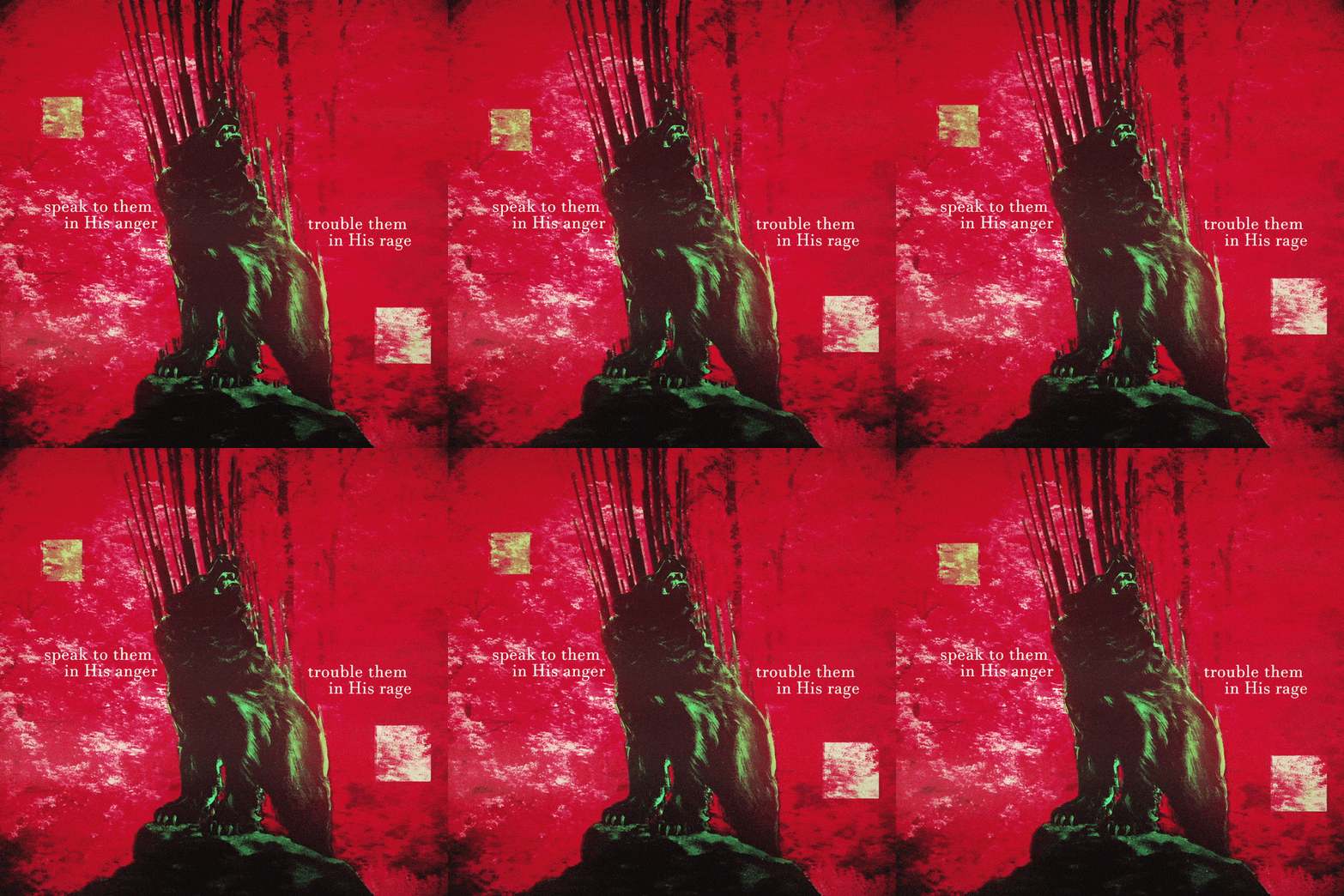
I wanted to have some fun with this animation, and I happened to find this great image of a raging bear which I thought would work nicely for this verse.
I cut it out in Photoshop and brought the bear in After Effects, precomping it for use. I then applied Stretch to the precomp and animated the cycle to go pretty quickly to give a sense of rage. I also applied a camera shake to the whole project to make it feel a tad unsettled and did some major color correction to create some false colors to sell the effect even more.
Enjoy.
Then shall he speak to them in his anger, and trouble them in his rage.
(Psalm 2:5 DR)
View a higher quality version of this gif here: