

But as for me, I have walked in my innocence: redeem me, and have mercy on me. (Psalm 25:11 DR)
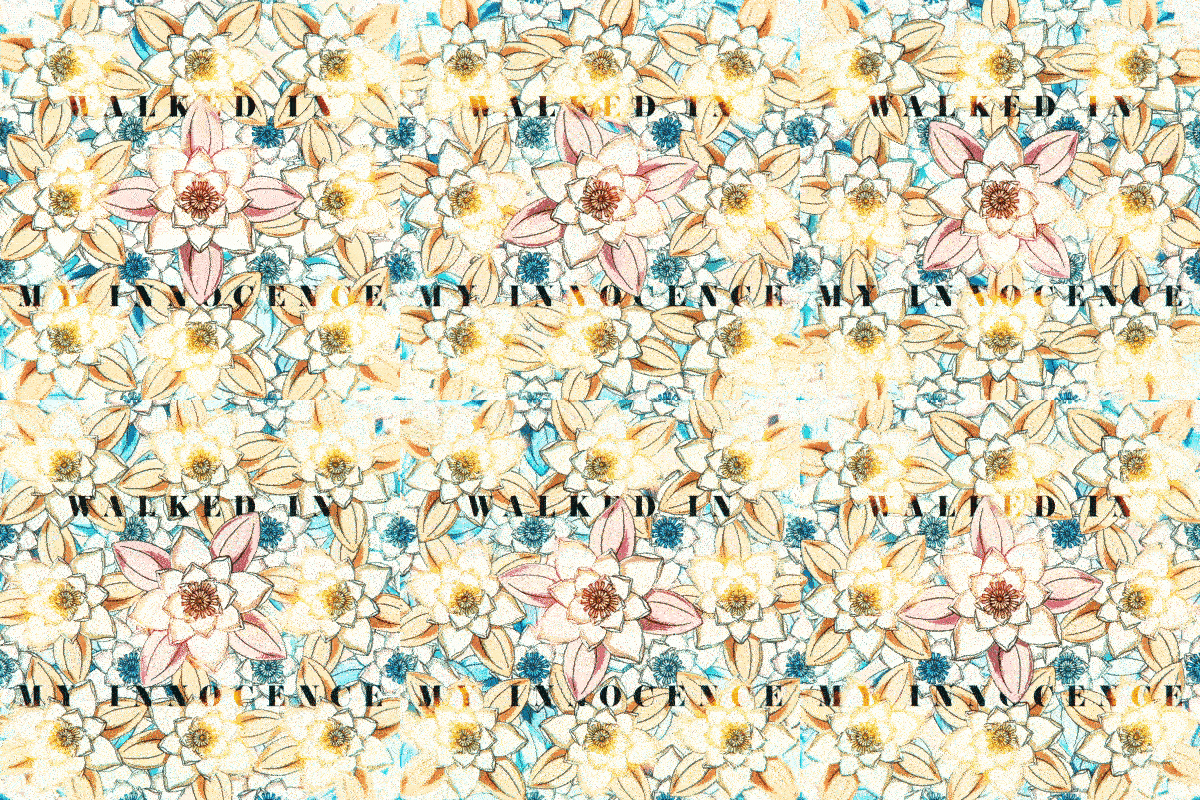
In color theory there is the concept of complementary colors, which doesn’t necessarily mean that the colors work well together. Indeed, in many cases they can horrifically clash and create contrast that is overwhelming. The notion of complementary colors is in fact purely one of the physics, if you like, of color, and colors which are complementary are those which are on the exact opposite sides of the color spectrum. If you envision the color spectrum as a wheel, they would exactly mirror each other in position.
This has the physical effect of complementary colors creating the greatest possible contrast for any given color. That is, if you want a color that will perfectly contrast with the color you have, its complementary color will do so, and this contrast increases in proportion to the saturation and luminance. Orange and blue, for example, are complementary, and while they can work together in certain situations such as set next to each other to create contrast, they can become harsh when one is set on top of the other without an intervening color or neutral:

In some instances another false color is visually interposed as an outline or separation between the two, as the contrast is so great our brains have to process some manner of distinguishing them.
The Psalmist draws out a final contrast between himself and the wicked. In the previous passage he decried their pursuit of worldly gain and their attempts to pervert justice, and now he sets himself in marked contrast to them. They may have done all these things, but he has walked in innocence:
But as for me, I have walked in my innocence: redeem me, and have mercy on me. This is the figure of syncrisis, when a man tries to make his case better by reference to his opponents. Whereas when they receive money they rejoice that their right hand is filled with gifts, he says that he himself has made his way into the riches of innocence. Having entered into spiritual treasures, he consoled himself much more genuinely than they could have rejoiced over worldly riches. Redeem me, in other words, free me with precious blood at Your coming, for by it the world was delivered when held subject to sins. And have mercy on me, that is, in this world, where You spare those who faithfully entreat You. (Cassiodorus, Explanation of the Psalms, 25, 11, Ancient Christian Writers.)
St. Robert Bellarmine observes that the figure of “redemption” is often synonymous with “deliverance,” although this does not preclude a spiritual understanding:
Deliver me from my present troubles, and then have mercy on me, that I may not fall into them again. The words “redeem” and “deliver,” most frequently have the same meaning in the Scriptures, unless, perhaps, the Holy Ghost may insinuate that any deliverance of the elect from tribulation may be called redemption, inasmuch as such is effected through the blood of Christ our Redeemer. (St. Robert Bellarmine, A Commentary on the Book of the Psalms, 25, 11.)
As the Psalmist protests a final time his innocence, he sets this as the reason why God should have mercy on him and redeem him. Or rather, it is not because of his innocence per se, as if it comes forth from himself, but rather because his hope and confidence is in God’s justice, Who will not sweep the innocent away with the wicked.
The Vulgate uses ego autem in innocentia mea ingressus sum, which the Douay-Rheims translates as “I have walked in my innocence.” This is an identical phrase to the first verse in this Psalm and thus forms a fitting parallel to complete it. The word ingressus tends to have the sense of “entering” or of a “passage.” He also speaks in the middle of this Psalm of “washing his hands among the innocent” and “compassing the altar of the Lord.” In this manner his walking in innocence is not merely a purity of heart and soul, although it is certainly not less than that. Rather, he has “entered” the house of the Lord in his innocence; in other words, his “walking” in innocence is completely dependent upon and oriented towards the tabernacle of the Lord, and not some misconceived self-righteousness. When he speaks of walking or entering in his innocence, he is not being holier-than-thou or presumptuous in his righteousness, but has fixed his heart and will on the Lord so that his righteousness comes from God as poured into his soul (cf. Romans 5:5). After all, to be on this path of righteousness is itself God’s will, as He desires our sanctification (cf. 1 Thessalonians 4:3). To maintain his innocence by walking in this way he has entered is thus to turn his will towards the Lord’s will, to follow in the path which He has laid out for him to walk.
This is why the Psalmist can both maintain his innocence and plead for mercy and redemption. His purity of heart is not a reward that he conjures out of his own will, but it is a “reward” for submitting his will to God’s and walking in His path. As noted in a previous passage, this is God “crowning His own gifts,” in that the merits that we receive from God are the result of His grace operating in our lives. Far from diminishing God’s glory, it rather accentuates it as the soul which is aligned with God’s will and is full of His charity and cooperates with His grace becomes a reflection and refulgence of the Source of that grace. In other words, the holier one becomes, the less one has to boast of one’s own efforts; in the words of St. John the Baptist: “He must increase, while I must decrease” (John 3:30 DR).
This is brought out in St. Jerome’s Hebrew translation, in which the term “simplicitate” is used in place of “innocentia.” Simplicitate, as the English cognate suggests, can mean “simplicity,” as in the phrase “simplicity of spirit.” This of course carries connotations of innocence, but in the sense of a lack of presumption or guile. That is, it is not merely being innocent of sin, but rather a disposition or posture towards the good and the noble and true. The Psalmist elsewhere captures this two-fold dynamic:
Blessed is the man to whom the Lord hath not imputed sin, and in whose spirit there is no guile. (Psalm 31:2 DR)
The Hebrew here also uses the word gradiar for “walked,” which has a more straightforward relation to walking forward. However, there is also potentially a reference to entering the tabernacle of the Lord with the innocent, for gradiar is related to the graduum or steps that form the superscription of the Gradual Psalms or Psalms of Ascent, which were sung while entering into Jerusalem or the temple by means of ascending steps, either figurative or literal. Additionally, the tense is different, for here the verb is in the present subjunctive active, indicating the sense of “I will walk” rather than “I have walked.” Interestingly, the Hebrew begins this Psalm with the phrase ego in simplicitate mea ambulavi, which has the sense of “I walked in my simplicity.” In this manner the Psalmist looks back at his past simplicity of spirit, and then as he closes this Psalm looks forward with the same mindset, a deliberation to continue to walk in that innocence and simplicity.
It is because of this lack of guile in his spirit that he can confidently plead to God to have mercy and redeem him. On the literal level this refers to the exile he currently faces and the dangers which encompass him. But on the spiritual level it prophetically looks forward to the deliverance from this vale of tears, when faith shall be made sight:
Let so great a price of my Lord's Blood avail for my complete deliverance: and in the dangers of this life let not Your mercy leave me. (St. Augustine, Expositions on the Psalms, 25, 11.)
For this animation I found some old vintage illustrations of flowers, and isolated them in Photoshop and then precomped and arranged them in After Effects. I animated the rotation and then offset them in time. Next I changed up the hue on some to give it some visual differentiation, then added in some glow and color correction.
Enjoy.
But as for me, I have walked in my innocence: redeem me, and have mercy on me.
(Psalm 25:11 DR)
View a higher quality version of this gif here:


