

I believe to see the good things of the Lord in the land of the living. (Psalm 26:13 DR)
The Psalmist sometimes uses the penultimate verse of a Psalm as a sort of bridge from the rest of the Psalm to the conclusion, in a sense recapitulating or restating the theme or the general tenor before launching into the conclusion.
In Psalm 26 he does something similar. The seeing that he believes in corresponds to the Lord as his light by which he believes so as to see the good things of the Lord, and these good things just are the one thing that he desired so ardently, to dwell in the house of the Lord, to see the delight of the Lord, to visit His temple.
He believes—credo—which is the first word from the Creed, and the present active form underscores that this belief is something he presently possesses and does. His will actively believes, even though in the previous passage he spoke of those who falsely accused him and earlier of those who pressed in around him to eat his flesh. To believe is not an intellectual exercise or merely a set of propositions but is rather something that is borne out in one’s life, the actions one takes, the things one says, the manner in which one lives irrespective of the circumstances or pressures.
Earlier translators of the Septuagint had the Greek equivalent of the Latin credidi—I believed, such as Aquila, and credebam—I was believing, such as Symmachus. These emphasize the point of belief (credidi) and the habit of believing (credebam), but credo—translating the Greek πιστεύω—sort of folds these into the present moment. The Psalmist’s belief and hope in the Lord cannot exist as something in the past, but is a present reality. For our actions in the past bring us to where we are in the present and in terms of habit can set a course for a future, but the will can only act in the present. Thus the Psalmist brings his faith and hope and trust as an act of his will into the now.
He believes to see not just good things in general, but the good things of the Lord. He therefore does not have in mind earthly delights or pleasures, even if in and of themselves they may be good things. Rather, he seeks those good things which are of the Lord, which signals those which are eternal, and which, of course, coalesce in God Himself, as it were, for God is the source and summit of all goodness.
For I, in spite of all my enemies, “believe,” have the strongest confidence, that “I will see the good things of the Lord;” that is, those good things which, before God, are good; which make man happy, which alone are really good; and that, “in the land of the living,” in that land where death hath no place, no dominion. (St. Robert Bellarmine, A Commentary on the Book of the Psalms, 26, 13)
This is further explicated in that these good things are to be seen in the land of the living. His present faith in the Lord thus provides the sight to see those good things, even though in this present vale of tears they seem so far off. For if these good things are in the land of the living, then this world corresponds to the land of the dying:
O the good things of the Lord, sweet, immortal, incomparable, eternal, unchangeable! And when shall I see you, ye good things of the Lord? I believe to see you, but not in the earth of the dying. I believe to see the good things of the Lord in the earth of the living. The Lord shall deliver me from the earth of the dying, Who for my sake vouchsafed to take upon Himself the earth of the dying, and to die amid the hands of the dying: the Lord shall deliver me from the earth of the dying: I believe to see the good things of the Lord in the earth of the living. (St. Augustine, Expositions on the Psalms, 26, Exposition 2, 22)
In this present exile we are only pilgrims and wayfarers, and the dangers of this world are manifold, but perhaps no more so than the tendency we have to make a home here, to become comfortable and at rest in a land through which we are only passing. The good pleasures and delights of this world—which are themselves gifts of God—can be twisted into ends rather than means, to become that for which we labor and strive rather than impetuses on to their source and summit in God. We can forget that this is a land and region of death, and that true life lies beyond. As the previous passage noted, iniquity can lie to itself, and we can very easily fall for that lie and believe—credo—to see the good things of the world in the land of death, rather than the good things of the Lord in the land of the living.
The previous passage thus serves as a warning, and this present one as a corrective, for the good things that the Psalmist seeks—that one thing—can only be found in the land of the living, as those good things are eternal and not passing and fading like this life. They also have their ultimate referent not in themselves as good things, but instead refer always to the Lord. The delights and pleasures and good things of this world are only good insofar as they direct our gaze to the Lord, as we receive them with gratitude. They can become stepping stones on the road to heaven, but can also be used to build houses in the love of this world. We must never love them or delight in them for their own sake, but always hold to them loosely as temporary gifts from the One Who wishes to give us of Himself for all eternity in the land of the living.
The world has been created for this purpose, that we may be born; we are born for this end, that we may acknowledge the Maker of the world and of ourselves—God; we acknowledge Him for this end, that we may worship Him; we worship Him for this end, that we may receive immortality as the reward of our labours, since the worship of God consists of the greatest labours; for this end we are rewarded with immortality, that being made like to the angels, we may serve the Supreme Father and Lord for ever, and may be to all eternity a kingdom to God. This is the sum of all things, this the secret of God, this the mystery of the world, from which they are estranged, who, following present gratification, have devoted themselves to the pursuit of earthly and frail goods, and by means of deadly enjoyments have sunk as it were in mire and mud their souls, which were born for heavenly pursuits. (Lactantius, Divine Institutes, Book VII, Chapter 6)
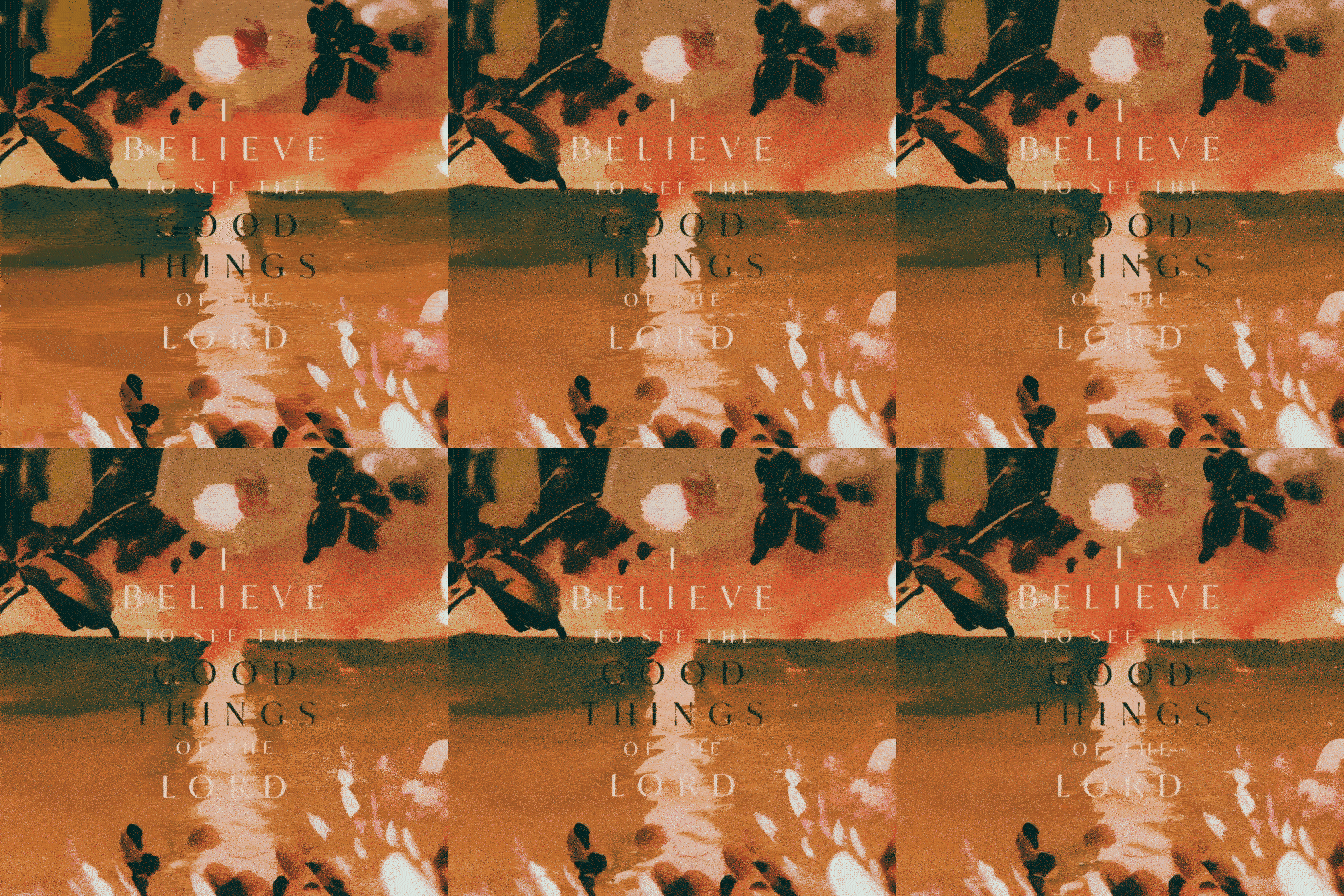
I found a nice image of a sunset on water and applied LoopFlow to it to create the water animation, and then extracted the floral components of a painting and superimposed them on the landscape, using some light position wiggle hold animation. I then applied some color correction and camera shake and added some wiggle hold animation on the position of the text.
Enjoy.
I believe to see the good things of the Lord in the land of the living. (Psalm 26:13 DR)
View a higher quality version of this gif here:


