

For he hath hidden me in his tabernacle; in the day of evils, he hath protected me in the secret place of his tabernacle. (Psalm 26:5 DR)
When I was in college I came across this song called Sit With You Awhile, which is a song in the “worship music” genre that for some reason struck a chord with me, and since I was playing guitar at the time, I suppose I also struck a chord with it. In all seriousness though, since it’s a “worship song,” it has at least at three more chords, but certainly not more.
In all actual seriousness, even though the lyrics are a bit saccharine, there was something about the idea of sitting with our Lord for awhile that spoke to my heart.
The verse goes as such:
When I cannot feel
When my wounds won’t heal
Lord I humbly kneel hidden in You.
Lord, You are my life
So I don’t mind to die
Just as long as I am hidden in You
The chorus then flows out of this:
If I could just sit with You awhile
If You could just hold me
Nothing could touch me
Though I’m wounded though I die
If I could just sit with You while
I need you to hold me
Moment by moment
’Til forever passes by
It’s a fairly simple song with imagery drawn from Colossians 3:3, and while it was never my favorite song, I also never forgot it, and there was something about the biblical idea of being hidden in Christ as eternity passed on by that really grabbed on to me. But even more so was the similarly simple idea of sitting with Jesus for awhile, no doubt an allusion to Mary sitting at the feet of Jesus. At the time when I was in college I would wake up very early to go into the school chapel and play this song in an attempt to sit with our Lord for awhile. To be sure, I had a very nebulous and emotionally-laden idea of what this might mean at the time, yet it was also sincere and prompted me to do things like get up early in the morning to pray or to stay up late at night and get away from my regular life to look up at the heavens and try to contemplate God’s grandeur.
Decades later I entered the Catholic Church, and I know understand what St. Paul meant when he referred to himself as a man born out of due time, for although I can see God’s grace working through all my life to lead me there, it is hard to not regret the time I seemingly wasted before coming into the fullness of the truth in His Church. But part of being hidden with Christ in God, as St. Paul will also state, is surely to leave those things to His providence and grace, trusting that He will work them to good even in spite of myself.
After coming into the Church, it wasn’t long after when I went to my first adoration as a Catholic. This was something somewhat foreign to my previous experience as a Christian, although perhaps not entirely, as I had many times made time to sit in silence and pray and meditate and such. But as I got up from kneeling for some introductory prayers and sat down to adore our Lord in the Blessed Sacrament, the lyrics to that song came flooding back into my mind. For so long I had wanted to sit with Jesus for awhile, and all my efforts, as sincere as they were and in good faith, were always mediated through my thoughts and intentions and emotions and actions. My sitting with Jesus was wholly dependent on my subjective state, and while I won’t retcon that to be insincerity or something that God is not pleased with, it lacked an objectivity that I desperately wanted and metaphysically needed, if God wasn’t to be only as near as my emotions and intentions allowed.
But here, sitting in front of Jesus himself, I had finally found what I was looking for. Those somewhat saccharine lyrics became more like precious jewels because they were no longer just a thought or an intention or a feeling or a desire, but were now a reality. They were now able to reach beyond their limitations, for the longing that the writer of this song expressed was now to found here and now, not in thought, not in hope, not in emotion, but in the real presence of the Lord, body, blood, soul and divinity. This realization blew me away and I sat without thought for several minutes, only thinking that: Finally, this is real. Everything I wanted God has graciously given to me, and I get to sit with Jesus for awhile.
This reality was brought even further into focus for me in respect to the verse of that song, which talks about the coming to Jesus with one’s wounds and being hidden with Him. When I first heard this song I had already experienced bouts with cancer and other such maladies, but at the time I had been in remission for decades and thought it was a bad and distant memory. At the time my biggest concerns and wounds were about finishing school, starting a career, starting a family, which are certainly not nothing.
But a decade later all the past health issues would come roaring back and become one of the defining characteristics of my life even to the present day. As I went through endless tests and treatments and surgeries and things more awful, I found that those wounds become deeper and greater. But through them God began to teach me what it meant to be hidden with Christ in God, to unite my sufferings with His. Before I became Catholic I didn’t really have the vocabulary to express this, but I began to see that all my sufferings were God’s way of sanctifying me if I would offer them to Him as an oblation of my life, to hide myself in Him.
As I was contemplating conversion I came across the Anima Christi prayer, and while the entire prayer is beautiful, hands-down the most meaningful line to me is this:
Intra tua vulnera abscondi me.
Within Thy wounds, hide me.
My being hidden with Christ in God was to be hidden in His wounds, to be united to Him and with Him in suffering so that, as part of His mystical Body, His wounds become mine and mine become His. I come to our Lord Jesus with my pains and hurts and sufferings as to One who already bears them and hides me deep within His Sacred Heart, that overflowing and endless furnace of charity in which Love bears its wounds and sufferings out of love for His beloved, and where that charity takes my wounds and heals them by conforming me into the likeness of His heart.
St. Catherine of Siena has an image of a bridge of three steps—which is Jesus—each step signifying a state of the soul. Two of these steps were made with the wood of the cross, and one retains the bitterness He tasted in death. The first step is symbolized by the feet which carry it to the side of Christ by crucifying the passions and lusts of the flesh and soul, as His feet were pierced on the cross. The second is to peer into His most Sacred Heart, pierced by the lance in which we can contemplate the charity He has for us. The final stage is to taste the bitterness of His passion, which St. Catherine symbolizes with the mouth, and in which we partake of his sufferings within ourselves. Our affections become fixed to the cross, our love is ignited by the furnace of His eternal charity in His Sacred Heart, and our wills are united in His suffering out of love for Him.
This ultimately becomes the culmination of my sitting with Jesus for awhile; not an emotional exuberance or a spiritual catharsis, but rather becoming united in heart and will with my Lord, offering my sufferings to Him as he offered His to the Father on the Cross, that very Passion re-presented at Mass and in which I can offer my life as a sacrifice in union with His. To sit with our Lord for awhile is Mary sitting at Jesus’ feet while Martha made dinner, but it also (and perhaps more profoundly) is the Blessed Virgin Mary sitting at His feet as He suffered on the cross, the promised sword of suffering piercing her soul, so that cor ad cor loquitur—heart speaks to heart.
In this passage of Psalm 26, the Psalmist brings all this to bear as he praises the Lord for having hidden me in His tabernacle. St. Robert Bellarmine again notes that this is certainly of prophetic import, for David in his historical life never hid in the tabernacle of the Lord, any more than in the previous passage he dwelt there:
He assigns a reason for having so boldly asked for a place in the house of the Lord, and a sight of his beauty; because he had already got a taste of his sweetness, and a pledge of his love: as if he briefly said, Having received the grace, I dare to ask for the glory. The whole is metaphorical; for, correctly speaking, David was not “hid in the tabernacle” of the Lord, when Saul was in pursuit of him; but the whole passage means, in the evil days of the present time, God has defended and protected me as effectually as if he had placed and hidden me in the inmost recesses of his tabernacle, and from such condescension on God’s part, I confidently hope that I will one day arrive at his house… (St. Robert Bellarmine, A Commentary on the Book of the Psalms, 26, 5)
This pledge of God’s love fills the Psalmist’s soul with prophetic ecstasy and transport, for he sees past the veil of this world and even his present time to see the Incarnate Word, God made flesh, Who would come and tabernacle among us:
“For He has hidden me in His tabernacle in the day of my evils.” For He has hidden me in the dispensation of His Incarnate Word in the time of temptations, to which my mortal life is exposed. “He has protected me in the secret place of His tabernacle.” He has protected me, with the heart believing unto righteousness. (St. Augustine, Expositions on the Psalms, 26, Exposition 1, 5)
The time of temptations—the day of evils—are the very times in which the Psalmist is hidden and protected in the tabernacle of the Lord. He does not escape there and hide as if in a cave that just happens to offer safety; rather, God is the One Who hides and protects Him in this tabernacle. In David’s flight from Saul he was often forced to hide in caves and the wilderness, far from the actual tabernacle of God. Yet in his great faith and in the prophetic vision of Christ given to him, even the desert and the caves become unto him as the very tabernacle of God:
For he hath hidden me in his tabernacle on the day of evils, meaning the time when during persecution by Saul he continually lay hidden in many regions in foul caves and on desolate mountains. This was truly for David a tabernacle, because his mind never abandoned its religious duty. Next comes: He hath protected me in the secret place of his tabernacle. Earlier he said: He hath hidden me; now he says: He hath protected me. Being hidden means not being exposed to the eyes of seekers; being protected means being freed from all fear and danger. He said: In the secret place of his tabernacle, in other words, in the depths of His divinity, towards which the spirit of this committed man always hastened; it seemed to him to be in the place where his attention was concentrated. (Cassiodorus, Explanation of the Psalms, 26, 5)
The Church Fathers and other Catholic writers were wont to connect this passage prophetically to Christ precisely because of the language employed.
The Vulgate has quoniam abscondit me in tabernaculo suo, with the ideas abscondit (hidden) and tabernaculo (tabernacle) having explicit New Testament connections to Christ. St. John speaks at the end of the prologue of his Gospel that the Word was made flesh, and dwelt among us. In the Greek the term for dwelt is ἐσκήνωσεν, which literally means tabernacled or made His tent. The Vulgate uses habitavit for ἐσκήνωσεν, but the literal meaning is always in the background and confirmed by our Lord, Who speaks of how His body is the temple, the temple being the consummation of the tabernacle in the Old Testament, as the glory cloud which rested on the tabernacle was transferred to the temple. After that glory cloud left prior to the temple’s destruction, it once again rested on the temple of our Lord, for that glory was what was seen when he tabernacled among us (cf. John 1:14).
The term abscondit—hidden—is used for the Greek ἔκρυψέν, from κρύπτω, which means to hide or conceal or even to hide in one own’s bosom. The word κρύπτω, when transliterated into English, becomes crypto, like a cryptogram or something that is cryptic, meaning something hidden within. St. Paul famously employs this term in Colossians 3:3:
Mortui enim estis, et vita vestra est abscondita cum Christo in Deo.
For you are dead; and your life is hid with Christ in God. (Colossians 3:3 DR)
The Psalmist’s vision of being hidden in the tabernacle of the Lord culminates with being hidden with Christ in God, since in the Incarnation Christ is the tabernacle of God, as the divine nature of the Word is united to the human nature in our Lord Jesus Christ. David thus does not use sentimental language describing some kind of emotional catharsis. Rather, in prophetic rapture he sees the body of Christ in our Lord Himself and in its mystical reality in the Church. Those who are within the Church are thus hidden in that tabernacle of Christ’s body, the holy temple, and are protected from falling into the snares of temptation and vices because they are united in heart and will to our Lord.
The Psalmist himself did not imagine that this protection involved no suffering on his part; in fact, the previous passages describe the manner in which his enemies surround him and press against him to eat his very flesh. From the natural and human point of view it would be hopeless; he could only hide in the bottom of a cave and hope beyond hope to not be discovered and destroyed.
Yet in his faith and prophetic vision the darkness of the cave becomes the very tabernacle of God, and this hiddenness is within the very wounds of our Lord Jesus Christ. In Psalm 22 he declares that he will fear no evils even if walking through the shadow of death, and the reason is that he has already been overshadowed by the protection and solicitude of the Lord for his soul. The wounds and sufferings he bears have already been borne within our Lord’s sacred heart, and in the hiddenness of this sacred tabernacle he finds the rest for his soul as he united his wounds to the wounds of the Sacred Heart of our Lord. He tastes the bitterness of our Lord’s Passion and in the union of suffering and charity finds heart calling to heart, and finds the peace and sweetness of being filled with virtue and charity. His wounds would only be wounds in the darkness of a damp and dank cave, but in the hiddenness of the opened side of our Lord on the cross he enters into the sanctuary itself, beholding the Heart of Christ which forever burns in charity and love and beckons His sons to be likewise ignited in charity:
So greatly hath she been loved in her deformity, how shall she shine in her beauty? For He hath hidden me in His tabernacle, in the days of my evils: He hath protected me in the secret of His tabernacle. What is the secret of His tabernacle? What is this? For there are, so to say, many members of a tabernacle seen from without. There is too, so to say, the shrine which is called the secret sanctuary (Hebr 9:3), the innermost part of the temple. And what is this? that which the priest alone entered. And haply the priest Himself is the secret of God’s tabernacle. For He received flesh from this tabernacle, and made for us the secret of the tabernacle: so that His other members, believers on Him, should be His tabernacle, but Himself the secret of the tabernacle. For ye are dead, saith the Apostle, and your life hath been hid with Christ in God (Col. 3:3). (St. Augustine, Expositions on the Psalms, 26, Exposition 2, 10)
In the Holy Sacrifice of the Mass our Lord the great high priest Who is the secret of the tabernacle offers the self-same sacrifice that He did on the cross. And when we unite our lives and suffering and pains and disappointments and worries and fears and loves and hopes and sorrows in union with His passion and death, we become hidden within that very secret tabernacle, His own Sacred Heart opened by a spear and pouring forth charity and the sacraments by which we are brought into friendship with Him and protected from the snares of sin. For as we unite our hearts and wills more fully to His, temptation—which will always press upon us—loses its allure as we gaze upon the flame of love that burned from all eternity; an inferno of grace and mercy and charity for the creation which that very overflowing of love and delight brought forth simply because of desiring its good. In this secret place of His tabernacle we need fear no evils, but may contemplate the hiddenness of God now made manifest in Christ, bringing those in His mystical body into that very hiddenness itself.
St. John thus concludes his prologue fittingly:
No man hath seen God at any time: the only begotten Son who is in the bosom of the Father, he hath declared him. (John 1:18 DR)
In my own life this has all taken on immense importance and meaning, for these words of the Psalmist are not simply of emotional catharsis or some abstract longing like when I would sing that song early in the mornings, as sincere and heartfelt as it was. Instead, it has become a transcendent reality made concrete in my life, for when I behold our Lord Himself in the blessed Sacrament I am enabled to see in the flesh what the Psalmist could only see in prophetic rapture. He was blessed to see with faith that which was to come, and I am even more so to come face to face with its fulfillment.
The trials and pains of this world are not lessened or removed, but neither need I fear them. In the darkness of my own caves of suffering I too can find the tabernacle of the Lord, and find myself hidden therein as I hide myself within the wounds of Christ, hidden with Christ in God. A light is clearly seen in a dark cave when there are no other lights, and suffering can have a way of dimming the distractions and allurements of this fading and temporary world, so that the light of Christ’s Sacred Heart wounded for sinners out of indescribable love can be more clearly seen. Within the depths of our wounds we can find the even deeper wounds of Christ, and in union with Him come to fullness of charity and sanctification as the love pouring forth from His wounded heart transforms our wounds into crowns, our tears into joy, and our sufferings into participation in His very life.
O make my heart beat with thy heart. Purify it of all that is earthly, all that is proud and sensual, all that is hard and cruel, of all perversity, of all disorder, of all deadness. So fill it with thee, that neither the events of the day nor the circumstances of the time may have power to ruffle it, but that in thy love and thy fear it may have peace. (St. John Henry Newman)
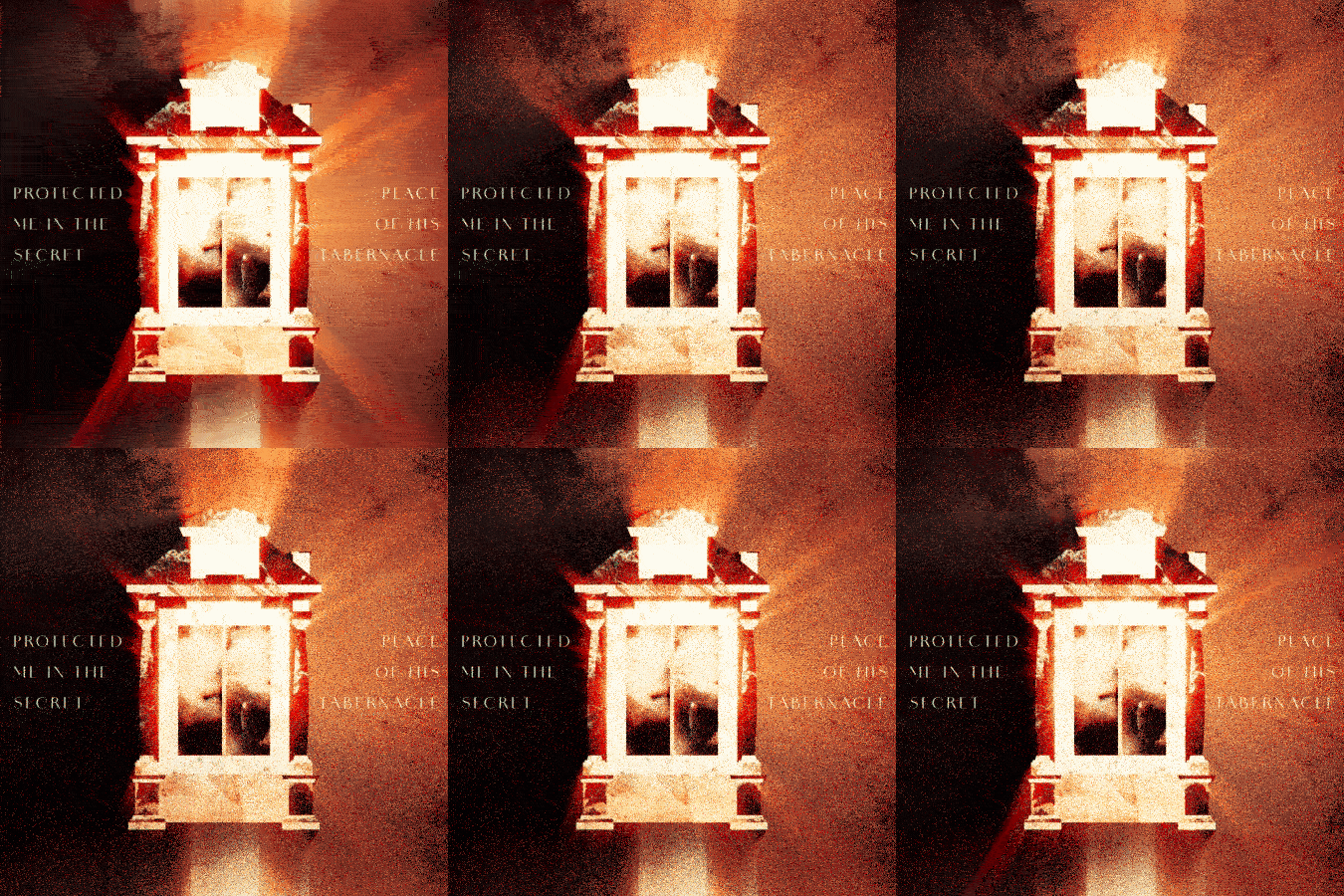
I created the tabernacle out of various shapes created in Illustrator, and then brought those into After Effects and precomped each piece. Inside each precomp I brought in a texture, using the shape as a matte and then added a slight looping wiggle to the motion of the texture.
In the main comp I added in some glow and some volumetric lighting using Trapcode Shine. I finally applied some color correction to finalize this.
Enjoy.
For he hath hidden me in his tabernacle; in the day of evils, he hath protected me in the secret place of his tabernacle.
(Psalm 26:5 DR)
View a higher quality version of this gif here:


