

He hath exalted me upon a rock: and now he hath lifted up my head above my enemies. I have gone round, and have offered up in his tabernacle a sacrifice of jubilation: I will sing, and recite a psalm to the Lord. (Psalm 26:6 DR)
The Psalmist thus far in this Psalm has made a series of juxtapositions between the encroachment and threat of his enemies against him and the manner in which these assaults are met by the action of God on his behalf.
When his enemies threaten to eat his flesh, they themselves are weakened; their flesh fails them and they fall. When they stand together against him to terrify him, he does not fear. When they bring battle against him, he has confidence in its outcome. All of these reversals are because he has made the Lord his light and salvation and has framed the entirety of his hope around the Lord as the protector of his life. He sets his heart on the one thing, to dwell in the tabernacle of God forever, to fix his delight on the Lord and love Him forever within His tabernacle. This desire within the deepest recesses of his soul is thus met by God hiding him and protecting him within that secret tabernacle, where evil cannot reach him.
This inward orientation of the Psalmist’s soul towards God in the union of divine charity now has its outward expression, for the Psalmist now proclaims that “He hath exalted me upon a rock, and now He hath lifted up my head above my enemies.” The Latin of this passage is in petra exaltavit me, et nunc exaltavit caput meum super inimicos meos, with petra being the term for rock and caput the term for head. St. Peter—who himself knew something about being termed a rock—links these two ideas together in his first epistle in speaking about Christ:
Behold, I lay in Sion a chief corner stone, elect, precious. And he that shall believe in him, shall not be confounded. To you therefore that believe, he is honour: but to them that believe not, the stone which the builders rejected, the same is made the head (caput) of the corner: And a stone of stumbling, and a rock (petra) of scandal, to them who stumble at the word, neither do believe, whereunto also they are set. (1 Peter 2:6-8 DR)
This of course has direct application to this Psalm, for earlier St. Peter speaks of how those who are in Christ in His Holy Catholic Church are themselves spiritual stones built into the spiritual house with Christ as the chief corner stone. St. Paul expresses this similarly by speaking of Christ being the foundation of the Church. The Church and her members as built upon and into Christ are thus exalted upon a rock, whereas the enemies who press against the Psalmist—and thus against the Church—find this Rock to be a stone of stumbling which defeats them and exalts the Church above them along with her Head, our Lord Jesus Christ:
Would ye know that he is speaking of this? The Rock assuredly is Christ (I Cor 10:4). Hear what follows, For He hath hidden me in His tabernacle in the days of my evils: He hath protected me in the secret of His tabernacle. You were asking what is the secret of the tabernacle: hear what follows: On the Rock hath He exalted me. Therefore in Christ hath He exalted me. Because thou hast humbled thyself in the dust, He hath exalted thee on the Rock…
Christ our Head is already in heaven, our enemies can as yet rage against us; we are not yet exalted above them; but our Head is already there… He hath said that He is in us here below: therefore we too are in Him there above; for that, Even now He hath exalted mine head above mine enemies. See what an earnest we have, whereby we too are by faith, and hope, and charity, with our Head in heaven for ever; because the Head Himself, by divinity, goodness, unity, is with us on earth even unto the consummation of the world. (Matt 28:20) (St. Augustine, Expositions on the Psalms, 26, Exposition 2, 11)
St. Augustine’s commentary tracks closely with the Psalmist’s series of juxtapositions already offered in this Psalm, for the Psalmist does not imagine or pretend that he faces no danger or trial, nor that his enemies no longer exist or threaten him any longer. Instead, it is precisely in the midst of their threats and assaults that he has found himself in the sanctuary of God, in a place without fear and in which he has found confidence in the salvation of the Lord.
It is not because his physical enemies have been defeated that he has been exalted, as if he is describing the worldly grandeur of victory in battle. Instead, it is because he has found the one thing he longed for that he has found this exaltation. In prophetic transport he finds his feet set upon Christ, and sees Christ as Head of the Church triumphing over the powers of sin and death and hell. In faith the Psalmist lays hold of this, prophetically joining in the communion of the saints within the Holy Catholic Church built into Christ as living stones:
For since he had said that he was exalted on the Rock, which is Christ; and that his Head, which is Christ, was exalted above his enemies; he would have it understood that he himself, who was exalted on the Rock, was exalted in the same, his Head, above his enemies: referring this to the Church’s honour, to which the persecution of the enemies gave way: and since this was effected through the faith of the whole world, he saith, I have gone about, and have sacrificed in His tabernacle the victim of rejoicing. That is, I have considered the faith of the whole world, in which faith my Head hath been exalted above them that persecuted me; and in His very tabernacle, that is, in the Church spread abroad throughout the whole world, have I in manner unspeakable praised the Lord. (St. Augustine, Expositions on the Psalms, 26, Exposition 2, 13)
On the moral level this exaltation extends to the extinguishing of vices and the growth in holiness and virtue, for the head which is lifted up becomes the intellect cleared from the darkness of all entanglements to sin, so that it can perceive what is good and true and beautiful:
But now he hath lifted up my head above my enemies. After he mentioned the rewards to come from the Lord’s incarnation, he now speaks of present rewards, since it is clear that he has been freed from his enemies whether of the flesh or of the spirit. My head we seem to interpret correctly as the mind’s eye, which is truly our head, for when it is fresh we can have clear sight; we often call it the head because the head stands out. Above enemies refers to the sinful appetites over which our mind is appropriately set when kept pure by God’s kindness. (Cassiodorus, Explanation of the Psalms, 26, 6)
St. Peter confirms this, for those who are built as living stones into the spiritual house of Christ are now “a chosen generation, a kingly priesthood, a holy nation, a purchased people: that you may declare his virtues, who hath called you out of darkness into his marvellous light.” To be called out of darkness and into light carries with it the expectation and enablement by means of God’s grace to put away the errors of sin and to shun the things of this world, both in light of our future home in heaven and in view of the coming of the Lord:
Dearly beloved, I beseech you as strangers and pilgrims, to refrain yourselves from carnal desires which war against the soul, having your conversation good among the Gentiles: that whereas they speak against you as evildoers, they may, by the good works, which they shall behold in you, glorify God in the day of visitation. (1 Peter 2:9, 11-12 DR)
Thus the Psalmist does not exult in his exaltation as if it is his doing, but rather orients it entirely upon and around Christ as both Rock and Head. In the preceding Psalm David speaks of how he will wash my hands among the innocent, and will compass Thy altar, O Lord, and now in this following Psalm he fulfills it by having gone round, offering up the sacrifice of jubilation. This encircling of the altar of the Lord stands in juxtaposition to the enemies in camp who stand against him, as if encircling him. His exaltation above his enemies who encircled him thus leads him to thanksgiving and praise and sacrifice to God, for it is the Lord Who has lifted him up over his enemies and protected him in the day of evils.
The term for offered up is immolavi which generally has the sense of immolate, in which the sacrifice offered is killed or completely destroyed. To offer up an immolation of jubilation is to fix the entirety of one’s heart and will upon the Lord, to keep nothing for oneself as if to call one’s own. The Psalmist’s jubilation and praise leaves nothing for himself in terms of exaltation or credit or boasting, for it is the Lord Who has exalted him upon a rock, the Lord Who has lifted up his head above his enemies. In this exaltation he is drawn into deeper humility, or, seen from the other side, his deep humility leads to his exaltation, in which he prophetically prefigures Christ:
He humbled himself, becoming obedient unto death, even to the death of the cross. For which cause God also hath exalted him, and hath given him a name which is above all names: That in the name of Jesus every knee should bow, of those that are in heaven, on earth, and under the earth: and that every tongue should confess that the Lord Jesus Christ is in the glory of God the Father. (Philippians 2:8-11 DR)
In this humility the Psalmist’s mind considers all the good things of the Lord and what God has done for him, and in whatever thing he considers in this life, he will have gone round and offered up this sacrifice, bringing everything back to the altar of the Lord, immolating his own will and desires and wants and loves as an offering unto God:
We sacrifice the victim of rejoicing, we sacrifice the victim of gladness, the victim of thankfulness, the victim of thanksgiving, which cannot be explained in words. But we sacrifice, where? In His very tabernacle, in the holy Church. What then do we sacrifice? Most abundant and inexpressible joy, with no words, with speech ineffable. This is the victim of rejoicing. Whence hath it been sought, where found? By going about. I have gone about, saith he, and sacrificed in His tabernacle the victim of rejoicing. Let thy mind go about through all creation: every where will creation cry out to thee, God made me. Whatever in art delighteth thee, sets forth the artificer: and much more if thou go about the universe, doth consideration conceive the great Workman’s praise. Thou seest the heavens: they are God’s great work. Thou seest the earth: God made the numerous seeds, the varieties of herbs, the multitude of animals. Go yet about the heavens even unto the earth, leave nothing: on all sides all things proclaim to thee the Framer, and the very species of creatures are so to say the voices of the Creator’s praisers. (St. Augustine, Expositions on the Psalms, 26, Exposition 2, 12)
The Psalmist’s words are prophetic prefigurements of Christ, Who as the Great High Priest will Himself have gone round and offered up this sacrifice of jubilation in the secret place of His tabernacle, His very self offered as an oblation and immolation to the Father. Our sacrifices are by their very nature imperfect, but since He is God in the flesh He was able to offer the infinitely perfect sacrifice of jubilation through the outpouring of His own life upon the cross. It may seem strange to link jubilation with His suffering and death, but this is precisely how the Scriptures speak:
Looking on Jesus, the author and finisher of faith, who having joy set before him, endured the cross, despising the shame, and now sitteth on the right hand of the throne of God. (Hebrews 12:2 DR)
But we see Jesus, who was made a little lower than the angels, for the suffering of death, crowned with glory and honour: that, through the grace of God, he might taste death for all. For it became him, for whom are all things, and by whom are all things, who had brought many children into glory, to perfect the author of their salvation, by his passion. (Hebrews 2:9-10 DR)
It is through our union with Christ in His mystical Body the Holy Catholic Church that we are enabled to participate and share in the offering of this sacrifice of jubilation; not only in offering prayers and praise to God, not only the offering of our own lives as living sacrifices, but also in participation in union with Christ’s perfect sacrifice, which elevates and transfigures those which we offer unto God:
But not only does Christ render upon the altar infinite homage and adoration to the Divine Majesty, but through and with His Sacrifice, the Church and we all are enabled perfectly to honor and adore the Most High in spirit and in truth (John 4:24). The Eucharistic Sacrifice is the property of the Church; she offers it through the priest, in order to render due worship to God in the name of all. In our hands also Christ has placed Himself as a victim, that we may be able to offer a gift to God capable of rendering Him infinite honor and pleasure. Whilst offering the Divine Victim in the Mass, we render to God inexpressible homage and adoration, fully proportionate to His divinity and dominion. — How exceedingly joyful and happy are not the souls that love God at the thought of being able, by the Sacrifice of the Mass, worthily to honor, praise and adore the Lord of heaven and earth! (Fr. Nicholas Gihr, The Holy Sacrifice of the Mass, Book I, Section 18.)
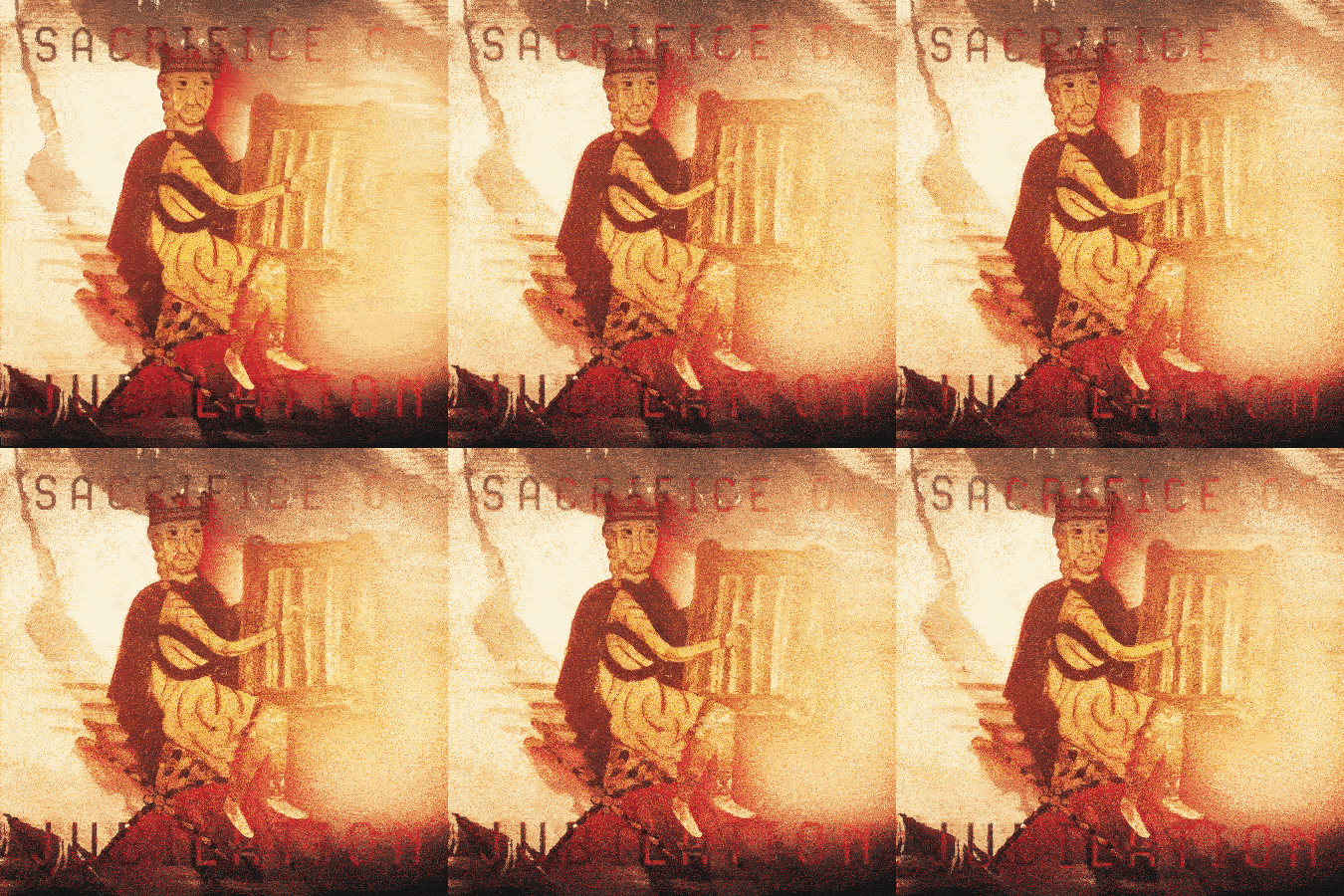
I found this image from an old Benedictine Psalterium and isolated it in Photoshop and then isolated the “playing” arm from the rest of the image, using Generative Fill to add in the missing pixels.
In After Effects I rigged this up using Puppet Tools 3 and animated the hand “playing” the harp along with some other secondary movements. I added in some textures in the background and some color correction along with some slightly offset text.
Enjoy.
He hath exalted me upon a rock: and now he hath lifted up my head above my enemies. I have gone round, and have offered up in his tabernacle a sacrifice of jubilation: I will sing, and recite a psalm to the Lord. (Psalm 26:6 DR)
View a higher quality version of this gif here:


