

Psalm 27:1
there's way more to fear than spiders
A psalm for David himself. Unto thee will I cry, O Lord: O my God, be not thou silent to me: lest thou be silent to me, I become like them that go down into the pit. (Psalm 27:1 DR)
In our human weakness there can be an odd admixture of hope and despair that exist simultaneously. For while we can be intellectually certain of something or have a rational expectation that something will be the case. our lower nature can nevertheless shrink back in weakness or fear.
Some of our little phobias are like this. Take a fear of spiders, for example. While there are certainly some spiders that one should scrupulously avoid, the vast majority are either absolutely harmless or at worst can inflict a minor bite. In comparison to the many things in nature that are capable of killing us, spiders are rather far down the list.
We can rationally apprehend this, and appreciate that the common spider making its small web in the corner of your window in not by any means a threat. One might even acknowledge that the spider is providing a service in reducing the population of other pests in one’s home that—while not outwardly as scary—are potentially more harmful (by spreading disease, etc.).
Yet even with this understanding our flesh can still shrink back in fear from such a tiny thing which poses no risk and is at best a minor inconvenience.
This strange concomitance of understanding and fear is a part of our condition as humans, and the Psalmist gives voice to this. He prophetically peers beyond the veil to place these words on Christ’s lips on the cross:
Words spoken by Christ as he hung on the cross, asking for a speedy resurrection. “Be not thou silent;” do not turn from me, as if you were deaf, and did not hear me. He asks in a few words, that he may be heard, and get an answer from God that his prayer would be heard. “Lest if thou be silent to me, I become like them that go down into the pit;” he wishes for an answer, because if God will not hear him, and give him a favorable answer, he will be like all other mortals who die and go to the lower regions, never to return therefrom. (St. Robert Bellarmine, A Commentary on the Book of the Psalms, 27, 1.)
In Jesus was united hypostatically the divine nature of the Word and the human nature. And while Jesus was not subject to sin nor did He have any sin, His human nature was truly a human nature. He thus hungered and thirsted, being subject to the limitations that our finite natures are. A further aspect of this was an aversion to pain coupled with a natural sense of self-preservation; we see this in our Lord’s agony in the garden:
Then he saith to them: My soul is sorrowful even unto death: stay you here, and watch with me. And going a little further, he fell upon his face, praying, and saying: My Father, if it be possible, let this chalice pass from me. Nevertheless not as I will, but as thou wilt. (Matthew 36:38-39 DR)
His human nature in its natural aversion to pain and death shrunk back from death, and His human will was inclined naturally to follow its lead. The Psalmist’s words here gain poignancy, for in prophetically revealing our Lord’s Passion they open up a window into the depths of the mystery of the Incarnation and of prayer.
Our Lord—even in the midst of the Passion—was within the Beatific Vision, as His human nature by its union with the Word experienced the Beatific Vision (cf. CCC 473, ST III, Q34, A4, R3). Unlike us, therefore, He had neither faith nor hope as He already immediately apprehended God. Yet even in this state of beatitude He still felt the shrinking back of His human nature and will from pain and death:
Although human nature was united to the Divine Person, He felt the bitterness of His Passion as acutely as if no such union had existed" because in the one Person of Jesus Christ were preserved the properties of both natures" human and divine; and therefore what was passible and mortal remained passible and mortal; while what was impassible and immortal, that is, His Divine Nature, continued impassible and immortal. (Catechism of Trent, IV, First Part, “Suffered”)
It is in the midst of this admixture of beatitude and agony that the union of our Lord’s human will with His divine will is plainly manifested, for despite the human will naturally desiring to preserve itself, He declares “Nevertheless not as I will, but as thou wilt.” This is not some interior struggle within the Trinity, as if the will of the Word could ever be different from the will of the Father since they are the self-same will. This is rather the fullness of the hypostatic union in which the beatitude the human nature enjoys by virtue of the union with the Word overcomes the natural aversion to pain and death and chooses to undergo that so as to fulfill the Divine will. The Psalmist captures the cry of the human will of our Lord which cries to God not in hope or in faith but in the confidence of beatitude:
Unto You, O Lord, have I cried; My God, separate not the unity of Your Word from that which as Man I am. “Lest at any time Thou be silent from me: and I shall be like them that go down into the pit.” For from this, that the Eternity of Your Word ceases not to unite Itself to Me, it comes that I am not such a man as the rest of men, who are born into the deep misery of this world: where, as if You are silent, Your Word is not recognized. (St. Augustine, Expositions on the Psalms, 27, 2.)
We in this wayfaring state do not yet posses the beatific vision, but faith provides the confidence and substance (cf. Hebrews 11:1) that enables us to follow our Lord’s example in shunning the desires of our human nature and its aversion to pain and death:
Looking on Jesus, the author and finisher of faith, who having joy set before him, endured the cross, despising the shame, and now sitteth on the right hand of the throne of God. (Hebrews 12:2 DR)
We need no longer fear pain and death, but rather are enabled to embrace the crosses our Lord calls us to take upon ourselves:
If any man will come after me, let him deny himself, and take up his cross, and follow me. For he that will save his life, shall lose it: and he that shall lose his life for my sake, shall find it. (Matthew 16:24-25 DR)
For this animation I created everything inside of After Effects. It was fairly simple—I created a big text block which said “silent” and applied some slight animation on the vertical axis. I then added Shadow Studio 3 to it for some nice shadow effects. I then duplicated that layer and placed multiple copies at different “depths” to create a nice staggered effect and offset them in time for some randomness. I finally added some color correction and the animation was complete.
Enjoy.
A psalm for David himself. Unto thee will I cry, O Lord: O my God, be not thou silent to me: lest thou be silent to me, I become like them that go down into the pit.
(Psalm 27:1 DR)
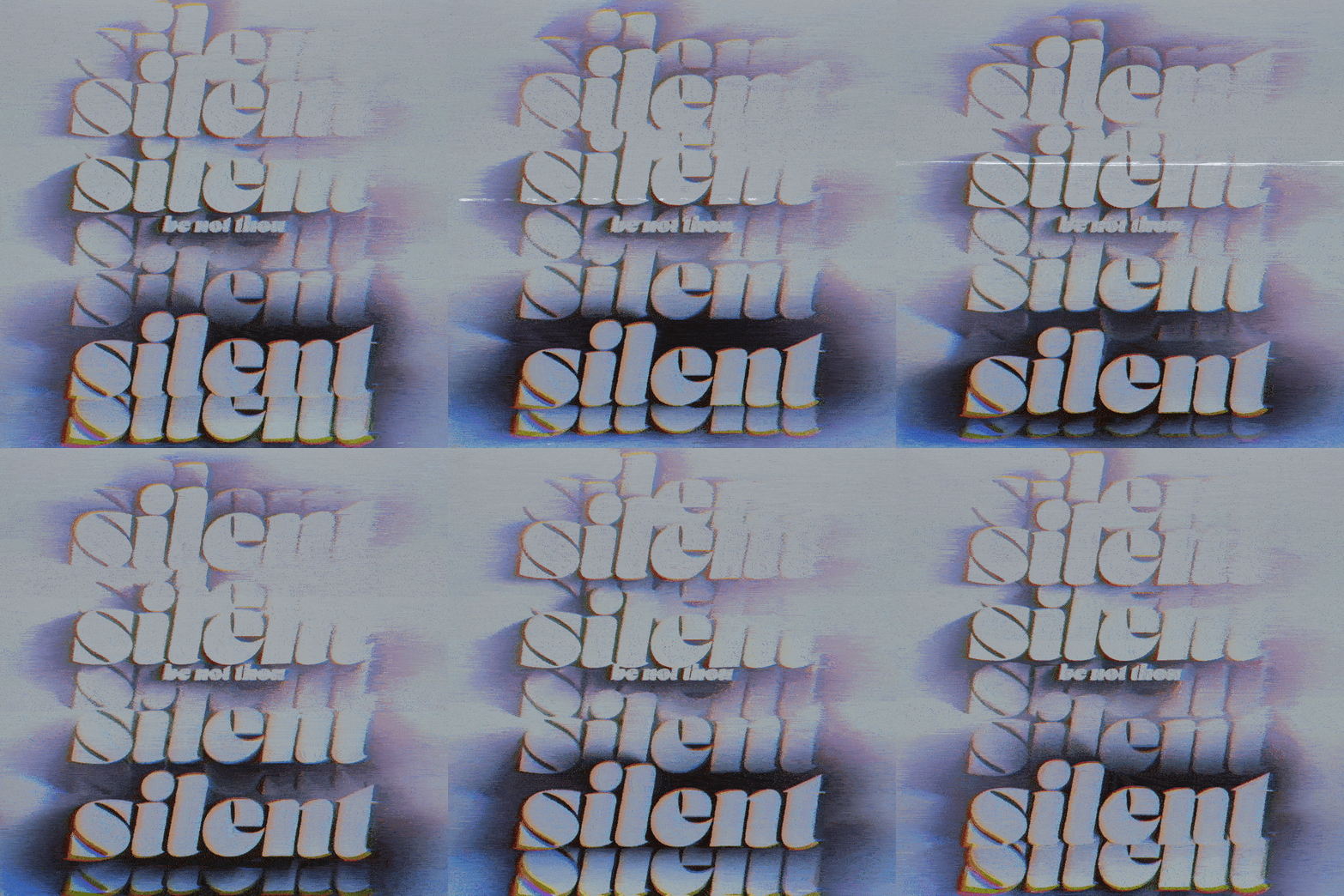
View a higher quality version of this gif here: