

Psalm 27:6
a death and a resurrection
Blessed be the Lord, for he hath heard the voice of my supplication. (Psalm 27:6 DR)
One of the many common themes that runs throughout the Psalms is a plea for God to hear one’s prayer. This very Psalm, of course, opens with such a request, and examples could be multiplied. But equally common is the prayer of thanksgiving for God having heard and answered, and it is not uncommon for the two to be separated by the circumstances surrounding the request or those precipitating it, such as in this Psalm.
Because of its commonality it can take on an all-too-familiar guise, in which it becomes easy to pass over quickly. The Psalmist cries for help, God answers, the Psalmist gives thanks. It’s a fairly common narrative arc.
But in this Psalm it is important to remember both what the Psalmist is asking and what his plea prophetically portends. He cries to God in distress, knowing that if God does not answer he will die, which he euphemistically characterizes as becoming like “them that go down into the pit” (Psalm 27:1 DR).
This Psalm carries prophetic import, in which the cry of the Psalmist is foreshadowing the cry of our Lord from the cross. In the garden He pleads in his humanity with the Father to take this cup from Him, “this cup” being His suffering and death, equivalent to the going “down into the pit” of the Psalmist.
Yet there seems a prophetic disconnect. The Psalmist was evidently heard and preserved from death, since he was able to give thanks for God hearing his prayer. Our Lord, however, united His human will with His divine will and accepted the suffering and death of the cross.
The resolution, however, is found not in escaping a physical death but rather in defeating it. The thanksgiving of the Psalmist for his preservation from death is the cry of the Savior following the resurrection, thus ultimately fulfilling the prophetic import of the Psalm. The Psalmist, after all, eventually died, so his preservation from death was not forever, whereas our Lord, by willingly undergoing death in conformity with the will of the Father, died and rose again, never to die again.
Our Lord thus becomes the paradigm of this Psalm which stretches beyond the purely historical manner of the Psalmist’s preservation from death. By foreshadowing our Lord’s death and resurrection, we find that the cry which God hears and answers is the one that is modeled on the very same cry which our Lord lifted up to the Father.
The answer to this prayer is thus to not always be found in escape from our circumstances or preservation from death, but in the defeat of sin and death which comes as we submit our wills (as our Lord did) to the will of the Father and unite ourselves and our sufferings with those of our Savior:
If any man will come after me, let him deny himself, and take up his cross, and follow me. For he that will save his life, shall lose it: and he that shall lose his life for my sake, shall find it. (Matthew 16:24-25 DR)
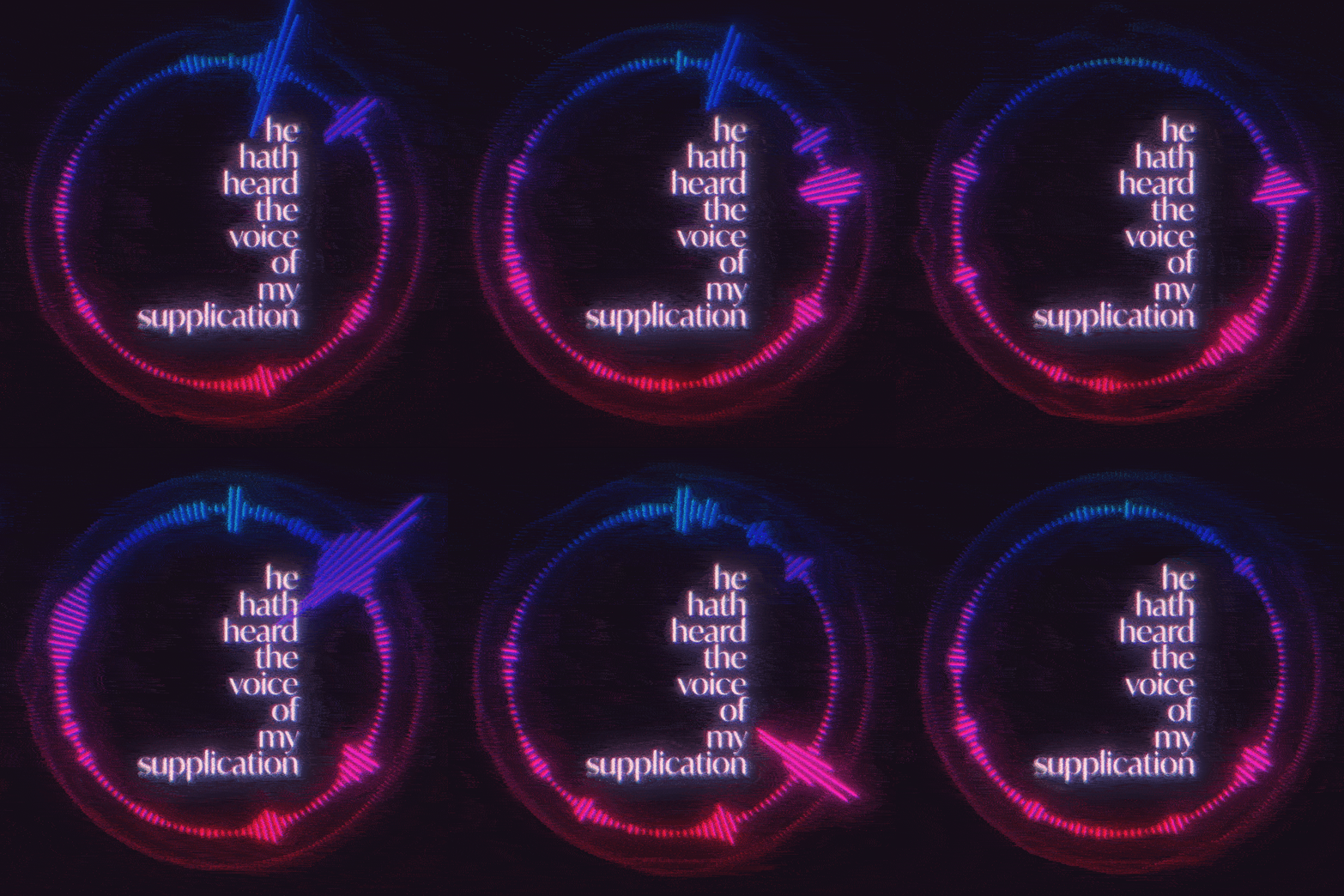
This animation was a twofold process. I knew that I wanted to create this waveform look, but I needed a track to generate the animation for the audio waves. Since the audio wouldn’t actually be heard I decided to try out an AI-driven track generator. It was—to be fair—pretty bland, but it did have a great feature of creating loops which is also what I was going for, so it worked out nicely for this.
One the track as generated and downloaded I brought it into After Effects and applied Audio Waveform to a Solid and modified the parameters (which I won’t bore you with) to create the look that you see. I added in some text, some glow and other color correction and let the audio drive the animation.
Easy.
Enjoy.
Blessed be the Lord, for he hath heard the voice of my supplication.
(Psalm 27:6 DR)
View a higher quality version of this gif here: