

Psalm 27:7
restoration
The Lord is my helper and my protector: in him hath my heart confided, and I have been helped. And my flesh hath flourished again, and with my will I will give praise to him. (Psalm 27:7 DR)
The Psalmist prophetically peers more deeply into the mystery of the Resurrection, expanding upon the reason for his joy in the previous passage. The prophetic import becomes more apparent, for while in the Psalm as whole there is no indication of a lack of health in his flesh, here he states that his flesh has flourished again.
To be fair, this is probably intended on a natural level euphemistically, where the attacks that come external to him from his enemies are likened to a disease which racked his body and which has finally been cured. There is no clear indication that he is suffering physically, and so the words go beyond the physical and have a spiritual and prophetic meaning; that is, referring to Christ’s resurrection in which our Lord’s body and soul were literally raised from the dead.
But even more than a mere resuscitation, our Lord is raised to a glorious body which St. Paul describes as a spiritual body (cf. 1 Corinthians 15:44). This body—while retaining a likeness and identity to the physical body, nevertheless transcends it and is not limited to the same weaknesses as the natural body, as we seen in some instances of our Lord’s interactions with His disciples. The Psalmist alludes to this when he describes his flesh as having flourished again, meaning that it is not just preserved but restored to some healthier state:
He describes the effect of God’s help and protection, namely, his glorious resurrection, for which he praises God with his whole heart. My flesh, that had withered up in death, is not only restored to life, but to the bloom of youth, health, joy, and beauty. (St. Robert bellarmine, A Commentary on the Book of the Psalms, 27, 7.)
The natural body of humankind after the fall, while natural in certain sense, is unnatural on a deeper level because God did not create mankind in a state of sin nor to suffer to the effects that the Fall brings on the physical world. The lack of cohesiveness between our soul and body is not by design but rather by means of defect due to the fault of our first parents; the other maladies we suffer are results of decay that sin brought into the world.
The resurrection doesn’t just revive our bodies and bring us back to life, but restores the body to what God intended. But even more than this, as we are united to Christ in His death and His resurrection, so too we share in this new resurrected body and actually surpass the original creation of Adam through the new Adam:
So also is the resurrection of the dead. It is sown in corruption, it shall rise in incorruption. It is sown in dishonour, it shall rise in glory. It is sown in weakness, it shall rise in power. It is sown a natural body, it shall rise a spiritual body. If there be a natural body, there is also a spiritual body, as it is written: The first man Adam was made into a living soul; the last Adam into a quickening spirit. Yet that was not first which is spiritual, but that which is natural; afterwards that which is spiritual. The first man was of the earth, earthly: the second man, from heaven, heavenly. Such as is the earthly, such also are the earthly: and such as is the heavenly, such also are they that are heavenly. Therefore as we have borne the image of the earthly, let us bear also the image of the heavenly. (1 Corinthians 15:42-49 DR)
The promise that the Psalmist sees in dim shadows comes into the fullness of light in Christ who will give life eternal to our mortal bodies. The Psalmist declares that with his will he shall give praise to God, which seems a veiled reference to Christ’s human will which—in view of the coming resurrection (cf. Hebrews 12:2)—both submitted and united to the will of Father and in the resurrection gives eternal thanks unto God, as Jesus’ human will is eternally united to the Word.
The Psalmist thus expresses great hope in the coming of the Anointed One, the Messiah, whose suffering and death and resurrection becomes the promissory note, as it were, of our hope for eternal life in Him:
For what is more ignoble than dead flesh? Or, on the other hand, what is more glorious than the same when it arises and partakes of incorruption? “It is sown in weakness, it is raised in power:” [1 Corinthians 15:43] in its own weakness certainly, because since it is earth it goes to earth; but [it is quickened] by the power of God, who raises it from the dead. “It is sown an animal body, it rises a spiritual body.” [1 Corinthians 15:44] He has taught, beyond all doubt, that such language was not used by him, either with reference to the soul or to the spirit, but to bodies that have become corpses. For these are animal bodies, that is, [bodies] which partake of life, which when they have lost, they succumb to death; then, rising through the Spirit's instrumentality, they become spiritual bodies, so that by the Spirit they possess a perpetual life. “For now,” he says, “we know in part, and we prophesy in part, but then face to face.” [1 Corinthians 13:9, 12] And this it is which has been said also by Peter: “Whom having not seen, you love; in whom now also, not seeing, you believe; and believing, you shall rejoice with joy unspeakable.” [1 Peter 1:8] For our face shall see the face of the Lord and shall rejoice with joy unspeakable — that is to say, when it shall behold its own Delight. (St. Irenaeus, Against Heresies, Book V, Chapter 7, 2.)
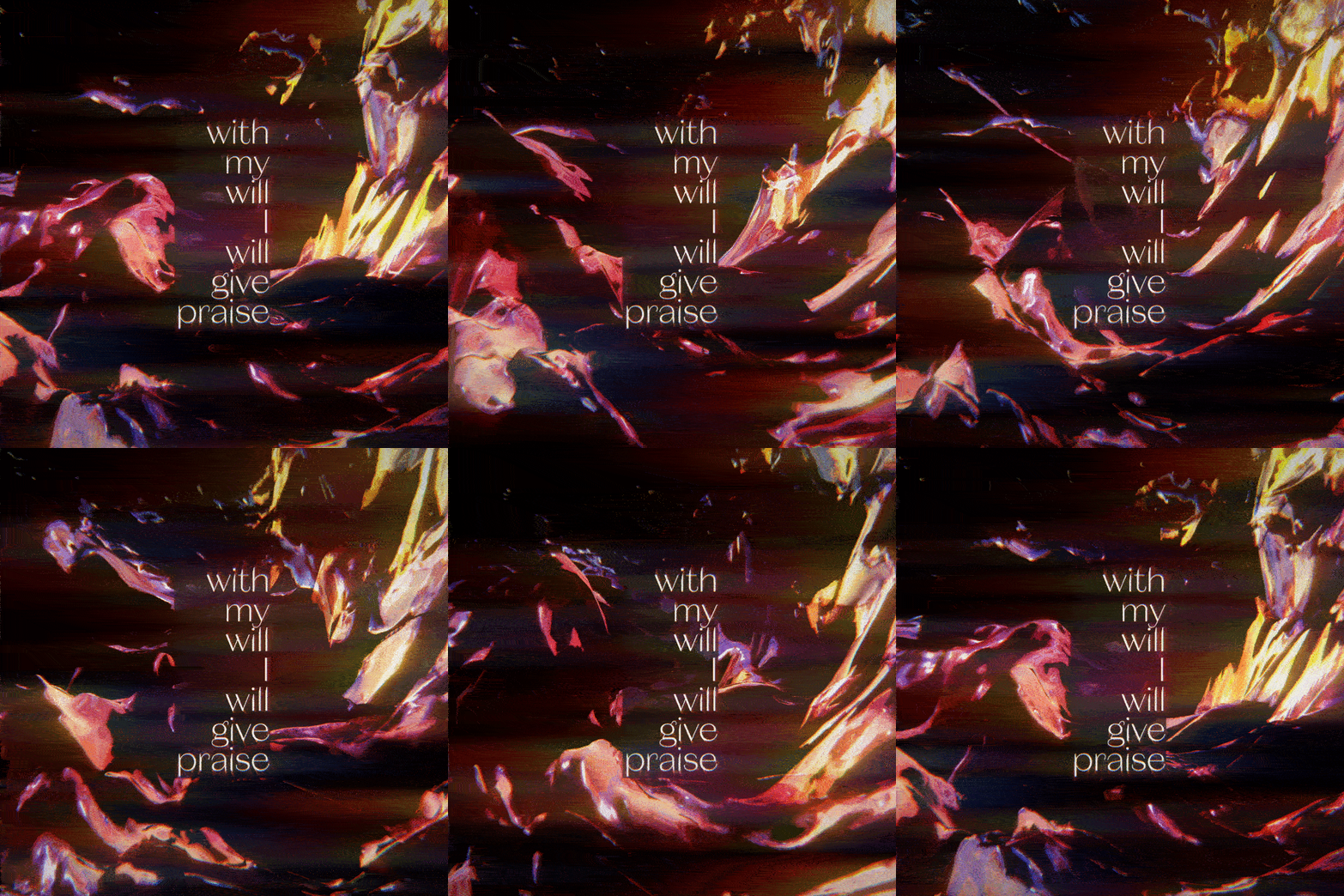
For this animation I wanted something kind of abstract, and so I went with Trapcode Mir as a tried and true method. I won’t bore with the details, but I liked how it turned out.
Enjoy.
The Lord is my helper and my protector: in him hath my heart confided, and I have been helped. And my flesh hath flourished again, and with my will I will give praise to him.
(Psalm 27:7 DR)
View a higher quality version of this gif here: