

Psalm 29:13
better than the beginning
To the end that my glory may sing to thee, and I may not regret: O Lord my God, I will give praise to thee for ever. (Psalm 29:13 DR)
The end of a speech, we are told, is better than the beginning (Ecclesiastes 7:9), and the Psalmist brings to culmination his reflections on the work of the Lord in his life. But he also speaks prophetically, as we have seen, as his words apply mystically to Christ and his body, the Church.
The Psalmist has experienced humiliation in his lifetime at the hands of his enemies, yet now at the dedication of David’s palace sees the triumph of righteousness over evil, of God’s elect over those who would stand against them. This of course prophetically points towards His Passion and death, to culminate in His glorious and triumphant resurrection.
In English we use the word end fairly loosely, and generally tend to mean it colloquially in a temporal sense, as when something comes to a finality in time. Thus, the end of the game is when the time runs out or the score threshold is met. Yet the word also carries in it the sense of purpose or directedness; it’s that for which something exists or towards which it is going.
And to be fair, they are not mutually exclusive meanings. The end of the game may be when time runs out, but the end of the game is to win. The reality is that one cannot attain the end until the end is reached. In this example, one cannot win the game until the game comes to an end; there is no such thing as victory in limbo.
Similarly, Christ’s Passion and death were the end of his Incarnation, the purpose for which he became man. It was also, in a sense, the end of his ministry and work as it came to a close and completion. But we see these two realities converge on the cross when before death he says it is consummated; that is, the end has been attained, the work is accomplished.
For the Church as Christ’s mystical body, there is also a passion and death, sometimes literally for the martyr, but certainly spiritually for all those who are striving to be dead to sin. And while we are all to some extent works in progress, we are not in some eternal journey; there is a goal we are striving for, a destination we are to eventually reach. The struggle against sin will not be eternal, but will be brought to an end when the children of God attain unto the Beatific vision and behold God face to face, in which sin will be no more.
The life of virtue and and striving for holiness and sanctification thus mirrors the experience of the Psalmist, full of trials and struggles and failure, but laced with the promise of triumph if we make God our abundance, rather than looking to ourselves and our own strength:
That now, not my humiliation, but my glory should not lament, but should sing unto You, for that now out of humiliation You have exalted me; and that I should not be pricked with the consciousness of sin, with the fear of death, with the fear of judgment. “O Lord, my God, I will confess unto You forever.” And this is my glory, O Lord, my God, that I should confess unto You for ever, that I have nothing of myself, but that all my good is of You, who art “God, All in all.” (St. Augustine, Expositions on the Psalms, 29, 13.)
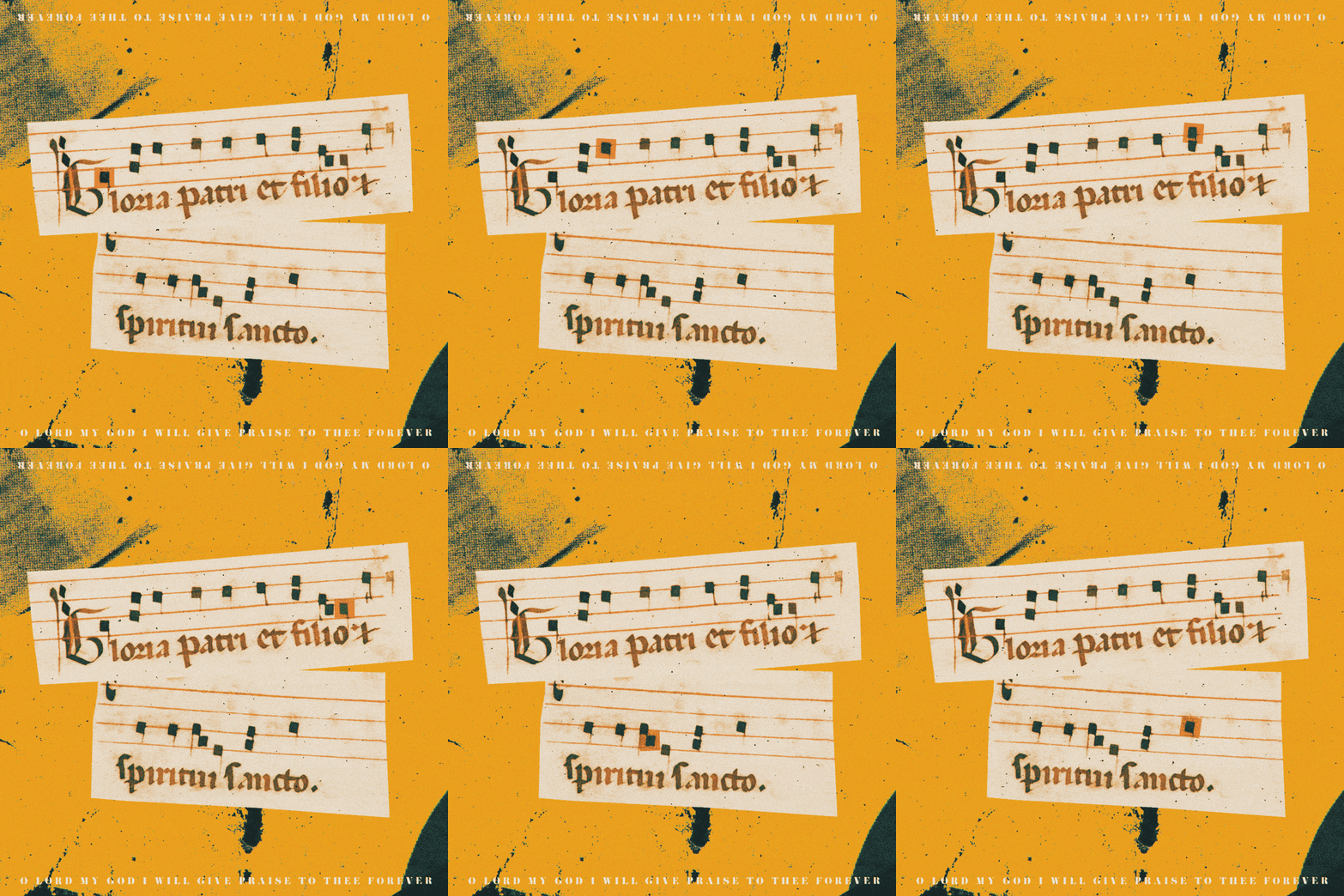
For this animation I found a Franciscan manuscript from the 14th century and thought it’d be great to pull out the Gloria Patri from it, which is used as a doxology in the Divine Office at the end of each Psalm that is recited or chanted. I thought this would be appropriate since this final verse is about the glory of God as the end of the matter, both temporally and teleologically.
I basically cut out the score from the manuscript in Photoshop and did some color correction as well as a little bit of content aware fixes to clean up some portions of it.
Then I brought it into After Effects and drew a little orange-ish box with transparency to act the note indicator on the neumes. Before animating the box I basically just counted up the number of notes and divided that by the number of seconds to determine how many frames each movement should last. I then animated the box using Hold keyframes on the Position and Rotation.
Finally I added some wiggle Hold to the two pieces of the score to give them a bit of movement. I precomped the notes and duplicated the precomp, linking one copy to each score so that they would follow the wiggle movement.
Enjoy.
To the end that my glory may sing to thee, and I may not regret:
O Lord my God, I will give praise to thee for ever.
(Psalm 29:13 DR)
View a higher quality version of this gif here: