

Psalm 29:3
fixing the tape
O Lord my God, I have cried to thee, and then hast healed me.
(Psalm 29:3 DR)
In this life we struggle against many things, and suffering and sickness are chief among the more vexing issues that trouble our hearts and minds. For not only do they afflict the body, but they can also turn the soul to bitterness and despair, as the flesh wars against the spirit.
We seek for healing in times of illness or bodily suffering, and not without reason have physicians been held in esteem throughout our history. Indeed, our Lord Jesus Christ even made physical healing a major part of his ministry, at times having to retreat into the mountains or across the sea to avoid the crowds that thronged him hoping for a miracle.
But as important as bodily healing is, it is the remedy for the ills of the soul which is more important. The struggle of our flesh against the spirit is perennial and never-ending, and if we aren’t careful and diligent the desires of the flesh can pull the soul into deeper maladies, whether in times of sickness or of health. The tragedy of our fallen race is that our souls—being the form of the body—are meant to rule and direct and even ennoble it, but Original Sin makes it the case that the opposite occurs apart from grace, given that Original Sin is itself a lack of grace. Our flesh keeps the soul tethered to earth, like broken wings that prevent a bird from rising aloft.
The Psalmist here gives praise to the Lord for the healing he has experienced, no doubt in some bodily form, as he finished extolling God in giving him triumph over his enemies. But given the prophetic slant of this Psalm, his worship is not merely over overcoming some physical adversity, but ultimately is about the triumph of Christ over sin and the sanctification of His Church and the members thereof.
Jesus, after all, came to free his people from their sins. The prophet Isaiah beautifully captures this promise centuries earlier:
Be comforted, be comforted, my people, saith your God. Speak ye to the heart of Jerusalem, and call to her: for her evil is come to an end, her iniquity is forgiven: she hath received of the hand of the Lord double for all her sins. (Isaiah 40:1-2 DR)
In his Epistle to the Romans St. Paul notes that in baptism the power of sin is destroyed; Original Sin is washed away and the Holy Ghost is given so as to make an end to actual sin. He likens baptism to dying and being buried with Christ, with the result that one is dead to son; it no longer has claim or hold. For just as someone who has died is no longer subject to the things he was subject to while alive, so baptism brings one from death to life in an interesting inversion in which life is found in this death:
For we are buried together with him by baptism into death; that as Christ is risen from the dead by the glory of the Father, so we also may walk in newness of life. For if we have been planted together in the likeness of his death, we shall be also in the likeness of his resurrection. Knowing this, that our old man is crucified with him, that the body of sin may be destroyed, to the end that we may serve sin no longer. For he that is dead is justified from sin. (Romans 6:4-7 DR)
Some translations render “justified” as “done,” in that someone who is (literally) dead cannot sin any longer. St. Paul weaves this analogy in and out of what he says here, comparing the one who has to died to sin in baptism as no longer subject to sin as if they had literally died. In other words, the one who has been joined to Christ has been freed from sin in a very real sense; being dead, he is no longer subject to laws of sin so as to live according to it. The death that he has died is a rebirth into a new life in the Holy Ghost, wherein by the infusion of grace in his heart and through the sacraments he is enabled to live not being subject to law of sin. This is why St. Paul exhorts us to not live according to the flesh but according to the Spirit, because we have been enabled to. Justification is not merely a judicial rendering of one being in a certain state but a recognition that that state exists in reality.
The analogy of death that St. Paul uses is fascinating, in that he draws this analogy to drive home how the one joined to Christ in baptism is freed from sin as if he were literally dead. Theodoret of Cyrus carries this analogy further to bring out the implications of it:
Whoever saw a dead man sleeping in some harlot’s bed, or bloodying his hands with murder, or doing anything else which is sinful? (Theodoret of Cyrus)
This is a fascinating set of examples, for we would find it absurd to think that a dead man could choose to do these things, since he is, well, dead and cannot. In a similar way those who have been joined with Christ in baptism are dead to sin and are not subject to it—they are not compelled to sin but have been freed from it and healed from it. The opportunity now exists to live in the freedom of the Holy Ghost which is not a license to do what one wants on a natural level but rather the more expansive freedom to no longer be a slave to sin but to actually now choose what is good and be given the grace to do it. This is the healing the Psalmist’s looks forward to prophetically and which Jesus consummates in his life, death and resurrection.
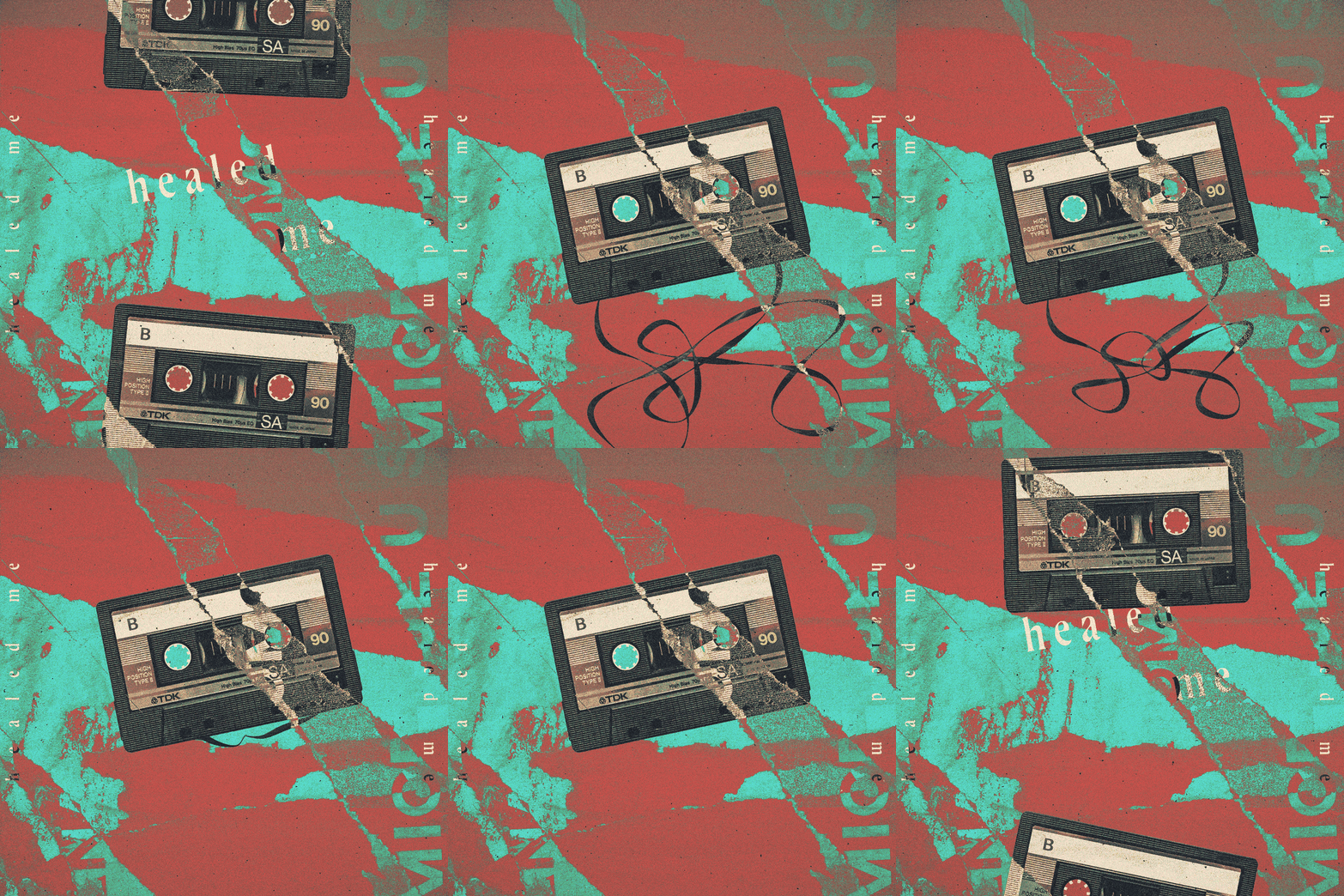
For this animation I was thinking about the nature of healing, and for some reason I was recalling when I was younger right on the tail end of cassette tapes (although apparently they are coming back?) as a viable medium for music. No matter how good your boombox, at some point one of your tapes would get tangled up and you’d have a mess. Sometimes it was pretty easy to fix—just stick a pencil in the holes and turn. But other times it got tangled and you’d have to delicately untangle it and hope you didn’t crease the tape too badly or end up making it worse.
At any rate, that gave me the idea for this, so I found an image of a cassette tape and cut it out in Photoshop and then redrew the inner gears in After Effects. I spent some time figuring out the best way to pull off the tape rewinding animation, but I eventually settled in a simple shape layer with a stoke.
I started in reverse, with the shape drawn to its final end point. I then moved back on the timeline and added a bunch of points on the line and moved them about to create the tangle. The interpolation essentially handled the rest, although I think I manually adjusted it a couple times in the middle of the animation to make it feel a bit more natural.
It still didn’t look great, mostly because the stroked line was too uniform. I went into the shape layer and added some tapering on the stroke which helped immensely and then finally added in some inner shadowing and beveling to create more of a dynamic and less uniform look. It’s not perfect, but for what I was wanting to do it did the trick.
Enjoy.
O Lord my God, I have cried to thee, and then hast healed me.
(Psalm 29:3 DR)
View a higher quality version of this gif here: