

Psalm 38:7
another existential crisis
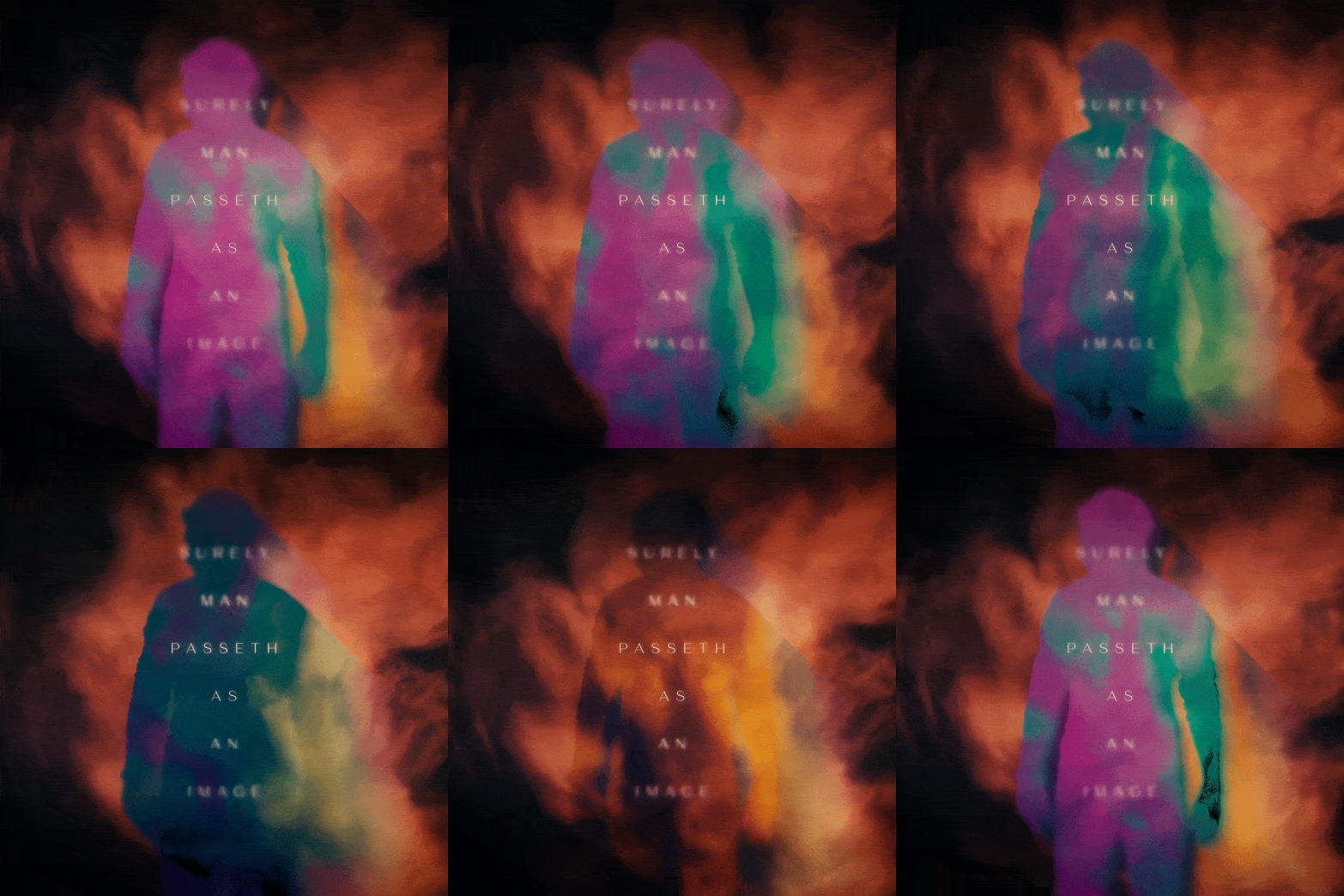
Surely man passeth as an image: yea, and he is disquieted in vain. He storeth up: and he knoweth not for whom he shall gather these things. (Psalm 38:7 DR)
Whenever we see a shadow we are conceptually drawn to that which casts it. The shadow itself has a sort of quasi-existence, for while it is visible and thus in some sense is, it doesn’t have any reality of its own. It only is because that which casts it is occluding a light source; once that is no longer the case, neither is the shadow any more.
The Psalmist continues in his reflection upon the transitory nature of this world by coming finally to himself, recognizing his own fleetingness in comparison to eternity. Like shadows, the things of this world—including our own existence—have the sense of ultimate reality, but their very contingency demonstrates that there is something of true and lasting reality that they do not possess. Like the passing days which are and then are not and thus grow old, so everything else which is contingent bears this burden and forms the existential malaise which disquiets the Psalmist:
Man walks and passes through life in the image, not in the reality of things, having before him on his journey, not the realities, but the images and the shadows. This life is but an image of the happy life that alone is the true one; the health of this life is only an image of the immortality that alone deserves the name of health; the beauty of this world is only the shadow of the beauty with which we will be clothed when “the just shall shine like the sun in the kingdom of their father.” The riches of this world are no riches, they are merely the image of the riches we shall have when we shall need nothing; for then God will be all unto all. The same may be said of wisdom, glory, grandeur, and everything else we call blessings. (St. Robert Bellarmine, A Commentary on the Book of the Psalms, 38, 6.)
For man himself this shadow reality is compounded in that he is suspended in a state of being a passing image which is made in the Image of God, which further exacerbates his disquietude. In his reason he can contemplate eternity and permanence yet in his existence has no experience of these things. It is this disjunction which prompts the Psalmist’s recognition of his own limitations and the vanity of the things of this world, although this disjunction actually causes him to raise his eyes to higher things:
“Albeit man walks in the Image” [Psalm 38:6]. In what “Image,” save that of Him who said, “Let Us make man in Our Image, after Our Likeness.” [Genesis 1:26] “Albeit man walks in the Image.” For the reason he says “albeit,” is, that this is some great thing. And this “albeit” is followed by “nevertheless,” that the “albeit” which you have already heard, should relate to what is beyond the sun; but this “nevertheless,” which is to follow, to what is under the sun, and that the one should relate to the Truth, the other to vanity. “Albeit,” then, “that man walks in the Image, nevertheless he is disquieted in vain.” Hear the cause of his disquieting, and see if it be not a vain one; that you may trample it under foot, that you may leap beyond it, and may dwell on high, where that vanity is not. (St. Augustine, Expositions on the Psalms, 38, 11.)
St. Augustine’s Latin version has a slightly different rendering, relating the image-ness of man to his relation to God over against his relation to this world. That is, it sees man as image in its primordial form before the Fall and then proceeds to describe that form after the Fall, whereas the Vulgate begins from the state of man as a passing image after the Fall. Both readings are certainly correct; it is a matter—as is often the case with St. Augustine’s divergent readings—of seeing the same reality from a different angle or from the end as opposed to from the beginning or vice-versa.
The reading St. Augustine takes actually accentuates the disquietude, for while the source of this disquietude is implicit in the Vulgate’s reading, here it is explicit. Man’s existential crisis is precisely because he is currently not what he was created to be. He was made for eternity yet it imprisoned, as it were, in the temporal and the decaying fallen order of the universe. It is because he can understand that he is made for eternity yet cannot of himself lay hold of it which causes such internal anguish, as if he were a bird born to fly yet born without wings. He is an image of the Eternal One, yet this same image is—because of sin—now a passing one.
This state is also compounded by how we tend to relieve this existential malaise, which is usually by doubling down on the vanity of this world and acquiring the very things which we know will pass away. Such is conceived of by the Psalmist as being disquieted in vain. The disquiet is both primordial and cumulative, for we spend all our efforts and emotions and toil for things which will not last; thus we suffer for temporary things in vain. The absurdity of our efforts is finally shown forth, for even though we know the things of this world are temporary, and even though we don’t know who will get our stuff after we die, we nevertheless persist in chasing after vanity and spending our lives in pursuit of the very gain we know will eventually be taken from us.
The words of our Lod thus become immediately apropos:
And he said: This will I do: I will pull down my barns, and will build greater; and into them will I gather all things that are grown to me, and my goods. And I will say to my soul: Soul, thou hast much goods laid up for many years take thy rest; eat, drink, make good cheer. But God said to him: Thou fool, this night do they require thy soul of thee: and whose shall those things be which thou hast provided? So is he that layeth up treasure for himself, and is not rich towards God. (Luke 12:18-21 DR).
For this animation I wanted to focus on the passing of man as an image, so I found—in literal fashion—an image of a man, actually a silhouette which I thought would work better. The original was already kind of indistinct which also worked well for my purposes. I cut it out in Photoshop and precomped it in After Effects and applied Shadow Studio 3 to it for some ambient interaction with the fog. For the fog I used Nebulosity which creates some really nice foggy and smoke-ish fractal noise, but generally more realistic looking than can be achieved (at least without a lot of effort) with the regular Fractal Noise effect.
The rest was some color correction and some glows on the image of the guy above the Shadow Studio 3 effect which has the, ahem, effect of extending the bounds of the source of the shadow so as to make it a it more indistinct, which I thought worked nicely here. The white-ish noise that passes over the image in the .gif is merely an artifact from the compression, but is kind of fun in its own right. Good job, robots.
Enjoy.
Surely man passeth as an image: yea, and he is disquieted in vain. He storeth up: and he knoweth not for whom he shall gather these things.
(Psalm 38:7 DR)
View a higher quality version of this gif here: