

Unto the end, understanding for the sons of Core. (Psalm 41:1 DR)
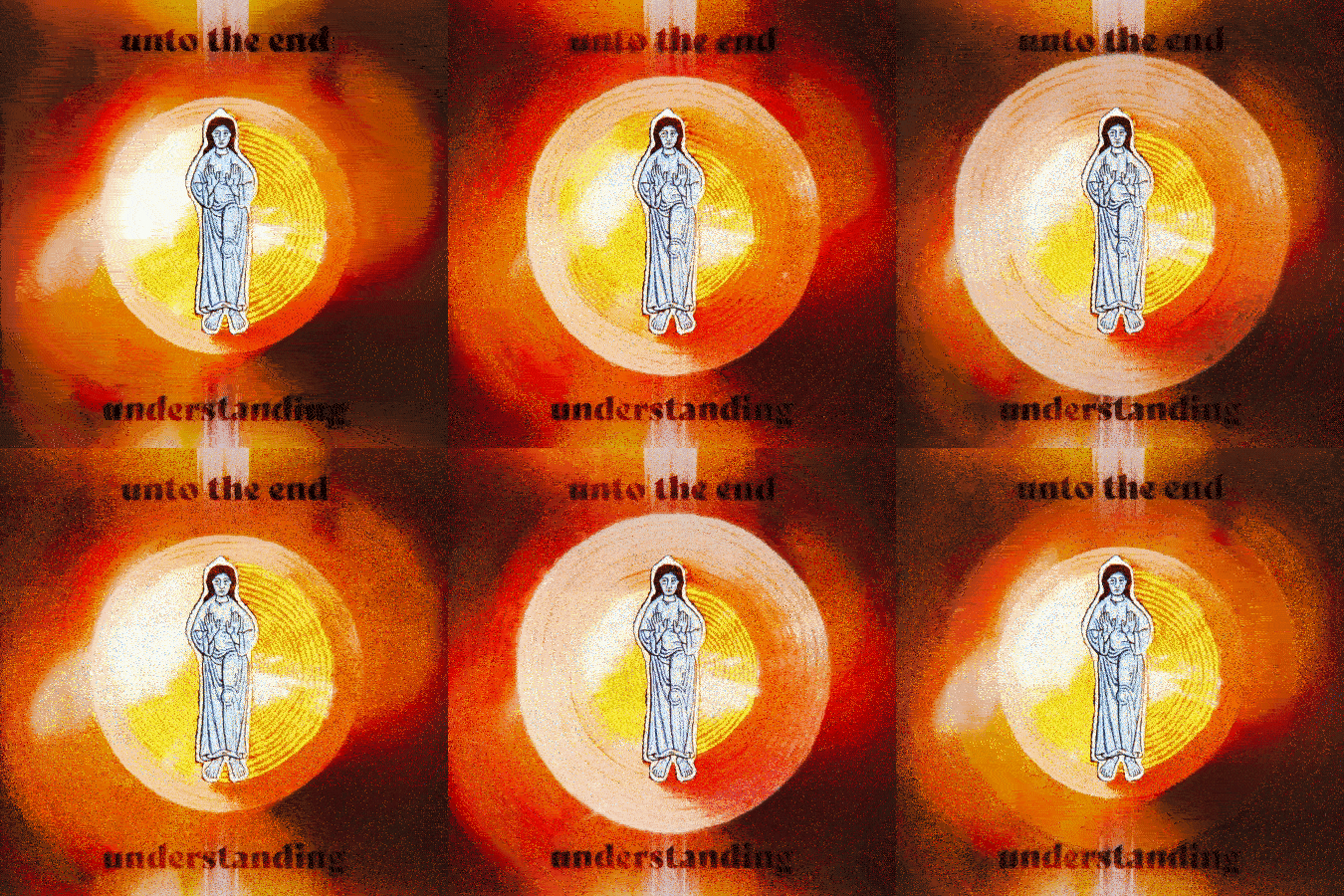
As with many other Psalms, the superscription for the end, unto the end, or to the end are in a mystical sense predicated of Christ, as St. Augustine explains in his expositions on numerous Psalms:
What to the end means, must not be too often repeated. “For Christ is the end of the law for righteousness to every one that believeth;” as the Apostle saith. We believe on Him, when we begin to enter on the good road: we shall see Him, when we shall get to the end. And therefore is He the end. (St. Augustine, Expositions on the Psalms, 13, 1.)
It is this “end” which then is expanded in the following clause, “understanding for the sons of Core.” That is, the end spoken of is that which forms the ground and framework for this understanding, which is then mystically identified with the “sons of Core.” Knowing therefore what this “end” and what the “sons of Core” signify is crucial to determining the “understanding” for which this Psalm exists.
St. Augustine takes seriously that this superscription is part of the sacred text and thus conveys a sacred meaning. To have understanding (in the Vulgate intellectus) of this end conveys the sense that the mystery will be brought to light, that the intellect will be illuminated. The phrase “for sons of Core,” in St. Augustine’s view, provides the key to the illumination of this end:
Now Korah may have been, as indeed he was, a certain definite person; and have had sons, who might be called the sons of Korah; let us however search for the secret of which this is the sacrament, that this name may bring to light the mystery, with which it is pregnant. (St. Augustine, Expositions on the Psalms, 41, 2.)
The sacrament to which St. Augustine refers is that of Baptism, for in the first verse proper he will note that the “longing” of the hart for the waters is a symbol of Baptism, and relates that this Psalm was in his day customarily chanted at the initiation of catechumens into the Church through Baptism. However, he goes on to note that this longing is not sated with Baptism, but rather enflamed, for it ushers the soul into deeper union with the Lord as it sojourns towards its heavenly home. Cassiodorus concurs in this:
So this psalm is relevant to every Christian who through the Lord’s love is fired by the flame of His affection; without this all that is considered of outstanding worth in human affairs is wholly tawdry. (Cassiodorus, Explanation of the Psalms, 41, 1, Ancient Christian Writers.)
St. Augustine sees the “sons of Core” or “Korah” as mystically signifying Christians, because they are sons of the bridegroom (cf. Matthew 9:15) and thus sons of Christ. However, the question is then raised: how is Korah a mystical signification for Christ?
The answer to this is found in the translation of “Core,” which St. Jerome notes is calvities or baldness:
Their spirit is, therefore, in keeping with the significance of their name for which the Latin is calvities, or ‘baldness.’ Because our Lord was crucified and buried in the place called Calvary, those who believe in His cross and Resurrection are sons of Core, the sons of Calvary. (St. Jerome, Homily 92, The Fathers of the Church, Vol. 57.)
This baldness he sees as a reference to the skull of which Calvary is the place of the skull, and also mystically signified in Eliseus (Elisha) who was himself literally bald. The journey of Eliseus from Jericho to Bethel that he undertook is an upward climb, and this is the famous account of the youths who mocked his baldness, for which they were punished with two bears coming forth to maul them. St. Jerome sees in this a mystical signification of our Lord’s Passion, Death, Resurrection and Ascension, as well as the forthcoming destruction of Jerusalem:
Eliseus, truly that most patient of men who had come to Bethel in order to save the city, at length turned and looked back; looked back and commanded two bears to come forth from the forest, and the bears came and they tore the forty-two boys to pieces. Even so our Lord, that is, our Core, when He had come into Bethel ready for His Ascension and was mocked by young boys, command two bears, Vespasian and Titus, to come forth, and they destroyed the forty-two boys. Who are these forty-two boys? From the Ascension of Christ to the destruction of Jerusalem, there are forty-two years. Ponder this diligently and you will find that it is so. Thus, for forty-two years after His Resurrection and Ascension to Bethel, the Lord gave His people the opportunity to repent, but because they cried out in derision: “Go up, thou bald head; go up, thou bald head,” two bears came out and killed them. (St. Jerome, Homily 17, The Fathers of the Church, Vol. 48.)
This connection with Calvary likewise creates immediate connections in St. Augustine’s mind:
Why then does Korah stand for Christ? Because “Korah” is equivalent to “Calvaria.” This is still more abstruse. I was asking why Korah stands for Christ; still more anxious am I to enquire, why Christ is thought to be connected with Calvaria. Why, does it not at once occur to you that He was crucified on Calvary? Unquestionably it does. Therefore, the sons of the bridegroom, the sons of His Passion, the sons redeemed by His Blood, the sons of His Cross, who bear on their forehead that which His enemies erected on Calvary, are called the sons of Korah; to them is this Psalm sung as a Psalm for understanding. (St. Augustine, Expositions on the Psalms, 41, 2.)
He notes that the sign of the cross—which is the sign of our Lord’s death, and thus of Calvary—is placed upon the foreheads of the catechumens and those who have entered into the Church. This is the understanding, the enlightenment of the heart and mind that is effected in Baptism when the charity of God is poured forth into the soul through the Holy Ghost (cf. Romans 5:5):
Let then our understanding be roused: and if the Psalm be sung to us, let us follow it with our understanding. What is it we are to understand? For what understanding is this Psalm sung? I venture to speak. “For the invisible things of Him from the creation of the world are clearly seen, being understood by the things which are made.”
For He is both the Fountain and the Light; for it is In Thy Light that we shall see light. If He is both the Fountain and the Light, with good reason is He the understanding also, because He both filleth the soul that thirsteth for knowledge ; and every one who hath “understanding,” is enlightened by a certain light; not a corporeal, not a carnal one, not an outward, but an inward light! There is then, brethren, a certain light within, not possessed by those who understand not. (St. Augustine, Expositions on the Psalms, 41, 2.)
Such an understanding and incorporation into the Church is thus effected by her Sacraments, namely the Sacrament of Baptism which initiates the person into all the other sacraments. The understanding that the Psalmist speaks of thus has both a mystical and a literal application. For while understanding properly belongs to the intellect which is immaterial, it is not something that the intellect can appropriate by its own power. That is, this understanding is not simply an intellectual apprehension of doctrines or theology. There is a sacramental reality to it. Sacraments are outward signs of inward grace. Their “outward” nature necessitates a physical reality, and thus the illumination of understanding that occurs in Baptism encompasses the totality of human nature as a body-soul composite. There is also a parallel between the physical reality of our Lord’s Death and Resurrection and the physical nature of Baptism which brings about the inward renovation of the soul, as St. Paul describes:
Know you not that all we, who are baptized in Christ Jesus, are baptized in his death For we are buried together with him by baptism into death; that as Christ is risen from the dead by the glory of the Father, so we also may walk in newness of life. For if we have been planted together in the likeness of his death, we shall be also in the likeness of his resurrection. (Romans 6:3-5 DR)
Baptism is thus the beginning of this understanding, the illumination of the soul (cf. Hebrews 10:32) that both satisfies its longing while also intensifying it, for the charity of God poured into the soul is the end for which we were created, an end which is infinite since its object is God, who will give joy to the sons of Core without end.
This animation uses one of the illustrations from St. Hildegard von Bingen’s Scivias, this one from the Second Vision of Part 2. I isolated the figure from the background and then the circle of radiance from the background and filled in the missing pixels using Generative Fill.
In After Effects I precomped the radiance circle and animated its opacity and scale and then layered multiple versions so that it would continually “radiate.” I then added in a background texture and a bunch of glows and color correction.
Enjoy.
Unto the end, understanding for the sons of Core.
(Psalm 41:1 DR)
View a higher quality version of this gif here:


