

Psalm 44:12
the beauty inside
And the king shall greatly desire thy beauty; for he is the Lord thy God, and him they shall adore. (Psalm 44:12 DR)
In this verse the Psalmist further considers the bride of this wedding song, noting that the king shall “greatly desire [her] beauty.” On a natural level this is understandable enough, but as the verse continues a twist in introduced by means of the parallelism. The reason given for this desire is that “he is the Lord thy God;” thus, the desire for the beauty of the beloved is predicated on the nature of bridegroom. St. Augustine notes this in his commentary:
“For the King has greatly desired your beauty” [Psalm 44:11]. What beauty is that, save that which is His own work? “Greatly desired the beauty” — Of whom? Of her the sinner, the unrighteous, the ungodly, such as she was with her father, the devil, and among her own people? No, but hers of whom it is said, “Who is this that comes up made white?” She was not white then at the first, but was made white afterwards. “For though your sins shall be as scarlet, I will make them white as snow.” [Isaiah 1:18] (St. Augustine, Expositions on the Psalms, 44, 24.)
There is thus an inequality introduced between those in this marriage, as the King is the one who is the source of the beauty he desires. It becomes clear that the Psalmist here is thus speaking prophetically by means of this psalm, in that the meaning delves deeper than a merely natural marriage but is peering behind the veil, so to speak, into a greater mystery between Christ and the Church, as St. Paul explains:
Husbands, love your wives, as Christ also loved the church, and delivered himself up for it: That he might sanctify it, cleansing it by the laver of water in the word of life: That he might present it to himself a glorious church, not having spot or wrinkle, or any such thing; but that it should be holy, and without blemish. (Ephesians 5:25-27 DR)
The beauty of the beloved, of the Church is not because of its own merits but rather because of the sanctification that Jesus Christ brings about, not only in some nebulous collective sense but also in the individual hearts of those who belong to her. This infusion of righteousness into the soul makes the beloved beautiful not only in some nominal sense in the eyes of the lover (such as in mere imputation of grace) but actually effects beauty in the soul. Thus, the Psalmist proclaims that the King greatly desires her beauty—as St. Augustine noted, he desires the beauty which is his own work, that which has been effected in her. This beauty is virtue, especially that of humility and obedience, as the beautiful soul must humbly recognize the source of its desireousness:
And since the principal beauty of the bride is interior... consisting in virtue, especially in obedience to the commandments, or in love of which all the commandments turn; he therefore adds, “for he is the Lord thy God;” that is to say, the principal reason for his so loving your beauty, which is based, mainly on your obedience, is, because “he is the Lord thy God.” (St. Robert Bellarmine, A Commentary on the Book of the Psalms, 44, 11.)
Obedience places oneself in a position of humility and truth; in obedience to the commandments we recognize God’s authority but also his love, desiring to unite our wills to his own in trust. In this humility and docility to his desire we demonstrate our own love for him, the love which he pours into our hearts. And since Christ “humbled himself, becoming obedient unto death,” (Philippians 2:8 DR), that same love which is infused into us must imitate the source from which it springs; thus Jesus plainly states that “if you love me, keep my commandments.” (John 14:15 DR) At the end of the day there is no other way to grow in virtue or in love of God than this:
Nothing is more imperatively required by the Lord from his servants, or by God from his creatures, than obedience. And for fear there should be any mistake about his being the absolute Lord and true God, he adds, “and him they shall adore;” that is to say, your betrothed is one with whom you cannot claim equality, he is only so by grace, remaining still your Lord, and the Lord of all creatures, who are bound to adore him. (St. Robert Bellarmine, A Commentary on the Book of the Psalms, 44, 11.)
This verse is of course most fittingly applied to the Blessed Virgin Mary, who as preserved free from original sin from her conception from her earliest moment exemplified this beauty that is desired by the King. It was not for any merit of her own but rather a singular act of grace on the part of her King that this beauty was bestowed upon her and becomes an exemplar of the soul that the King desires of those who are in his Church. In perfect humility and obedience she submitted herself to God’s will, and thus in a mystical sense becomes the beloved whom the King desires for her beauty, as that beauty is a perfect reflection of the charity and purity God placed in her.
The goal of the Christian vocation is to thus mirror this obedience and purity, as our souls are washed whiter than snow in baptism and enabled to live a new life.
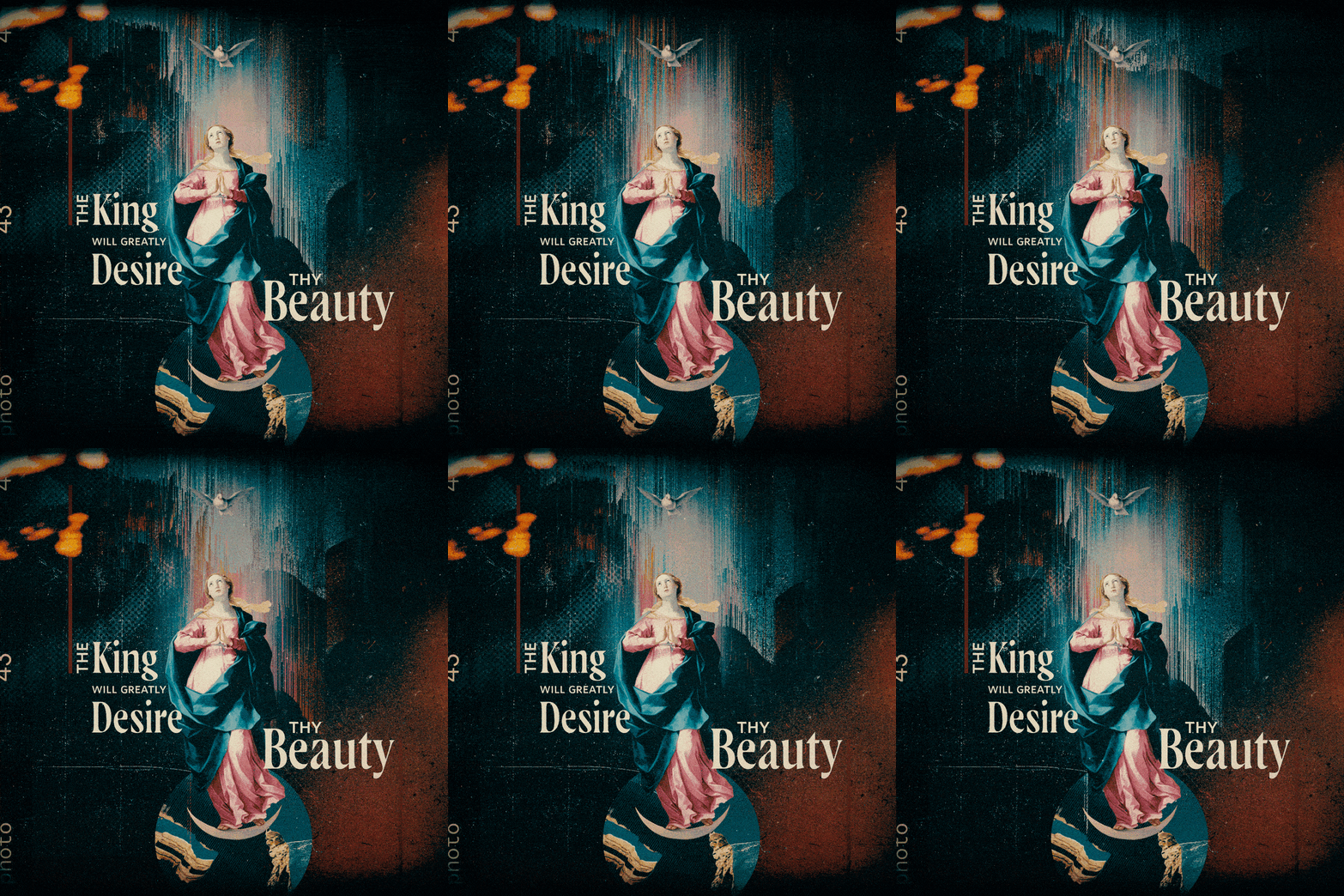
Given that I think there are Marian overtones to this verse, I thought it’d be nice to take that approach to this verse, and to sort of complete the triptych of these three verses, as it were.
Since it’s not exactly easy to depict the Immaculate Conception, I found instead an image of the Blessed Virgin based on the vision of the woman in the Apocalypse. I cut it out in Photoshop and also did the same for the dove from a separate image.
In After Effects I added some slight movement to both by means of a wiggle hold expression on the Position. In the background I added some pixel sorting which I thought would be a nice framing to rest of the composition.
Under the feet and moon I drew a sphere and used that as a matte for a texture to create a sort of earth and applied a looping wiggle expression for some slight position shift.
Nothing ground-breaking as afar as animation, but for these types of things I think the concept and composition is usually more important, and I really liked how it turned out.
Enjoy.
And the king shall greatly desire thy beauty;
for he is the Lord thy God, and him they shall adore.
(Psalm 44:12 DR)
View a higher quality version of this gif here: