

Psalm 44:17
sons and churches
Instead of thy fathers, sons are born to thee: thou shalt make them princes over all the earth. (Psalm 44:17 DR)
There is a famous passage in the gospels in which Jesus encounters a rich young man who asks what he must do to obtain eternal life. Jesus begins with what might be considered the stock answer: keep the commandments, etc. The man replies that he has done this, which gives Jesus the opportunity to drill down to the real thing keeping him from eternal life:
If thou wilt be perfect, go sell what thou hast, and give to the poor, and thou shalt have treasure in heaven: and come follow me. (Matthew 19:21 DR)
This, of course, is beyond the pale for this rich young man who walks away with sadness and regret, for though he sincerely desires eternal life, the things of this world tie him down to earth, such that he cannot rise above them. Seeing this, Jesus remarks:
It is easier for a camel to pass through the eye of a needle, than for a rich man to enter into the kingdom of heaven. (Matthew 19:24 DR)
Jesus’ disciples are shocked and scandalized at this statement. Within their mindset riches and wealth were often seen as a sign of God’s blessing, the reward for righteousness. Indeed, the rich young man’s initial answer need not necessarily be seen as cynical or evasive; it is very possible he had kept the commandments as he said, and thus saw for himself the wealth he enjoyed as heaven’s seal of approval on his life. Thus they ask: “Who then can be saved?” (Matthew 19:25 DR)
Thus the rich young man and Jesus’ disciples are operating under a similar paradigm, which is why they react as they do. They reason: if someone who enjoys God’s favor and who has been blessed on account of their righteousness can barely enter the kingdom of God, what hope is there for anyone else?
Jesus naturally understands this reaction and replies:
With men this is impossible: but with God all things are possible. (Matthew 19:26)
Peter, upon hearing this, makes a connection between the earlier discourse with the rich young man and what Jesus has just finished saying. For earlier Jesus promised the man that if he left all he had he would have treasure in heaven; Peter naturally wonders if he himself will also have treasure in heaven since he has forsaken all to follow Jesus:
Behold we have left all things, and have followed thee: what therefore shall we have? (Matthew 19:27 DR)
Jesus’ reply is that they will receive a hundredfold of what they have left behind and life everlasting. But it is fascinating that in St. Mark’s Gospel there is an addition that St. Matthew doesn’t include: persecuttions.
Amen I say to you, there is no man who hath left house or brethren, or sisters, or father, or mother, or children, or lands, for my sake and for the gospel, who shall not receive an hundred times as much, now in this time; houses, and brethren, and sisters, and mothers, and children, and lands, with persecutions: and in the world to come life everlasting. (Mark 10:29-30 DR)
St. Mark’s Gospel is traditionally held to be a compilation of Peter’s sermons, and thus we might surmise that Peter included this aspect of Jesus’ words both in retrospect of his own life and experience of suffering for Christ, but also because he would want his readers to understand that one does not follow Christ for the promises of this life, but for the rewards of the next. When Jesus promises rewards now in this time, he is not describing a purely natural reward, but rather is mystically pointing to the church.
By being incorporated into the body of Christ we become part of God’s family, and gain all the things enumerated above. One can see this even played out in a temporal manner in which the early church shared with each other lands and such for those who were in need, thus fulfilling Jesus’ words.
St. Peter looks back on Jesus’ words in this exchange and brings it into sharp relief for his readers, demonstrating how it is applied in his own life and that of the Church:
Blessed be the God and Father of our Lord Jesus Christ, who according to his great mercy hath regenerated us unto a lively hope, by the resurrection of Jesus Christ from the dead, unto an inheritance incorruptible, and undefiled, and that can not fade, reserved in heaven for you, who, by the power of God, are kept by faith unto salvation, ready to be revealed in the last time. Wherein you shall greatly rejoice, if now you must be for a little time made sorrowful in divers temptations: That the trial of your faith (much more precious than gold which is tried by the fire) may be found unto praise and glory and honour at the appearing of Jesus Christ: Whom having not seen, you love: in whom also now, though you see him not, you believe: and believing shall rejoice with joy unspeakable and glorified; Receiving the end of your faith, even the salvation of your souls. (1 Peter 1:3-9 DR)
In this penultimate verse the Psalmist likely addresses the bride, for having earlier encouraged her to forget her people and her father’s house, he promises a reward that exceeds what might have been had she not.
This verse prophetically marks out the Church from whom innumerable sons are born who are to be made princes over the earth. For though in the beginnings the Church was modest and received the persecutions promised by Christ, nevertheless the promises of blessings were also bestowed which came to fruition in the Gospel going forth into the whole world:
Instead of your fathers, who are now dead, that is, instead of the patriarchs and prophets, and fathers, you have left behind, and you have been ordered to forget; “sons are born to thee;” that is, Apostles and Disciples of Christ, able to teach, and make laws for the entire world; therefore, “thou shalt make them princes over all the earth.” And, in fact, the Apostles, the first children of the Church, made laws for the whole world, a thing never accomplished by any one temporal monarch. (St. Robert Bellarmine, A Commentary on the Book of the Psalms, 44, 16.)
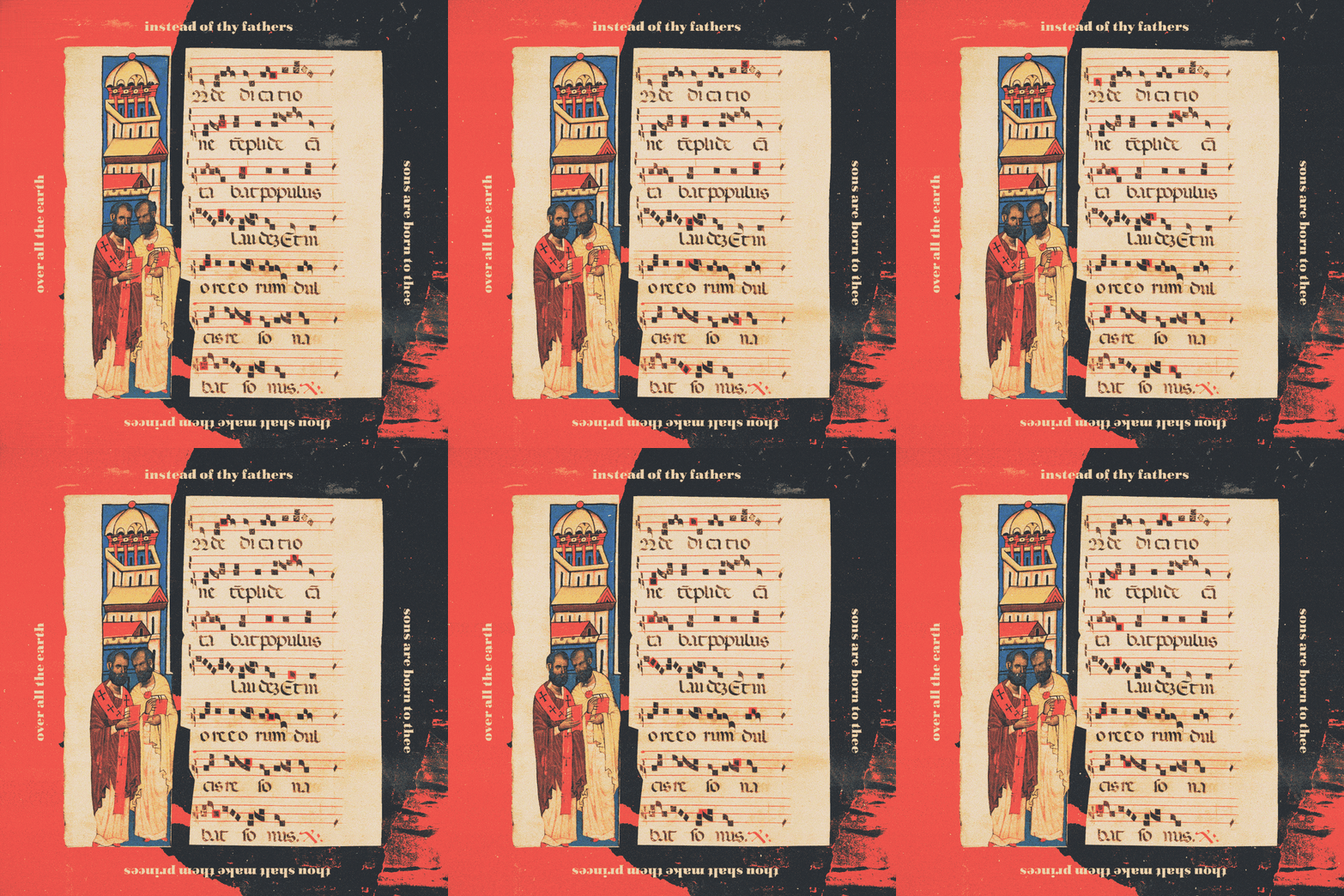
This animation is pretty specific to the imagery used, which is from a 13th century manuscript. The figures are St. Augustine and an unidentified saint, whereas the chant is In dedicatione templi, a Responsory for the feast of the Dedication of a Church (In Dedicatione Ecclesiae). I thought it would be appropriate given the thoughts above.
I cut out the figures in Photoshop and did quite a bit of Content Aware Fill to recreate the buildings behind the figures, which Photoshop struggled with a bit, but it finally worked out.
In After Effects I rigged the figures with the Puppet Tool to give them a bit of a sway, as I knew I’d be doing some animation on the chant. Since the animation is only five seconds, I knew I wouldn’t be able to highlight each neume sequentially, so I decided to do so for each line individually. While this certainly isn’t an accurate portrayal of the chant, it seemed a good way to sort of split the difference, and I think it gives a nice bit of visual interest.
I simply shifted the position of the red highlight over each note and applied hold keyframes t give it a stop-motion feel. The I pre-comped the shapes and applied some time-remapping with the loopOut() expression to get the loop, and then offset the times so they wouldn’t all be moving at the same rate at the same time.
Pretty simple, but I liked how it turned out.
Enjoy.
Instead of thy fathers, sons are born to thee:
thou shalt make them princes over all the earth.
(Psalm 44:17 DR)
View a higher quality version of this gif here: