

Psalm 44:2
speak the word
My heart hath uttered a good word I speak my works to the king; My tongue is the pen of a scrivener that writeth swiftly.
(Psalm 44:2 DR)
Of all the many terms assigned to the Trinitarian relations, that of Word carried great significance for the Church Fathers, as they saw in it by analogy the eternal generation of the Son by the Father.
The word in human speech is the internal word brought forth, the thought expressed. In human language this is not always 1:1 as we often lack for words to express our thoughts, but for God—who is infinite and perfect—this expression of the internal word is always perfect, and since it expresses the fullness of the Godhead it is both with God and is God, as St. John notes in his Gospel. For God to utter his Word is to beget the Son eternally.
St. Augustine sees in this passage an expression of this mystery, cloaked in the poetics of the Psalm. The eternal generation of the Son is not by means of the Father taking something unto himself to beget (as a husband does with his progeny) but comes from his heart alone, from the totality of his nature:
Lest you should haply think something to have been taken unto Him, out of which God should beget the Son (just as man takes something to himself out of which he begets children, that is to say, an union of marriage, without which man cannot beget offspring), lest then you should think that God stood in need of any nuptial union, to beget the Son, he says, “Mine heart has uttered a good word.” (St. Augustine, Expositions on the Psalms, 44, 4.)
The begetting of the Son is thus more analogous to the expression of thought than of biological generation, as man in his own life analogously brings forth thought and speech without external means:
This very day your heart, O man, begets a counsel, and requires no wife: by the counsel, so born of your heart, you build something or other, and before that building subsists, the design subsists; and that which you are about to produce, exists already in that by which you are going to produce it; and you praise the fabric that as yet is not existing, not yet in the visible form of a building, but on the projecting of a design: nor does any one else praise your design, unless either you show it to him, or he sees what you have done. (ibid.)
In the Word the Father is always speaking eternally, not in a word that is spoken and passes away but in the eternal and ineffable union of the Father and the Son. Seen from another angle, in our own lives we conceive of ourselves and form an image in our minds of ourselves. In our limitation that image is not ourselves since we do not have the capacity to know ourselves that deeply nor to conceive of something that fully. But God is not bounded by our limitations, being infinite. His conception of himself is thus infinite and fully expressive of who he is, which entails that that conception of himself is as much God as he himself is. There is no phantasm but reality. In this sense then the word which is internal to God is the same in nature as the word which he utters:
For what does “I speak” mean? “I utter a Word.” And whence but from His heart, from His very inmost, does God utter the Word? You yourself do not speak anything but what you bring forth from your “heart,” this word of yours which sounds once and passes away, is brought forth from no other place: and do you wonder that God “speaks” in this manner? But God's “speaking” is eternal. You are speaking something at the present moment, because you were silent before: or, look you, you have not yet brought forth your word; but when you have begun to bring it forth, you as it were “break silence”; and bring into being a word, that did not exist before. It was not so God begot the “Word.” God's “speaking” is without beginning, and without end: and yet the “Word” He utters is but “One.” (St. Augustine, Expositions on the Psalms, 44, 5.)
The Psalmist thus—whether known to him or not—is given a prophetic glimpse behind the veil into the inter-Trinitarian life of God, and gives utterance to the mystery by which the Father generates the Word.
This animation was pretty straight-forward. In After Effects I used the plugin Mir to create the moving background for this, and used triangle tessellation for reasons pertaining to idea expressed above. Beyond that I was also going for a sort of dark aesthetic with shimmers of light and color, which I think turned out well.
I changed the blending mode of the Mir layer to Exclusion to get some inverted colors as the triangles pass in front of the text. I then added some wiggle hold on the text and the animation was complete.
Enjoy.
My heart hath uttered a good word I speak my works to the king;
My tongue is the pen of a scrivener that writeth swiftly. (Psalm 44:2 DR)
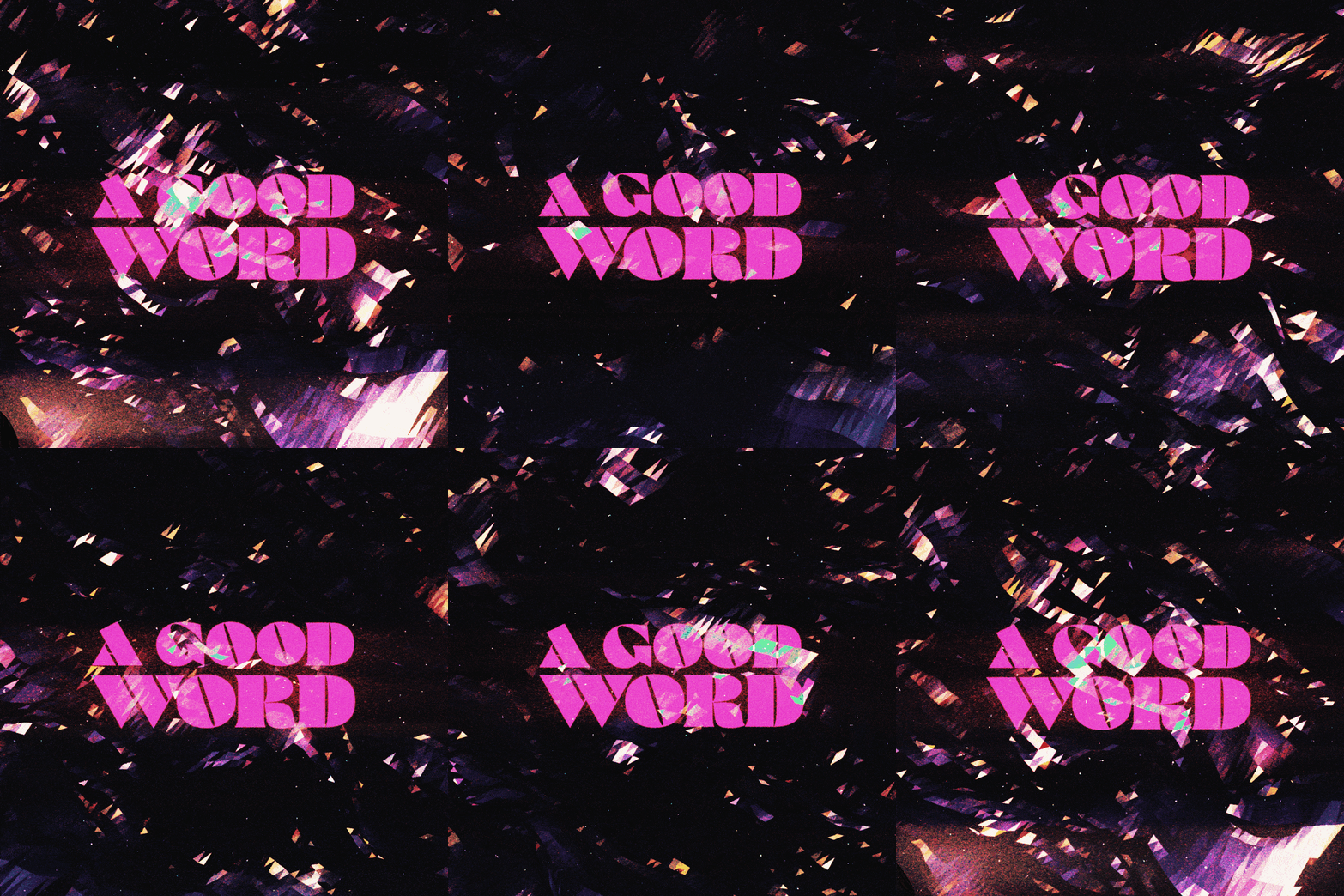
View a higher quality version of this gif here: