

Psalm 44:7
unbending ourselves
Thy throne, O God, is for ever and ever: the sceptre of thy kingdom is a sceptre of uprightness. (Psalm 44:7 DR)
The Psalmist transitions to praise the justice of God by considering his reign over the earth; for this he uses the image of a throne and scepter. God is conceived here as king over creation, an eternal reign signified by the scepter of uprightness.
A scepter in the ancient world was a sign of authority, just as the throne signified the elevation of the individual as ruler. But whereas human thrones are temporal, God’s is eternal, thus his reign is without limitation. By giving attributes to the throne and scepter, the Psalmist notes aspects of God’s attributes as seen in their temporal effects.
The scepter also denotes the authority of the ruler to pass judgment, to correct and to rebuke. Thus the judgment of God is not arbitrary but premised upon his own uprightness and justice, which are not attributes he possesses per se but rather God just is his uprightness and justice. We can have confidence then that God’s rule is always upright, always just.
The rub, however, is that we are not. After the Fall there is a certain bent in our will towards sin, a woundedness in our nature where we are subject to the rule of our passions and appetites, rather than ruling over them. In the narrative of the creation of man Adam is given authority over creation, which is denoted not only by God commanding him to tend the garden, but also in delegating to him authority to name the animals. What for us moderns may seem an exercise in taxonomy was in the ancient conception an unmistakable assertion of authority and rule.
In this way man was given a scepter by God to rule over creation as a steward, but that scepter was lost through sin, that rule being now ironically held by the lower nature of man which he was supposed to rule over. Yet God’s reign is not therefore lost, as his providence still rules over all even though we may rebel:
“The sceptre of direction” is that which directs mankind: they were before crooked, distorted; they sought to reign for themselves: they loved themselves, loved their own evil deeds: they submitted not their own will to God; but would fain have bent God's will to conformity with their own lusts. For the sinner and the unrighteous man is generally angry with God, because it rains not! and yet would have God not be angry with himself, because he is profligate. And it is pretty much for this very reason that men daily sit, to dispute against God: “This is what He ought to have done: this He has not well done.” (St. Augustine, Expositions on the Psalms, 44, 15)
In our rebellion against God we presume to direct him in what is right or good to do, but our vantage is crooked and bent; what to us appears straight is therefore crooked, when the reality is the inverse.
In my house some of the walls aren’t quite square with either the ceilings or the floors, which can make hanging pictures on the wall interesting. I will use a level which will give me an accurate placement of the picture, but once it is hung, in some places it looks crooked, not because it is actually cooked, but because some of the walls are.
In a similar way we cannot rely on our own perception of uprightness but must submit ourselves to God’s rule in our lives. Sanctification becomes a painful process of bending our crooked necks back into alignment, and if you’ve ever been to a chiropractor, you know that it is not usually a pleasant process, but is necessary to return one’s frame to proper alignment:
It is you that are crooked! His ways are right. When will you make the crooked coincide with the straight? It cannot be made to coincide with it. Just as if you were to place a crooked stick on a level pavement; it does not join on to it; it does not cohere; it does not fit into the pavement. The pavement is even in every part: but that is crooked; it does not fit into that which is level. The will of God then is “equal,” your own is “crooked:” it is because you can not be conformed unto it, that it seems “crooked” unto you: rule you yourself by it; seek not to bend it to your own will: for you can not accomplish it; that is at all times “straight!” Would you abide in Him? “Correct you yourself;” so will the sceptre of Him who rules you, be unto you “a rule of direction.” (ibid.)
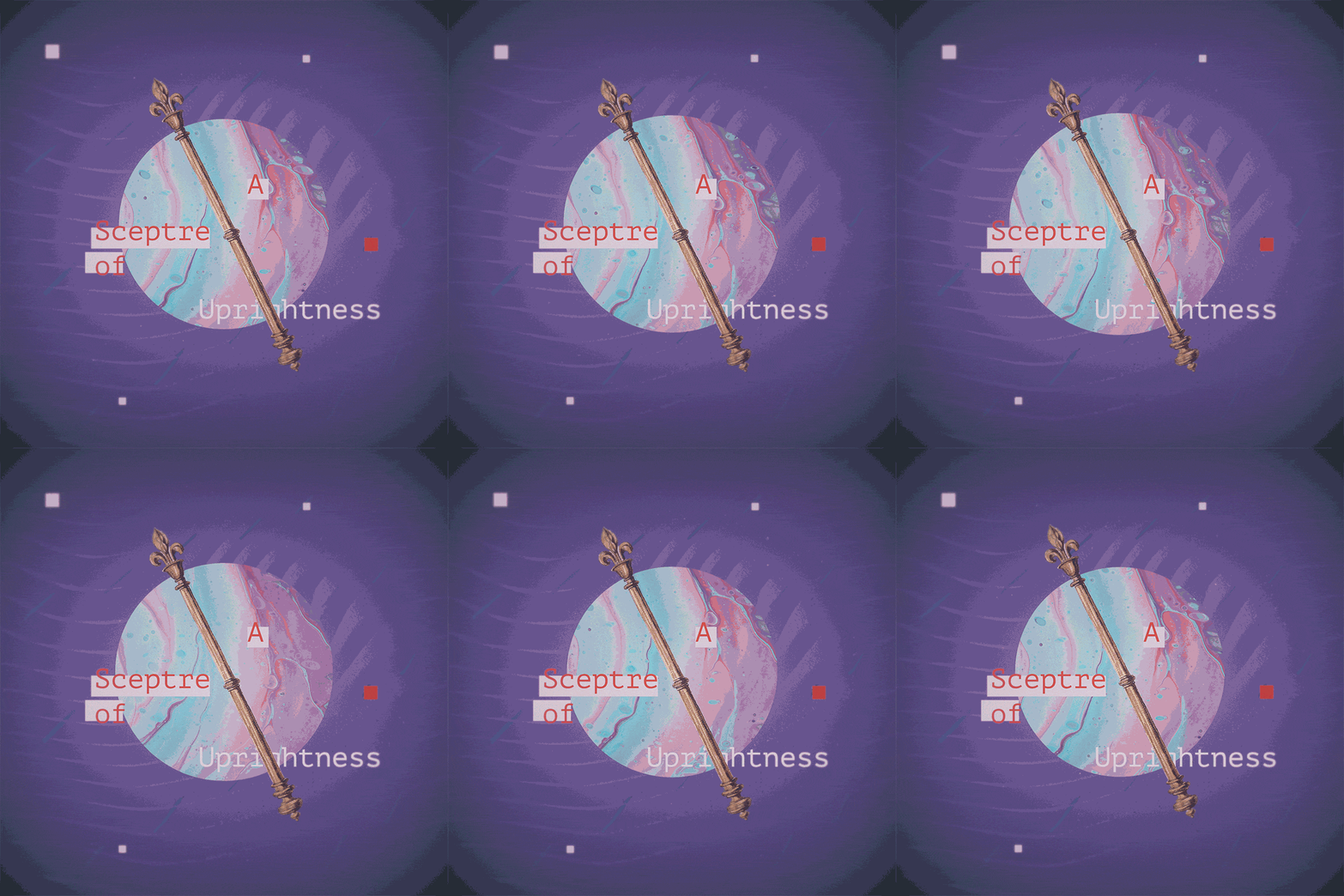
This was a pretty straightforward animation, and I wanted to take it in a fairly literal direction while also have a a nice aesthetic balance.
I found a nice image of a scepter and cut it out in Photoshop and then brought it into After Effects. I applied a quick expression to the Position property to get some random-ish movement which looks like this:
f = 6;
a = 2;
posterizeTime(f);
wiggle(f, a);
Here f is the frequency of the wiggle per second and a is the range of pixels +/- the specified value for each change in frequency. posterizeTime basically maps the posterize time effect (well, not the effect per se, since it’s an expression itself) to that frequency so that the movement changes are basically turned into the equivalent of Hold keyframes rather than interpolating between values. The concluding line calls these variables within the standard wiggle expression, where the first value is always frequency per second and the second value is always amount.
For the background within the circle I just grabbed a texture from Unsplash and applied LoopFlow to it, which is definitely one of the more useful scripts I have ever purchased and is handy in so many different circumstances. The final background halftone texture simple has a looping Turbulent Displace applied to it.
It’s fairly simple overall, but I think it has a nice look and does the job.
Enjoy.
Thy throne, O God, is for ever and ever:
the sceptre of thy kingdom is a sceptre of uprightness.
(Psalm 44:7 DR)
View a higher quality version of this gif here: