

Psalm 44:8
bending and breaking
Thou hast loved justice, and hated iniquity: therefore God, thy God, hath anointed thee with the oil of gladness above thy fellows. (Psalm 44:8 DR)
In our lives the way we respond to things often becomes the lens through which we perceive them. We can having radically different perceptions of something even though it might objectively remain the same.
For example, if you have been outside on a nice day and your eyes have become acclimated to the sun, it illumines the world around you and reveals its beauty; without the brightness and clarity of its light all would be dark and dull. However, if you are in a dark room and suddenly step outside into the full brightness of the sun, that same brightness which was otherwise beautiful becomes a source of pain; it overwhelms and one’s first instinct is to shut one’s eyes, in a sense to return to the darkness which may have been unpleasant but not seems a refuge from something even worse.
We see this in the Israelites as they are led from captivity in Egypt. For years they had groaned in their captivity and longed for redemption. God intervenes miraculously and leads them forth, but once in the desert they begin to long for the fleshpots of Egypt, considering their bondage preferable to the new and unknown situation.
In this verse the Psalmist continues the thought from the previous verse about the scepter of justice. Here it is abstracted to become a metaphor for the desire for justice and righteousness; no longer does it merely describe rule but the motivation and grounding of that uprightness of reign.
St. Augustine inverts the view from the one ruling to consider the one who is ruled, namely us. Christ rules with a scepter of righteousness, and the questions becomes our response to that. Will we be docile to that rule or war and kick against it?
“You have loved righteousness, and hated iniquity.” [Psalm 44:7] See there “the rod of direction” described. “You have loved righteousness, and hated iniquity.” Draw near to that “rod;” let Christ be your King: let Him “rule” you with that rod, not crush you with it. For that rod is “a rod of iron;” an inflexible rod. “You shall rule them with a rod of iron: and break them in pieces like a potter's vessel.” Some He rules; others He “breaks in pieces:” He rules them that are spiritual: He “breaks in pieces” them that are carnal. (St. Augustine, Expositions on the Psalms, 44, 16.)
The way in which we experience God’s justice is thus dependent on our orientation to that justice; if we are docile to it and unite our will to God’s so that we submit to his rule, that justice flows forth to us as mercy. But if we resist and remain stiff-necked, fighting against his rule with all our might, then that rule and justice takes on the character of wrath. As Jesus said to St. Paul, it is hard to kick against the goads.
However, it remains that whether we experience God’s rule and justice as mercy or as wrath, it is yet one and the same in God, given that he is not composed of parts. While we limited and have to consider these qualities separately, in God they are one in his simplicity of act and will. And though we do not deserve it, the Scriptures declare that God unequivocally desires the salvation of all:
For this is good and acceptable in the sight of God our Saviour, Who will have all men to be saved, and to come to the knowledge of the truth. For there is one God, and one mediator of God and men, the man Christ Jesus: Who gave himself a redemption for all, a testimony in due times. (1 Timothy 2:3-6 DR)
God thus rules not to crush us or break us in pieces, but rather that through his loving providence we may turn to him:
Would He so loudly declare that He was about to smite you, if He wished to smite you? He is then holding back His hand from the punishment of your offenses; but do not thou hold back. Turn you yourself to the punishment of your offenses: for unpunished offenses cannot be: punishment therefore must be executed either by yourself, or by Him: do thou then plead guilty, that He may reprieve you. (ibid.)
The time and season to repent is now, to bow ourselves beneath that scepter of righteousness and willingly submit to his rule in lives, bending the still neck of pride in humility that we may receive mercy rather than be broken by the wrath which flows from the same source:
Let no one flatter himself with fond hopes of God's mercy. His sceptre is “a sceptre of righteousness.” Do we say that God is not merciful? What can exceed His mercy, who shows such forbearance to sinners; who takes no account of the past in all that turn unto Him? So love thou Him for His mercy, as still to wish that He should be truthful. For mercy cannot strip Him of His attribute of justice: nor justice of that of mercy. Meanwhile during the time that He postpones your punishment, do not thou postpone it. (ibid.)
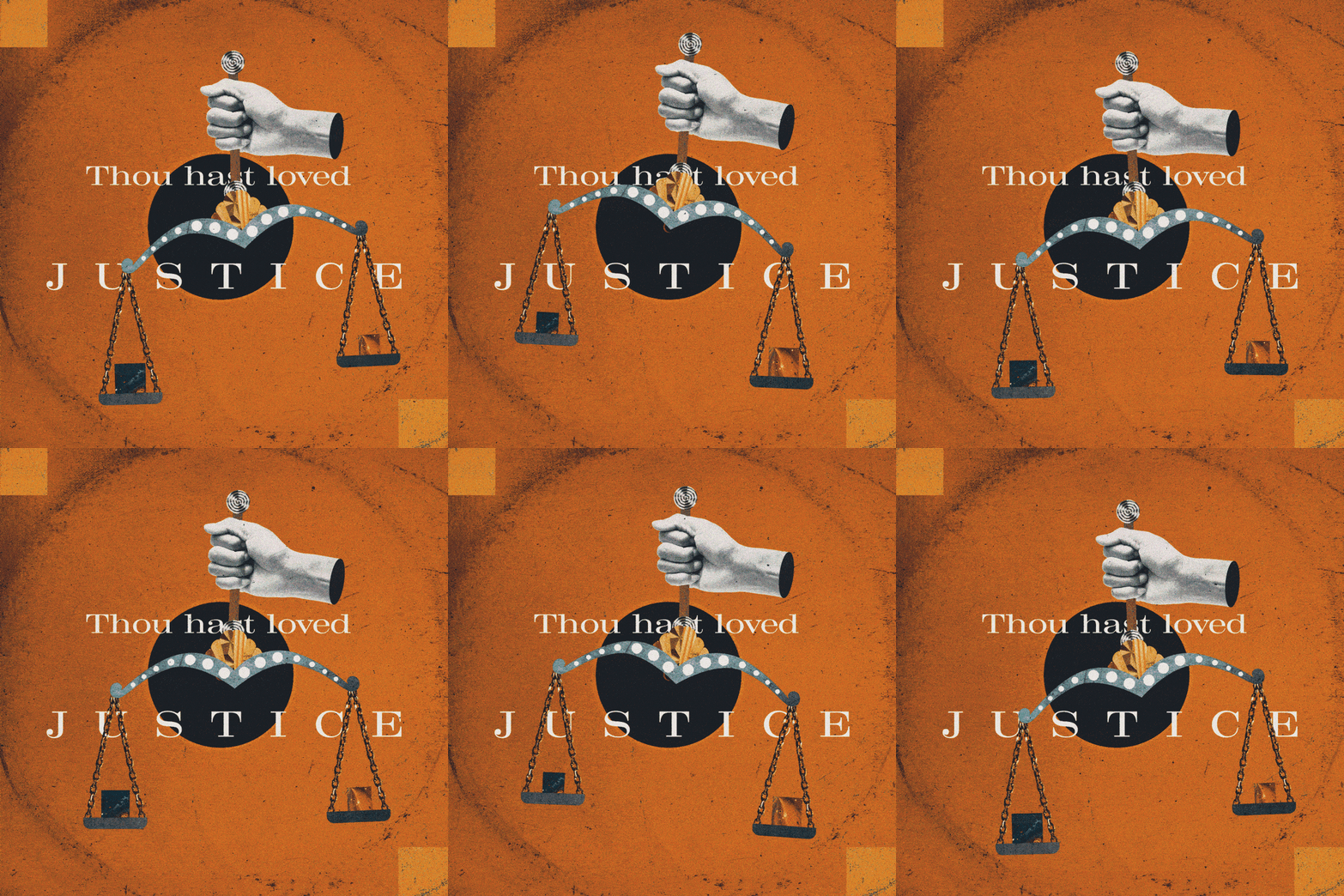
In this animation I wanted to focus on the aspect of justice from this verse, so I decided on the imagery of scales in the balance.
I first found this hand in a holding position and cut it out in Phooshop. Next in Illustrator I drew a bunch of shapes that would become the various pieces of the scales. I brought all those pieces into After Effects and used track mattes to map various textures onto those pieces to create the look of the scales, which is a technique I like to do from time to time to get a nice mixed media look.
I then precomped the pieces and created various parenting chains for those pieces depending on their position in the hierarchy. The scales are parented to the arch to which they are attached; that is then parented to the base above it, which is parented to the handle that the hand is holding and then finally to the hand holding it. There isn’t any kind of inverse kinematics going on; it just helps to keep everything organized and in sync as far as position and rotation.
Next I animated the hand with a bit of position and rotation that loops. This pretty slight, as I wanted to have the scales react to this movement. I then animated the rotation of the base and worked my way down the chain, which helped in each successive step to know how much I would need on the level further down.
For the scales I created a couple textured boxes and animated them increasing and decreasing in scale as the scale moves up or down, with the box starting to grow bigger as the scale moves down and decreasing in size as it goes back up to help give some heft to the animation.
Finally I added the loopOut() expression to all the animated properties and then offset most of the keyframes to give a more organic and flow-y swinging animation, especially with the scales.
Enjoy.
Thou hast loved justice, and hated iniquity:
therefore God, thy God, hath anointed thee with the oil of gladness above thy fellows.
(Psalm 44:8 DR)
View a higher quality version of this gif here: